Loading...
Done
Australian actress Elizabeth Debicki pictured as Princess Diana wearing her “Revenge Dress” at Vanity Fair's annual fundraising gala for the Serpentine Gallery while filming hit Netflix TV series “The Crown” in London, United Kingdom on November 1, 2021. The dress, created by Greek fashion designer Christina Stambolian, is one of the most famous dresses the late Princess wore. The form fitting, off-the-shoulder chiffon cocktail dress was worn in June 1994. The same night Diana wore the dress to the Serpentine party, her estranged husband, Prince Charles, confessed on national television that he had been unfaithful to her. (Photo by Splash News and Pictures)

Australian actress Elizabeth Debicki pictured as Princess Diana wearing her “Revenge Dress” at Vanity Fair's annual fundraising gala for the Serpentine Gallery while filming hit Netflix TV series “The Crown” in London, United Kingdom on November 1, 2021. The dress, created by Greek fashion designer Christina Stambolian, is one of the most famous dresses the late Princess wore. The form fitting, off-the-shoulder chiffon cocktail dress was worn in June 1994. The same night Diana wore the dress to the Serpentine party, her estranged husband, Prince Charles, confessed on national television that he had been unfaithful to her. (Photo by Splash News and Pictures)
Details
28 Nov 2021 07:40:00


WOOTTON, UNITED KINGDOM - APRIL 07: Hot air balloons prepare to depart from Lydden Hill race circuit near Canterbury to take part in mass crossing of the Channel on April 7, 2011 in Wootton, England. 51 balloonists of various nationalities from across Europe took off from Kent making for Calais, France at about 7am. It is the first time a Guinness World Record bid has been made for "the largest group of hot air balloons to make the Channel crossing". (Photo by Oli Scarff/Getty Images)
Details
07 Apr 2011 10:15:00
A chef cooks raw dog meat at a restaurant in Gwacheon, South Korea

A chef cooks raw dog meat at a restaurant on July 5, 2005 in Gwacheon, South Korea. Dog meat is a traditional dish in Korea dating back to the Samkuk period (period of the three kingdoms BC 57 – AD 668). Although many recipes existed historically for dog meat, now chefs only make soups, or dishes using boiled or roasted meat. Koreans traditionally eat dog meat on the hottest day of the summer, for it's reputed benefits of virility, invigoration and health. (Photo by Chung Sung-Jun/Getty Images)
Details
21 Feb 2012 12:54:00
British underwater photographer of the year 2021, British waters wide angle category winner and My Backyard category winner. While You Sleep by Mark Kirkland (UK), common frog taken in Malls Mire, Glasgow, Scotland. (Photo by Mark Kirkland/Underwater Photographer of the Year 2021)

British underwater photographer of the year 2021, British waters wide angle category winner and My Backyard category winner. While You Sleep by Mark Kirkland (United Kingdom), common frog taken in Malls Mire, Glasgow, Scotland. (Photo by Mark Kirkland/Underwater Photographer of the Year 2021)
Details
13 Feb 2021 10:27:00
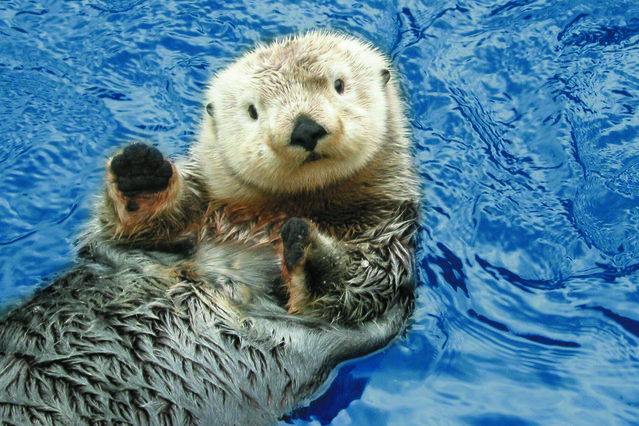
The Sea Otter

The sea otter (Enhydra lutris) is a marine mammal native to the coasts of the northern and eastern North Pacific Ocean. Adult sea otters typically weigh between 14 and 45 kg (31 and 99 lb), making them the heaviest members of the weasel family, but among the smallest marine mammals. Unlike most marine mammals, the sea otter's primary form of insulation is an exceptionally thick coat of fur, the densest in the animal kingdom. Although it can walk on land, the sea otter lives mostly in the ocean.
Details
26 Jan 2014 12:20:00


“The Crimean War (October 1853 – February 1856) was a conflict fought between the Russian Empire and an alliance of the French Empire, the British Empire, the Ottoman Empire, and the Kingdom of Sardinia. The war was part of a long-running contest between the major European powers for influence over territories of the declining Ottoman Empire. Most of the conflict took place on the Crimean Peninsula, but there were smaller campaigns in western Anatolia, Caucasus, the Baltic Sea, the Pacific Ocean and the White Sea”. – Wikipedia

Photo: A vivandiere, a female soldier selling provisions and spirits, with the Allied forces during the Crimean War. (Photo by Hulton Archive/Getty Images)
Details
18 Jul 2011 11:57:00
An installation by the artist Richard Wilson, entitled 'Turning the Place Over', is built into the condemned Cross Keys House in Moorfields as part of the Capital of Culture for 2008

“Richard Wilson (born May 24, 1953) is a sculptor, installation artist and musician. Wilson's work is characterised by architectural concerns with volume, illusionary spaces and auditory perception”. – Wikipedia

Photo: An installation by the artist Richard Wilson, entitled “Turning the Place Over”, is built into the condemned Cross Keys House in Moorfields as part of the Capital of Culture for 2008, on June 25, 2007 in Liverpool, England. The piece consists of an 8 metre ovoid cut from the building's facade that oscillates in three dimensions. (Photo by Jim Dyson/Getty Images)
Details
27 Mar 2012 10:31:00


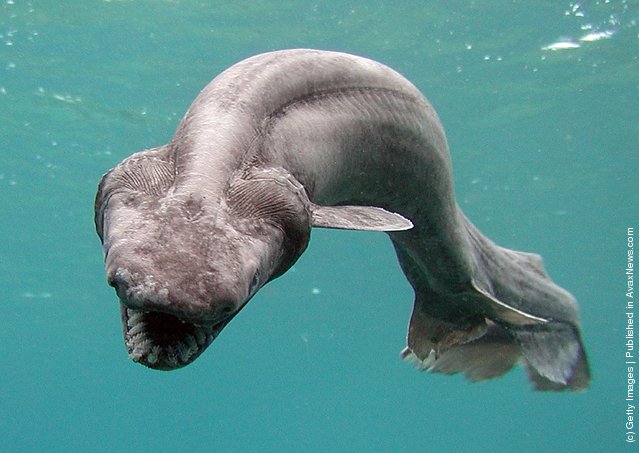
“The frilled shark (Chlamydoselachus anguineus) is one of two extant species of shark in the family Chlamydoselachidae, with a wide but patchy distribution in the Atlantic and Pacific Oceans. This uncommon species is found over the outer continental shelf and upper continental slope, generally near the bottom though there is evidence of substantial upward movements. It has been caught as deep as 1,570 m (5,150 ft), whereas in Suruga Bay, Japan it is most common at depths of 50–200 m (160–660 ft). Exhibiting several “primitive” features, the frilled shark has often been termed a «living fossil»”. – Wikipedia

Photo: A 1.6 meter long Frill shark swims in a tank after being found by a fisherman at a bay in Numazu, on January 21, 2007 in Numazu, Japan. The frill shark, also known as a Frilled shark usually lives in waters of a depth of 600 meters and so it is very rare that this shark is found alive at sea-level. It's body shape and the number of gill are similar to fossils of sharks which lived 350,000,000 years ago. (Photo by Awashima Marine Park/Getty Images)
Details
05 May 2011 10:01:00