Loading...
Done
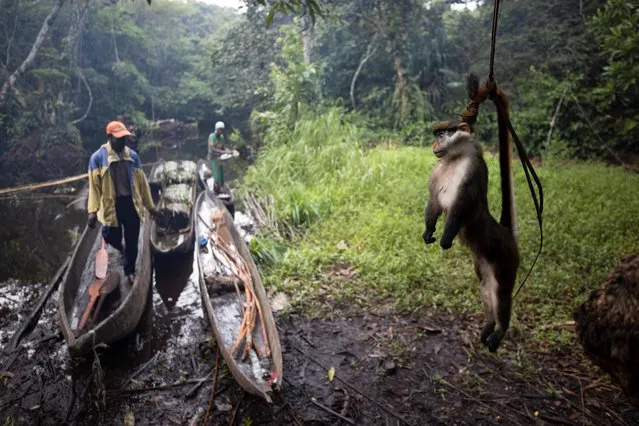
A dead red-tailed monkey hangs by its tail above the ground, in order to keep it away from ants, in the forest near the city of Mbandaka, Democratic Republic of the Congo, April 5, 2019. Bushmeat hunters are emptying Central Africa's forests at a high rate, researchers say. A growing appetite for wild meat in cities has ramped up the scale of hunting. Research shows around 6 million tonnes of bushmeat are sourced annually from the Congo Basin, whose forest spans across six countries and is second in size only to the Amazon. (Photo by Thomas Nicolon/Reuters)

A dead red-tailed monkey hangs by its tail above the ground, in order to keep it away from ants, in the forest near the city of Mbandaka, Democratic Republic of the Congo, April 5, 2019. Bushmeat hunters are emptying Central Africa's forests at a high rate, researchers say. A growing appetite for wild meat in cities has ramped up the scale of hunting. Research shows around 6 million tonnes of bushmeat are sourced annually from the Congo Basin, whose forest spans across six countries and is second in size only to the Amazon. (Photo by Thomas Nicolon/Reuters)
Details
14 Oct 2019 00:03:00


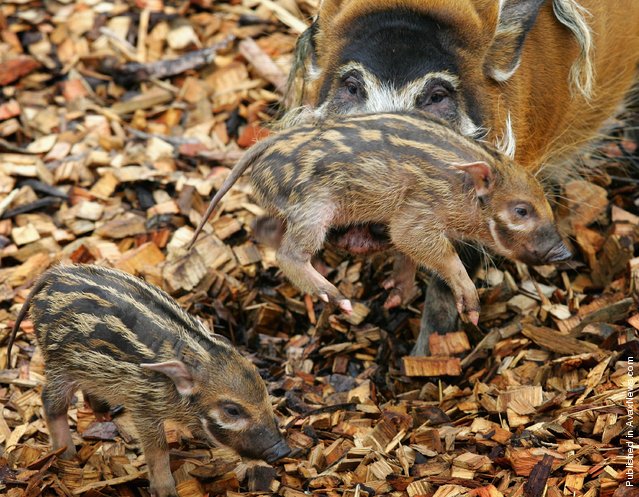
“The Red River Hog (Potamochoerus porcus), also known as the Bush Pig (but not to be confused with P. larvatus, common name “Bushpig”), is a wild member of the pig family living in Africa, with most of its distribution in the Guinean and Congolian forests. It is rarely seen away from rainforests, and generally prefers areas near rivers or swamps.

Red River Hogs eat grass, berries, roots, insects, molluscs, small vertebrates and carrion. They are capable of causing damage to plantations. Red River Hogs typically live in herds of 6-20 members led by a dominant boar. Sows rear 3-6 piglets at a time.”

Photo: Two 17 day old red river hoglet twins forage for food next to their mother Bahiti at London Zoo on August 23, 2007 in London, England. Red River hoglets inhabit the forests and swamps of West and Central Africa. The recent additions to the London Zoo pig pen have been eagerly awaited by zoo keepers. (Photo by Chris Jackson/Getty Images)
Details
18 Mar 2011 15:15:00
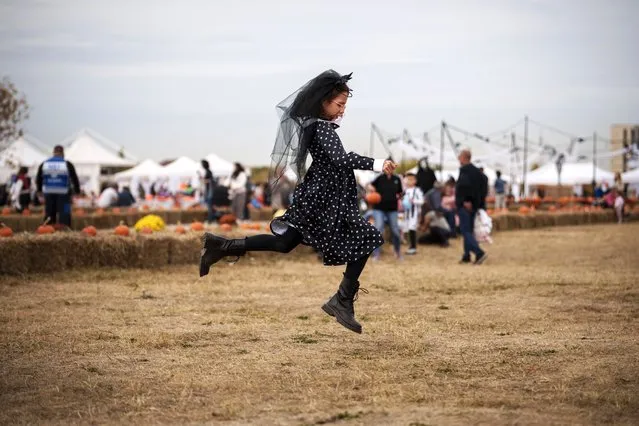
A girl plays at the West Side Hallo Fest, a Halloween festival in Bucharest, Romania, Friday, October 27, 2023. Tens of thousands streamed last weekend to Bucharest's Angels' Island peninsula for what was the biggest Halloween festival in the Eastern European nation since the fall of Communism. (Photo by Vadim Ghirda/AP Photo)

A girl plays at the West Side Hallo Fest, a Halloween festival in Bucharest, Romania, Friday, October 27, 2023. Tens of thousands streamed last weekend to Bucharest's Angels' Island peninsula for what was the biggest Halloween festival in the Eastern European nation since the fall of Communism. (Photo by Vadim Ghirda/AP Photo)
Details
29 Nov 2023 00:07:00
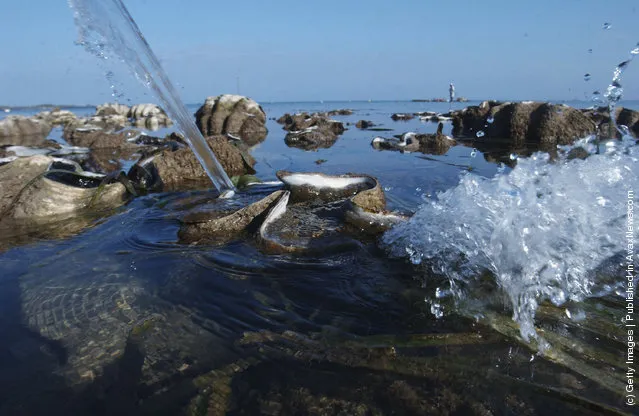
Tridacna Gigas, or Giant Clams

“The giant clam, Tridacna gigas (known as pā’ua in Cook Islands Māori), is the largest living bivalve mollusc. T. gigas is one of the most endangered clam species. It was mentioned as early as 1825 in scientific reports. One of a number of large clam species native to the shallow coral reefs of the South Pacific and Indian oceans, they can weigh more than 200 kilograms (440 lb) measure as much as 120 cm (47 in) across, and have an average lifespan in the wild of 100 years or more”. – Wikipedia

Photo: Tridacna Gigas, or Giant Clams spew water as a traditional fisherman passes by a small sanctuary on January 23, 2004 near Bolinao in the Northern Philippines. The clams, prime builders for coral reefs and providing shelter for spawning fish and other marine life, are exposed by low tides in the sanctuary. Overfishing and pollution throughout the country are not only threatening food security, but are also starting to choke one of the few working clam sanctuaries in the world. (Photo by David Greedy/Getty Images)
Details
01 Oct 2011 13:10:00
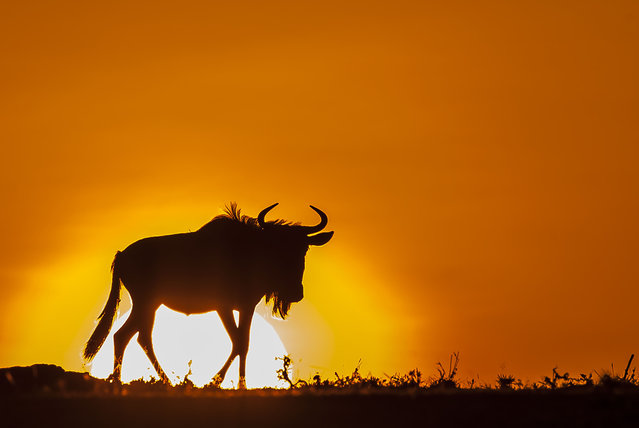
A blue wildebeest moves through grassland at dawn with the sun in the background in Mara Naboisho Conservancy, Kenya, Africa. (Photo by Renato Granieri/Caters News/Ardea)

These images show off some of the world's most majestic creatures silhouetted against the beautiful rising and setting sun. The vibrant pictures feature a variety of animals in the wild and were taken by a host of photographers at locations around the world. The striking images all have one thing in common: the photographers' awe-inspiring ability to perfectly capture the silhouettes of earth's beautiful creatures. Here: a blue wildebeest moves through grassland at dawn with the sun in the background in Mara Naboisho Conservancy, Kenya, Africa. (Photo by Renato Granieri/Caters News/Ardea)
Details
02 Sep 2015 11:12:00
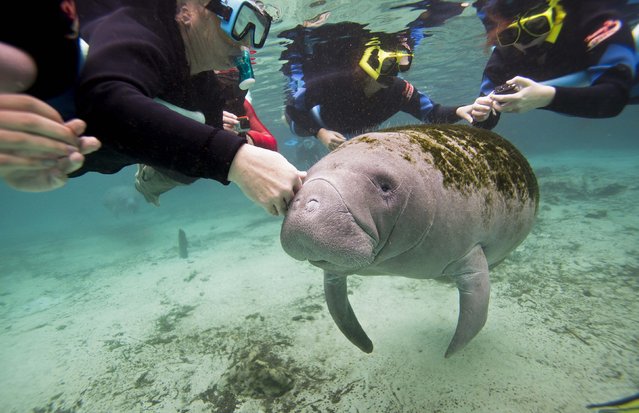
Snorkelers interact with a Florida Manatee inside of the Three Sisters Springs in Crystal River, Florida January 15, 2015. On winter days, Florida manatees flock by the hundreds to the balmy waters of Three Sisters Springs, drawing crowds of snorkelers and kayakers to the U.S. sanctuary, where people may swim with the endangered species. (Photo by Scott Audette/Reuters)

Snorkelers interact with a Florida Manatee inside of the Three Sisters Springs in Crystal River, Florida January 15, 2015. On winter days, Florida manatees flock by the hundreds to the balmy waters of Three Sisters Springs, drawing crowds of snorkelers and kayakers to the U.S. sanctuary, where people may swim with the endangered species. But as tolerant as the gentle, whiskered sea giants can be of the accidental kicks and splashes of delighted tourists, wild life regulators want to ban most canoes and paddle boards and create people-free zones to protect the wintering “sea cow”. Proposed limitations for this winter are awaiting approval by the U.S. Fish and Wildlife Service. (Photo by Scott Audette/Reuters)
Details
22 Jan 2015 13:34:00
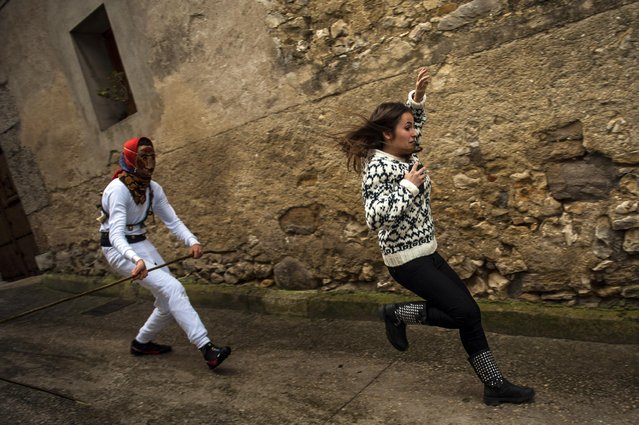
In this photo taken on Sunday, February 15, 2015 a girl runs away from a “Mamuxarro” during the carnival, in the small town of Unanu, northern Spain. While Rio de Janeiro may boast the world’s most famous carnival, the festive period of masquerades and wild and colorful costumes that precedes the Christian religious season of Lent is also a permanent and popular fixture for celebration in Spain and Portugal, with each country having its own strange and unique way of doing it. (Photo by Alvaro Barrientos/AP Photo)

In this photo taken on Sunday, February 15, 2015 a girl runs away from a “Mamuxarro” during the carnival, in the small town of Unanu, northern Spain. In the northern Spanish ancient village of Unamu, people dress up as “Mamuxarro”, folkloric figures in white with a red sash and a metal mask to cover their faces as they pursue townsfolk with sticks. According to custom, their “victims” (usually young women) must kneel and kiss the mamuxarro’s knee after he makes the sign of the cross on their forehead. (Photo by Alvaro Barrientos/AP Photo)
Details
22 Feb 2015 10:51:00
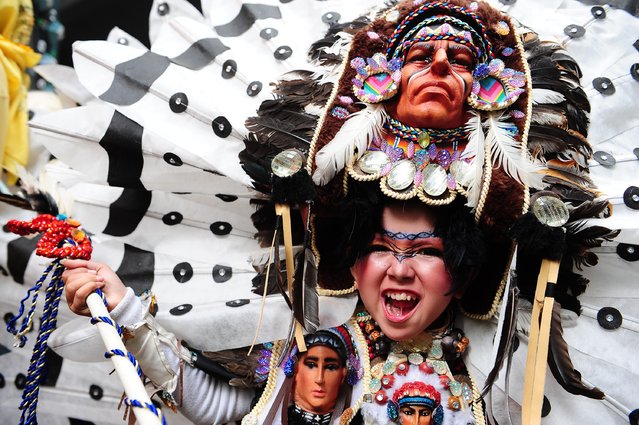
A model wears an Apache costume in the kids carnival during The 13th Jember Fashion Carnival 2014 on August 21, 2014 in Jember, Indonesia. (Photo by Robertus Pudyanto/Getty Images)

A model wears an Apache costume in the kids carnival during The 13th Jember Fashion Carnival 2014 on August 21, 2014 in Jember, Indonesia. The 13th Jember Fashion Carnival (JFC) 2014 theme is “Triangle, Dynamic in Harmony” and consists of ten parades which include Mahabharata, Tambora, Phoenix, Pine Forest, Apache, Borobudur, Flying Kite, Wild Deers, Stalagmite, and Chemistry. This street carnival is claimed to be one of the biggest in the world and comprises more than 850 performers parading along 3.6 km road used as the catwalk. (Photo by Robertus Pudyanto/Getty Images)
Details
24 Aug 2014 09:09:00