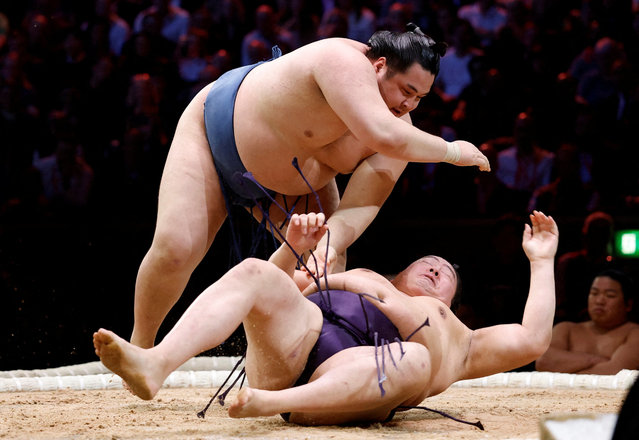
Onokatsu in action against Ichiyamamoto during the twelfth bout of the Grand Sumo Tournament at Royal Albert Hall in London on October 15, 2025. (Photo by Peter Cziborra/Action Images via Reuters)
A boy rides on a snow wagon towed by a robot dressed as a Teddy bear, which only moves forward by moving its legs, during the Ice and snow carnival at Taoranting park in Beijing February 9, 2015. (Photo by Kim Kyung-Hoon/Reuters)
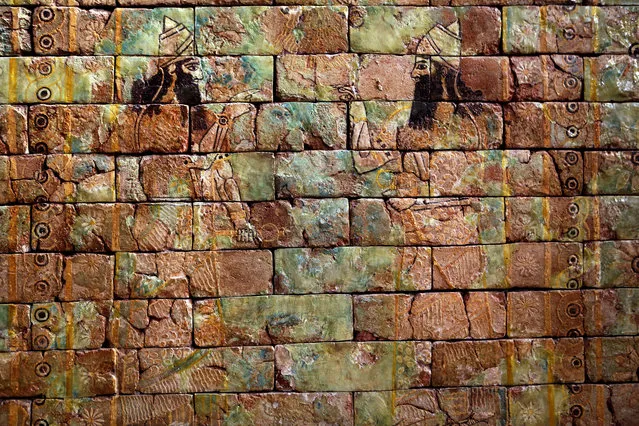
This Monday, September 15, 2014 photo shows glazed bricks displayed at the Iraqi National Museum in Baghdad. The Islamic State militants seek to purge society of all influences that don't conform with their strict, puritanical version of Islam. That means destroying not only relics seen as pagan but also Muslim sites they see as contradicting their ideology, particularly Sunni Muslim shrines they see as idolatrous as well as mosques used by Shiites, a branch of Islam they consider heretical. (Photo by Hadi Mizban/AP Photo)
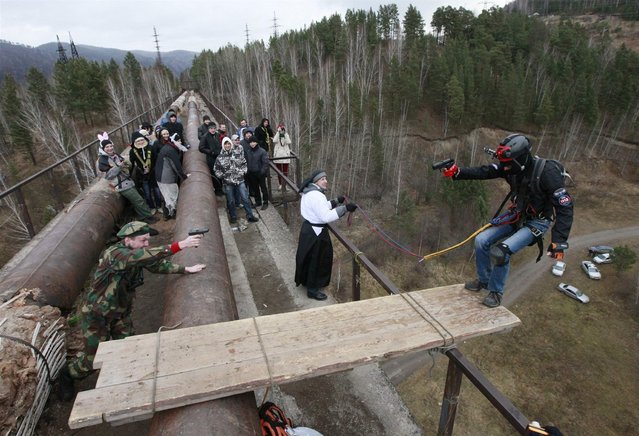
Members of the “Exit Point” amateur rope-jumping group stage a performance as they jump from a 44-metre high (144-ft) waterpipe bridge in the Siberian Taiga area outside Krasnoyarsk, November 3, 2013. Fans of rope-jumping, a kind of extreme sport involving a jump from a high point using an advanced leverage system combining mountaineering and rope safety equipment, marked the end of the group's jumping season and recent Halloween festivities. (Photo by Ilya Naymushin/Reuters)
13-year-old Emmanuel Festo from Tanzania poses for a portrait with a plush toy that he says makes him feel safe at night and that he sleeps with, in New York's Staten Island, September 21, 2015. Albino body parts are highly valued in witchcraft and can fetch a high price. Superstition leads many to believe albino children are ghosts who bring bad luck. Some believe the limbs are more potent if the victims scream during amputation, according to a 2013 United Nations report. (Photo by Carlo Allegri/Reuters)
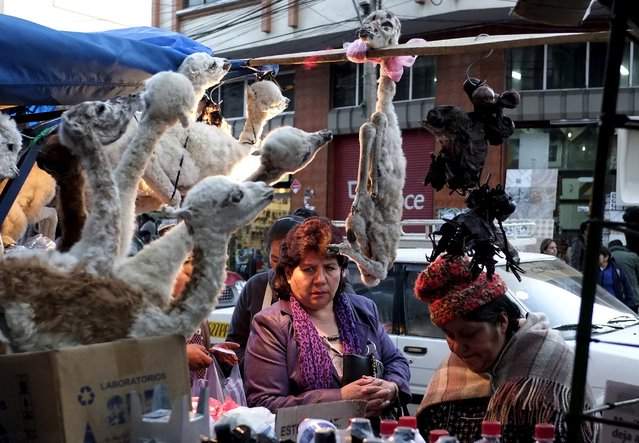
A woman (C) shops for an offering at the witch doctor's street in La Paz, July 31, 2015. According to Andean culture, the all the month of August is a time to give offerings to “Pachamama” to give thanks for their farms and health. The Aymaras use coca leaves, candies, animal fat, llama fetuses, some dried fruits, powdered minerals and alcohol during these rituals. (Photo by David Mercado/Reuters)
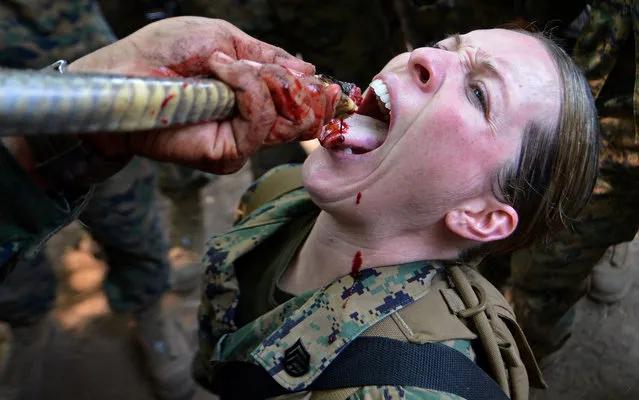
During a jungle survival program February 20, 2013 taught by Royal Thai Special Forces in Sannapit, Thailand, U.S. Marines learned to catch cobras and drink their fresh blood, not to mention eat forest insects and pull the heads off of chicken. The training was part of Operation Cobra Gold 13, the 32nd edition of international military exercises hosted by the Thai. According to a U.S. Marines press release, Cobra Gold is the largest exercise of its kind in Asia and incorporates troops from five other nations in addition to the U.S. and Thailand. The Daily Mail reports that the Marines were invited to experience the local custom of drinking cobra blood after being taught to catch and kill cobras in the wild. As CNN notes, Cobra blood is believed to be a panacea and aphrodiasic in parts of Southeast Asia. In Jakarta, vendors can earn over $100 a night selling shots of cobra blood mixed with liquor. (Photo by Pornchai Kittiwongsakul/AFP Photo)
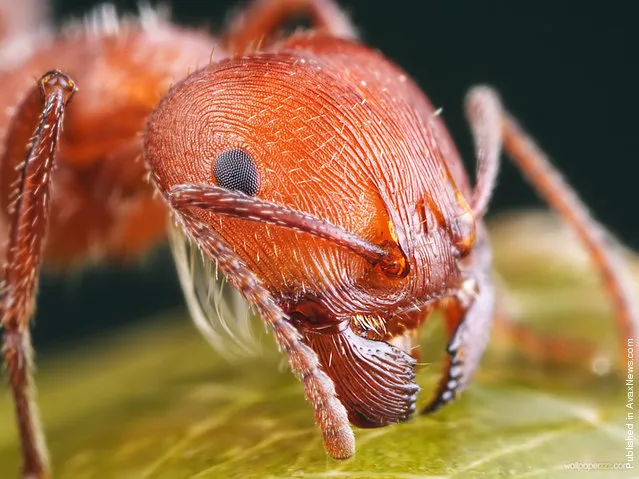
Once upon a time a myth was born that insects, unlike animals, are just a machines that not capable of learning and survive only based on their instincts. That myth has become the widespread opinion. Of course, this opinion is indeed erroneous, like many other widespread opinions. Let us try to find out which part is a myth and which part is true.