Loading...
Done
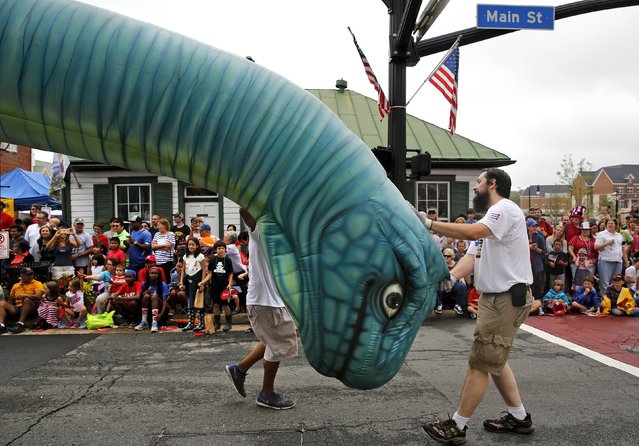
A team from Woody's Ice Cream shop wrangle a large inflatable dinosaur down the street during the Independence Day Parade in Fairfax, Virginia July 4, 2015. (Photo by Jonathan Ernst/Reuters)

A team from Woody's Ice Cream shop wrangle a large inflatable dinosaur down the street during the Independence Day Parade in Fairfax, Virginia July 4, 2015. Americans marched in star-spangled parades, ran relay races, gathered for fireworks shows and crowned a new world hot dog eating champion as they celebrated Independence Day in traditional style on Saturday. (Photo by Jonathan Ernst/Reuters)
Details
05 Jul 2015 10:52:00


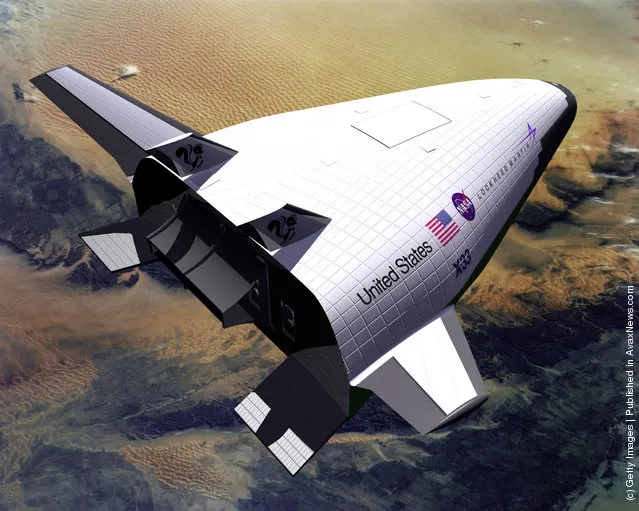
“The Lockheed Martin X-33 is an unmanned, sub-scale technology demonstrator suborbital spaceplane developed in the 1990s under the U.S. government-funded Space Launch Initiative program”. – Wikipedia

Photo: An Artist's Rendering Shows How Nasa's X-33 Technology Demonstrator, A Cost-Cutting Fully Reusable Single-Stage-To-Orbit Space Vehicle, Will Look Upon Completion. The 67 Foot-Long, 278,600 Pound, Twin Engine Space Vehicle, Capable Of Reaching Speeds In Excess Of Mach 15, Will Lead To The Construction Of A 127 Foot-Long, 2,186,000 Pound Version With Seven Engines And A 50,000 Pound Payload Capacity Called The “Venturestar”. (Photo By Nasa/Getty Images)
Details
22 Mar 2011 12:05:00


“NTV (Cyrillic: НТВ) is a Russian television channel. As a subsidiary of Vladimir Gusinsky's company Media-Most, it was a pioneer in the post-Soviet independent television media, but was later taken over by state-owned Gazprom”. – Wikipedia

Photo: A woman with “I love NTV” painted on here face cheers in support of the independent Russian NTV television station April 7, 2001 during a rally in Moscow. Thousands of people gathered in the rain to show their support for Russia's only national independent television station in its fight against new owners. (Photo by Oleg Nikishin/Newsmakers)
Details
15 Apr 2011 10:53:00
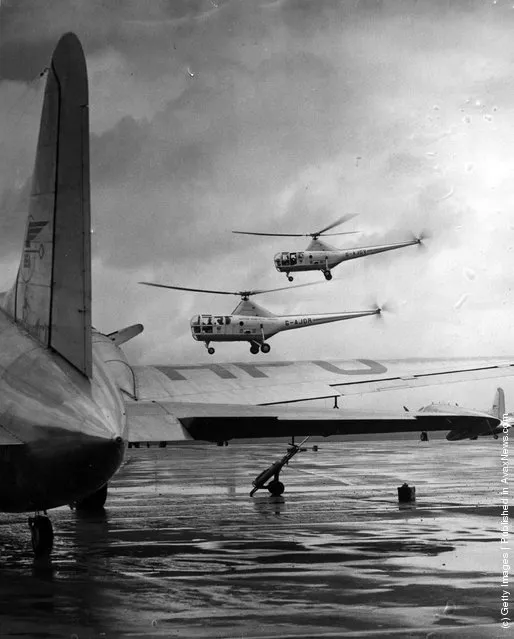
Sikorsky H-5 helicopters

“Igor Sikorsky (May 25, 1889 – October 26, 1972), born Igor Ivanovich Sikorsky was a Russian American pioneer of aviation in both helicopters and fixed-wing aircraft. He designed and flew the world's first multi-engine fixed-wing aircraft, the Russky Vityaz in 1913, and the first airliner, Ilya Muromets, in 1914. After immigrating to the United States in 1919, Sikorsky founded the Sikorsky Aircraft Corporation in 1923, and developed the first of Pan American Airways' ocean-conquering flying boats in the 1930s. In 1939 Sikorsky designed and flew the Vought-Sikorsky VS-300, the first viable American helicopter, which pioneered the rotor configuration used by most helicopters today. Sikorsky would modify the design into the Sikorsky R-4, which became the world's first mass-produced helicopter in 1942”. – Wikipedia

Photo: Westland Sikorsky H-5's, used by British European Airways Helicopters, which fly between London and Birmingham. The Sikorsky H-5, (aka R-5, S-51, HO3S-1, or Horse) (R-5 until 1948; company designation VS-327) is a helicopter built by Sikorsky Aircraft Corporation, formerly used by the United States Air Force, and its predecessor, the United States Army Air Forces, as well as the United States Navy and United States Coast Guard (with the designations HO2S and HO3S). (Photo by Harrison /Topical Press Agency/Getty Images). 22nd May 1951

Details
06 Sep 2011 10:18:00
An aerial view shows a sinkhole 3.5 km (2 miles) to the east of Solikamsk-2 mine in Perm region, November 20, 2014. Shares in Russia's Uralkali, the world's top potash producer, fell sharply for a second day on Wednesday after a mine accident that could reduce global supplies and push up prices of the crop nutrient worldwide. (Photo by Reuters/Press service of Uralkali company)

An aerial view shows a sinkhole 3.5 km (2 miles) to the east of Solikamsk-2 mine in Perm region, November 20, 2014. Shares in Russia's Uralkali, the world's top potash producer, fell sharply for a second day on Wednesday after a mine accident that could reduce global supplies and push up prices of the crop nutrient worldwide. Uralkali shares have fallen 28 percent since Tuesday when it suspended work at its Solikamsk-2 mine, which accounts for a fifth of the company's output and 3.5 percent of global capacity, following an inflow of water. A sinkhole, stretching 30 by 40 metres (yards), found at an abandoned mine 3.5 km (2 miles) to the east, increased concern about the future of the mine because an inflow of water and the resulting sinkhole in 2006 forced another Uralkali operation to shut permanently. (Photo by Reuters/Press service of Uralkali company)
Details
22 Nov 2014 13:51:00
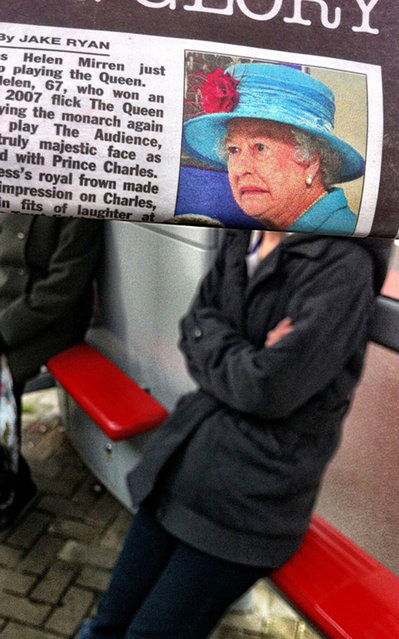
How To Pass Time On Your Commute To Work

We all have our own ways of passing time on our daily commutes. Some people read, others try to sleep, and many listen to music or play on their phones. But one creative commuter has a simple and highly entertaining way that hopefully more people will embrace. By placing a face from a newspaper in front of a person at just the right angle, they transform other commuters into recognizable celebrities while keeping the unbeknownst participant obscured.
Details
02 Jul 2013 10:46:00
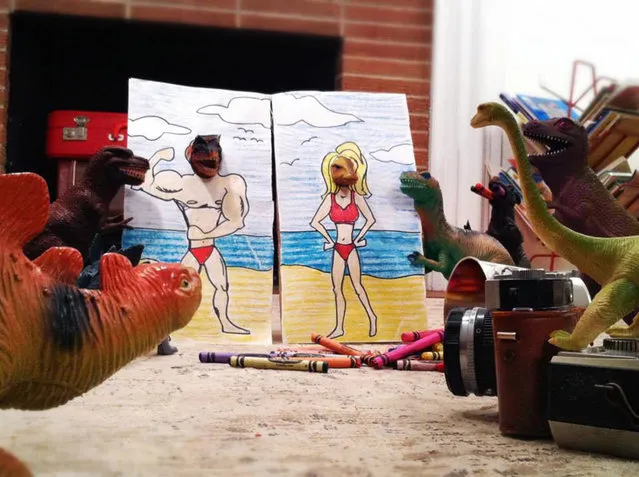
Welcome To Dinovember

Every November (AKA Dinovember), Refe Tuma and his wife pose their kids’ plastic dinosaurs engaging in activities in order to convince their kids the toys come to life while they sleep. It started out small, with dinosaurs stealing food from the kitchen and making small messes, but Dinovember quickely escalated into dinosaurs playing board games, kidnapping other toys, and watching that scene from The Land Before Time while crying tiny little toy dinosaur tears made from paper.
Details
19 Nov 2013 11:12:00
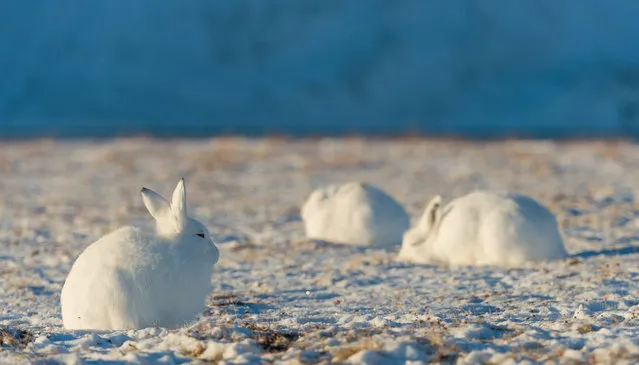
Arctic Hare

The arctic hare, or polar rabbit, is a species of hare which is adapted largely to polar and mountainous habitats. The arctic hare survives with a thick coat of fur and usually digs holes in the ground or under snow to keep warm and sleep. Arctic hares look like rabbits but have shorter ears, are taller when standing, and, unlike rabbits, can thrive in cold climates. They can travel together with many other hares, sometimes huddling with dozens or more, but are usually found alone, taking, in some cases, more than one partner. The arctic hare can run up to 60 kilometres per hour (40 mph). Its predators include the arctic wolf, arctic fox, and ermine.
Details
17 Mar 2014 13:56:00