Loading...
Done
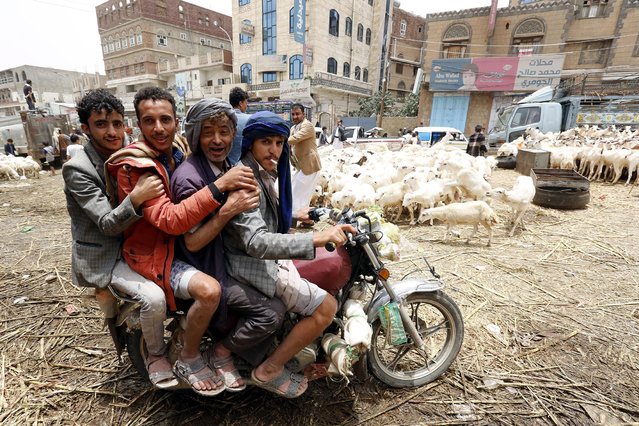
Four men ride a motorbike past sacrificial animals displayed for sale ahead of the Eid al-Adha festival at a livestock market in Sana'a, Yemen, 08 August 2019. Eid al-Adha is the holiest of the two Muslims holidays celebrated each year; it marks the yearly Muslim pilgrimage (Hajj) to visit Mecca, Islam's holiest place. Muslims slaughter a sacrificial animal and split the meat into three parts: one for family, one for friends and relatives, and one for the poor and needy. (Photo by Yahya Arhab/EPA/EFE)

Four men ride a motorbike past sacrificial animals displayed for sale ahead of the Eid al-Adha festival at a livestock market in Sana'a, Yemen, 08 August 2019. Eid al-Adha is the holiest of the two Muslims holidays celebrated each year; it marks the yearly Muslim pilgrimage (Hajj) to visit Mecca, Islam's holiest place. Muslims slaughter a sacrificial animal and split the meat into three parts: one for family, one for friends and relatives, and one for the poor and needy. (Photo by Yahya Arhab/EPA/EFE)
Details
29 Aug 2019 00:03:00
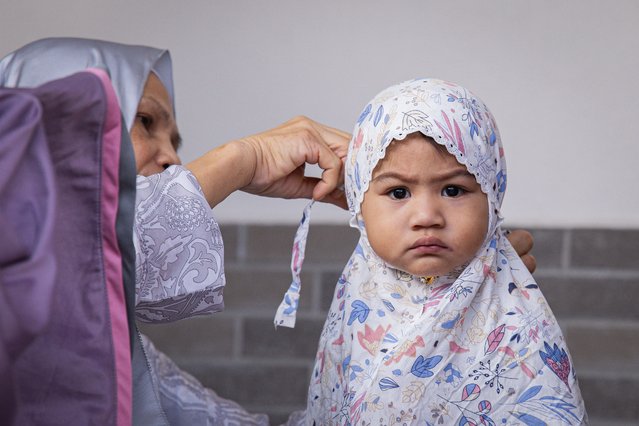
A young Muslim girl looks on as an elder helps her tie her hijab before the Eid al-Fitr prayer at Masjid Jamek Cina Muslim Klang on March 31, 2025, in Selangor, Malaysia. The mosque, inspired by the Great Mosque of Xi’an, blends Chinese and Islamic architectural influences, reflecting the nation’s rich cultural harmony. Eid al-Fitr, marking the end of Ramadan, is a time of prayers, family reunions, and celebration for Muslims worldwide. (Photo by Annice Lyn/Getty Images)

A young Muslim girl looks on as an elder helps her tie her hijab before the Eid al-Fitr prayer at Masjid Jamek Cina Muslim Klang on March 31, 2025, in Selangor, Malaysia. The mosque, inspired by the Great Mosque of Xi’an, blends Chinese and Islamic architectural influences, reflecting the nation’s rich cultural harmony. Eid al-Fitr, marking the end of Ramadan, is a time of prayers, family reunions, and celebration for Muslims worldwide. (Photo by Annice Lyn/Getty Images)
Details
08 Sep 2025 03:58:00
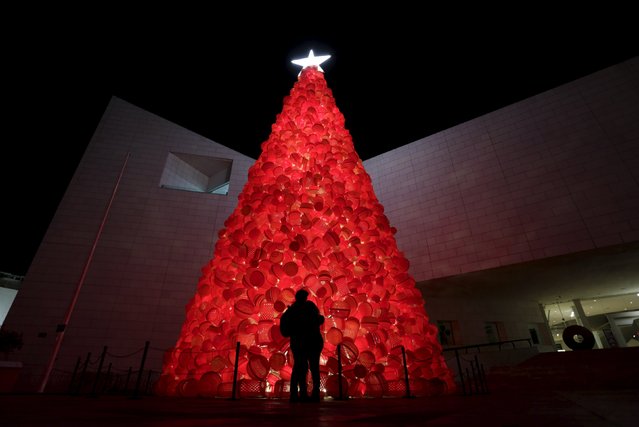
A couple hugs while standing near a Christmas tree made out of plastic bins and plastic hampers outside the Museum of History in Monterrey, Mexico, December 4, 2015. (Photo by Daniel Becerril/Reuters)

A couple hugs while standing near a Christmas tree made out of plastic bins and plastic hampers outside the Museum of History in Monterrey, Mexico, December 4, 2015. The humble Christmas tree has a rich history, from evergreen trees used to symbolise eternal life in Ancient Egypt to tree worship among pagan Europeans. The modern version has its origins in Germany, where the song “O Tannenbaum” is still a festive favourite. Today the traditional tree with lights and decorations appears in cities including Washington, Moscow and Beirut. Alternative constructions range from recycled rubbish in Mexico City to old window frames in Rakvere, Estonia. Whatever the shape or size, the message is the same: Merry Christmas. (Photo by Neil Hall/Reuters)
Details
23 Dec 2015 08:01:00
Dad Superhero By Giulia Pex

Italian photographer and illustrator Giulia Pex has made a statement to the world using her dual crafts. She declared boldly “Dad, You Are My Favorite Superhero” by taking a series of family photographs of her father in ordinary settings.
Details
11 May 2014 11:40:00
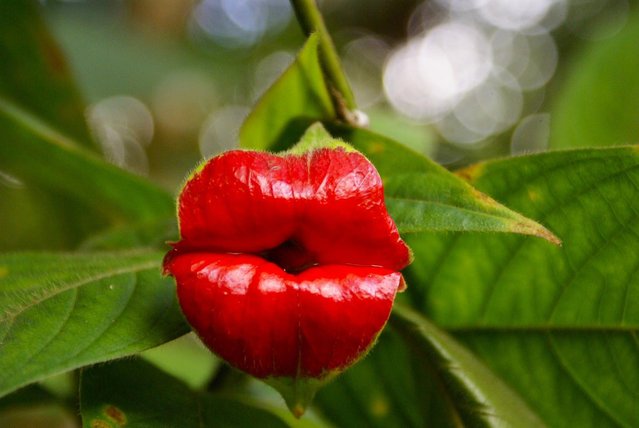
A Kiss From Mother Nature - Psychotria Elata

Psychotria is a genus containing some 1900 species within the plant family Rubiaceae. Members of the genus are small understorey trees in tropical forests. The former genus Cephaelis is considered a synomym of Psychotria.
Details
28 May 2013 10:07:00
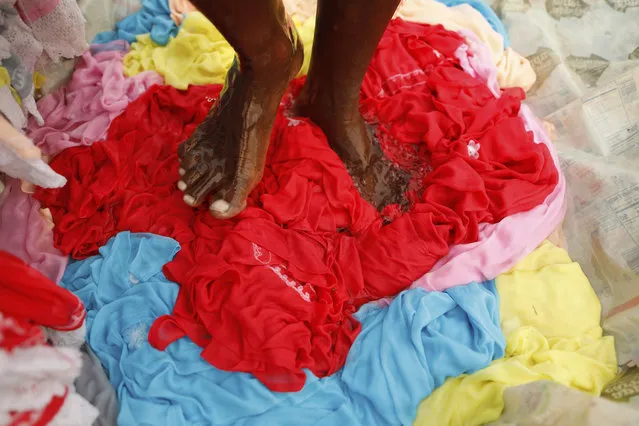
A dhobi, or a washerman washes cloths on the banks of the River Gomti in Lucknow, India, Saturday, September 12, 2020. Dhobis are traditional laundry workers who wash clothes by hand and dry them in the sun, an occupation which has been in existence for generations. Most cities in India have a Dhobi Ghat, or washermen's area, where the city's pile of clothes is laundered. This practice is still popular in India, despite of modern technology. Around 1,000 families work in Lucknow's Dhobi Ghat. However, in light of the novel coronavirus, their wages have decreased drastically. With each family earning around US$100-200 per month. (Photo by Rajesh Kumar Singh/AP Photo)

A dhobi, or a washerman washes cloths on the banks of the River Gomti in Lucknow, India, Saturday, September 12, 2020. Dhobis are traditional laundry workers who wash clothes by hand and dry them in the sun, an occupation which has been in existence for generations. Most cities in India have a Dhobi Ghat, or washermen's area, where the city's pile of clothes is laundered. This practice is still popular in India, despite of modern technology. Around 1,000 families work in Lucknow's Dhobi Ghat. However, in light of the novel coronavirus, their wages have decreased drastically. With each family earning around US$100-200 per month. (Photo by Rajesh Kumar Singh/AP Photo)
Details
25 Sep 2020 00:03:00


Newly commissioned 2nd lieutenants throw their caps in the air as a team of F-16 Air Force Thunderbirds fly over the 2011 graduating class of the U.S. Air Force Academy on May 25, 2011 in Colorado Springs, Colorado. A total of 1,021 graduates received their diplomas in front of their families and dignitaries at the Academy's Falcon Stadium. (Photo by John Moore/Getty Images)
Details
26 May 2011 08:27:00


Students from John Moores' University celebrate and pose for family photographs as they take part in their degree congregations at Liverpool's Anglican Cathedral on July 13, 2011 in Liverpool, England. Thousands of students are taking part in graduations across Britain and will begin looking for employment. According to recent surveys there are currently 83 graduates chasing every job vacancy. (Photo by Christopher Furlong/Getty Images)
Details
14 Jul 2011 09:53:00