Loading...
Done
A photo provided by the Atlanta Journal-Constitution shows Atlanta police officer T. R. Coxe removing painted material of a large swastika featuring a likeness of Republican presidential candidate, Donald Trump, along the northbound Buford Highway Connector just south of the Piedmont exit, in Atlanta, Georgia, USA, 09 December 2015. Just days after Donald Trump's call to ban Muslims from entering the United States, someone painted large swastikas featuring the Republican presidential candidate's face on at least two northeast Atlanta bridge supports. (Photo by John Spink/EPA/AJC)

A photo provided by the Atlanta Journal-Constitution shows Atlanta police officer T. R. Coxe removing painted material of a large swastika featuring a likeness of Republican presidential candidate, Donald Trump, along the northbound Buford Highway Connector just south of the Piedmont exit, in Atlanta, Georgia, USA, 09 December 2015. Just days after Donald Trump's call to ban Muslims from entering the United States, someone painted large swastikas featuring the Republican presidential candidate's face on at least two northeast Atlanta bridge supports. The symbol, which includes a cartoon of Trump sporting a Hitler-like mustache, was painted along the Buford Highway Connector. A second, similar image was found on a concrete bridge support on nearby Piedmont Road. Trump said in a statement released on 07 December that there should be a total and complete shutdown of Muslims entering the United States. (Photo by John Spink/EPA/AJC)
Details
11 Dec 2015 11:49:00
A youth poses while holding two fishes before his face in Iraq's southern port city of al-Faw, 90 kilometres south of Basra near the Shatt al-Arab and the Gulf, on May 18, 2020. In Iraq, a national lockdown to halt the COVID-19 coronavirus pandemic has found some unexpected fans: local businesses who no longer have to compete with Turkish, Iranian or Chinese imports. Those countries, as well as Saudi Arabia, Jordan and Kuwait, typically flood Iraqi markets with inexpensive products at prices local producers can't compete with. (Photo by Hussein Faleh/AFP Photo)

A youth poses while holding two fishes before his face in Iraq's southern port city of al-Faw, 90 kilometres south of Basra near the Shatt al-Arab and the Gulf, on May 18, 2020. In Iraq, a national lockdown to halt the COVID-19 coronavirus pandemic has found some unexpected fans: local businesses who no longer have to compete with Turkish, Iranian or Chinese imports. Those countries, as well as Saudi Arabia, Jordan and Kuwait, typically flood Iraqi markets with inexpensive products at prices local producers can't compete with. (Photo by Hussein Faleh/AFP Photo)
Details
02 Jul 2020 00:01:00
Camel herders scoop up water in plastic buckets from one of the few watering holes in the area, to water their animals near the drought-affected village of Bandarero, near Moyale town on the Ethiopian border, in northern Kenya, Friday, March 3, 2017. The U.N. humanitarian chief, Stephen O'Brien, toured Bandarero village on Friday and called on the international community to act to “avert the very worst of the effects of drought and to avert a famine to make sure we don't go from what is deep suffering to a catastrophe”. (Photo by Ben Curtis/AP Photo)

Camel herders scoop up water in plastic buckets from one of the few watering holes in the area, to water their animals near the drought-affected village of Bandarero, near Moyale town on the Ethiopian border, in northern Kenya, Friday, March 3, 2017. The U.N. humanitarian chief, Stephen O'Brien, toured Bandarero village on Friday and called on the international community to act to “avert the very worst of the effects of drought and to avert a famine to make sure we don't go from what is deep suffering to a catastrophe”. (Photo by Ben Curtis/AP Photo)
Details
05 Mar 2017 00:03:00
A waste picker unloads garbage at a waste transfer station in Bamako, Mali, August 19, 2018. In the Malian capital of Bamako, donkey carts driven by young men like 19-year-old Arouna Diabate play a vital role battling the fast-growing city's waste problem. Every morning before dawn, Diabate hitches his donkey to a cart and sets off on his rounds, going door-to-door to collect household garbage which he delivers to a local waste transfer station for a monthly salary of around $35. “I won't be picking up trash with a donkey cart for the rest of my life, but for now people appreciate us because we help clean up the homes of Bamako”, Diabate said. (Photo by Luc Gnago/Reuters)

A waste picker unloads garbage at a waste transfer station in Bamako, Mali, August 19, 2018. In the Malian capital of Bamako, donkey carts driven by young men like 19-year-old Arouna Diabate play a vital role battling the fast-growing city's waste problem. Every morning before dawn, Diabate hitches his donkey to a cart and sets off on his rounds, going door-to-door to collect household garbage which he delivers to a local waste transfer station for a monthly salary of around $35. “I won't be picking up trash with a donkey cart for the rest of my life, but for now people appreciate us because we help clean up the homes of Bamako”, Diabate said. (Photo by Luc Gnago/Reuters)
Details
18 Sep 2018 00:01:00
A 40-tonne humpback launching out of the water in an incredible breach in New South Wales, Australia on October 2022 in front of a sunset. The humpback whale can grow up to 56 feet long and typically covers 9,900 miles a year as it travels through the oceans of the world. Humpback whales are a species of Baleen whale, meaning they don't have teeth. Instead, they have baleen which helps them to filter feed. Their main source of food is krill or tiny bait fish. (Photo by Jodie Lowe/Media Drum Images)

A 40-tonne humpback launching out of the water in an incredible breach in New South Wales, Australia on October 2022 in front of a sunset. The humpback whale can grow up to 56 feet long and typically covers 9,900 miles a year as it travels through the oceans of the world. Humpback whales are a species of Baleen whale, meaning they don't have teeth. Instead, they have baleen which helps them to filter feed. Their main source of food is krill or tiny bait fish. (Photo by Jodie Lowe/Media Drum Images)
Details
30 Oct 2022 04:28:00
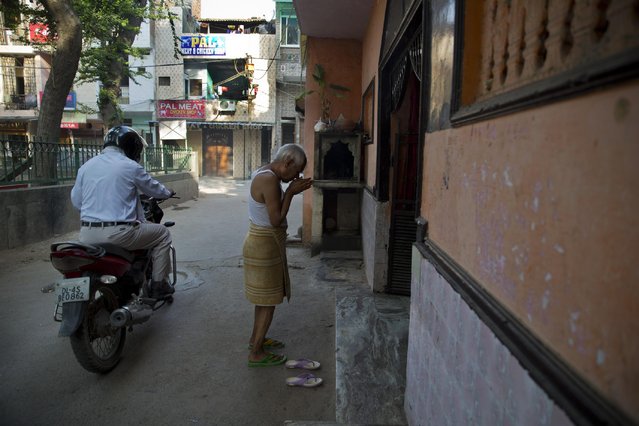
In this June 8, 2015 photo, Omkarnath, who goes by the name “Medicine Baba”, pays his reverence at a neighborhood temple as he begins his day in New Delhi, India. The chatty, 79-year-old retired blood-bank technician has been collecting unused prescription drugs from the affluent for the past eight years, and distributing whatever hasn't expired to patients who need medicines they cannot afford. (Photo by Saurabh Das/AP Photo)

In this June 8, 2015 photo, Omkarnath, who goes by the name “Medicine Baba”, pays his reverence at a neighborhood temple as he begins his day in New Delhi, India. The chatty, 79-year-old retired blood-bank technician has been collecting unused prescription drugs from the affluent for the past eight years, and distributing whatever hasn't expired to patients who need medicines they cannot afford. (Photo by Saurabh Das/AP Photo)
Details
25 Jul 2015 12:18:00
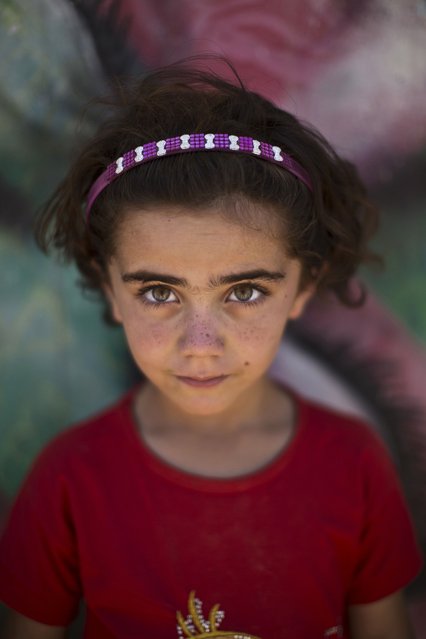
In this Tuesday, July 29, 2014, photo, Syrian refugee Samah, 5, poses for a picture at Zaatari refugee camp, near the Syrian border, in Mafraq, Jordan. More than 2.8 million Syrian children inside and outside the country – nearly half the school-aged population – cannot get an education because of the devastation from the civil war, according to the U.N. children's agency, UNICEF. (Photo by Muhammed Muheisen/AP Photo)

In this Tuesday, July 29, 2014, photo, Syrian refugee Samah, 5, poses for a picture at Zaatari refugee camp, near the Syrian border, in Mafraq, Jordan. More than 2.8 million Syrian children inside and outside the country – nearly half the school-aged population – cannot get an education because of the devastation from the civil war, according to the U.N. children's agency, UNICEF. That number is likely higher, as UNICEF can't count the children whose parents didn't register with the United Nations refugee agency. (Photo by Muhammed Muheisen/AP Photo)
Details
03 Aug 2014 07:46:00
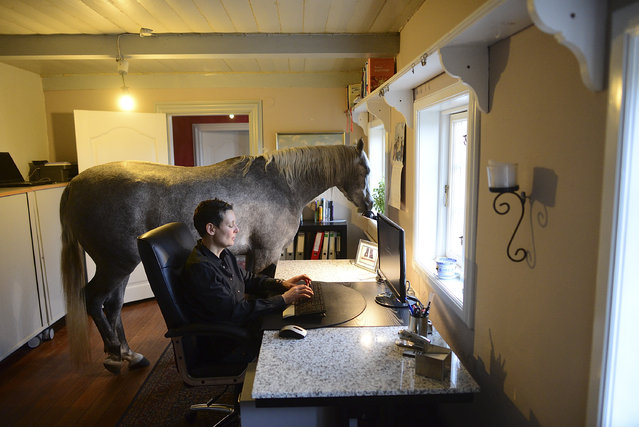
Nasar, an Arabian horse, stands in the office of doctor Stephanie Arndt at her home on February 19, 2014 in Holt, Germany. Fearing for the horse's safety, Mrs. Arndt brought the horse into her house during the Xaver heavy storm back in December, and the horse now wanders through the house daily, inspecting details and looking for snacks. Mrs. Arndt says she doesn't mind, and though the horse never spends the night, it does occasionally take a nap in the house. (Photo by Patrick Lux/Getty Images)

Nasar, an Arabian horse, stands in the office of doctor Stephanie Arndt at her home on February 19, 2014 in Holt, Germany. Fearing for the horse's safety, Mrs. Arndt brought the horse into her house during the Xaver heavy storm back in December, and the horse now wanders through the house daily, inspecting details and looking for snacks. Mrs. Arndt says she doesn't mind, and though the horse never spends the night, it does occasionally take a nap in the house. (Photo by Patrick Lux/Getty Images)
Details
23 Feb 2014 09:44:00