Loading...
Done
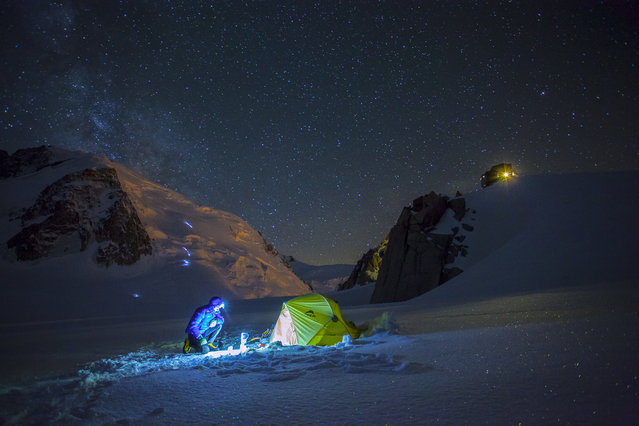
“A snapshot from mountaineer's life”. Have you ever wondered how does a mountaineer's day start? (Photo and caption by Kamil Tamiola/National Geographic Traveler Photo Contest)

“A snapshot from mountaineer's life”. Have you ever wondered how does a mountaineer's day start? I will give you a hint: you wake up at 3 am, set the stove, wake up your partner, pretend it is warm, quickly consume a high-calorie breakfast, watch your friends slowly ascending the icy slopes of your dream summit with their tiny head torches glimmering against perfectly blue ice, and hope for the good weather. One would ask: why all this trouble? The answer is easy: for the love of the adventure and the unknown. Location: Chamonix, Haute Savoye, France. (Photo and caption by Kamil Tamiola/National Geographic Traveler Photo Contest)

ATTENTION! All pictures are presented in high resolution. To see Hi-Res images – just TWICE click on any picture. In other words, click small picture – opens the BIG picture. Click BIG picture – opens VERY BIG picture.
Details
27 Jun 2013 12:47:00
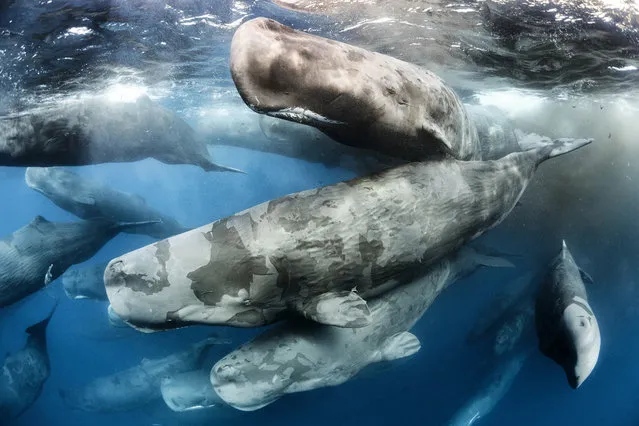
Giant gathering by Tony Wu. “The first indication that something extraordinary was going on were the blows, huge numbers of them – the exhalations of huge numbers of whales. Entering the water, the photographer witnessed an extraordinary scene. Hundreds, possibly thousands, of sperm whales were twirling and twisting through the water, bumping and rubbing against each other, and there was a cacophony of sound – the pulsation, buzz, creak and crackle of whale communication. The picture shows just a fraction of the scene, with the whales stacked up below. Undoubtedly, this was a clan gathering”. (Photo by Tony Wu/Unforgettable Underwater Photography/NHM)

A new book published by the UK Natural History Museum showcases some of the most memorable underwater photographs taken over the last few decades in its annual wildlife photographer of the year competition. Here: Giant gathering by Tony Wu. “The first indication that something extraordinary was going on were the blows, huge numbers of them – the exhalations of huge numbers of whales. Entering the water, the photographer witnessed an extraordinary scene”. (Photo by Tony Wu/Unforgettable Underwater Photography/NHM)
Details
17 Apr 2018 00:03:00
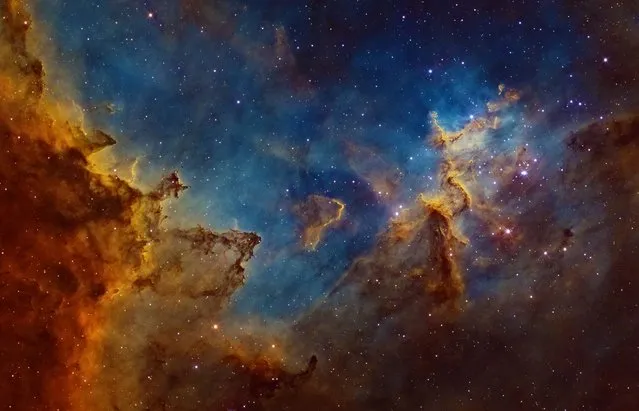
Centre of the Heart Nebula by Ivan Eder (Hungary). Situated 7500 light years away in the ‘W’-shaped constellation of Cassiopeia, the Heart Nebula is a vast region of glowing gas, energized by a cluster of young stars at its centre. The image depicts the central region, where dust clouds are being eroded and moulded into rugged shapes by the searing cosmic radiation. (Photo by Ivan Eder)

The competition, which is run by the Royal Observatory Greenwich in association with BBC Sky at Night Magazine, is now in its sixth year and has received over 2,500 entries. Photo: Centre of the Heart Nebula by Ivan Eder (Hungary). Situated 7500 light years away in the “W”-shaped constellation of Cassiopeia, the Heart Nebula is a vast region of glowing gas, energized by a cluster of young stars at its centre. The image depicts the central region, where dust clouds are being eroded and moulded into rugged shapes by the searing cosmic radiation. (Photo by Ivan Eder)
Details
03 Jul 2014 11:59:00
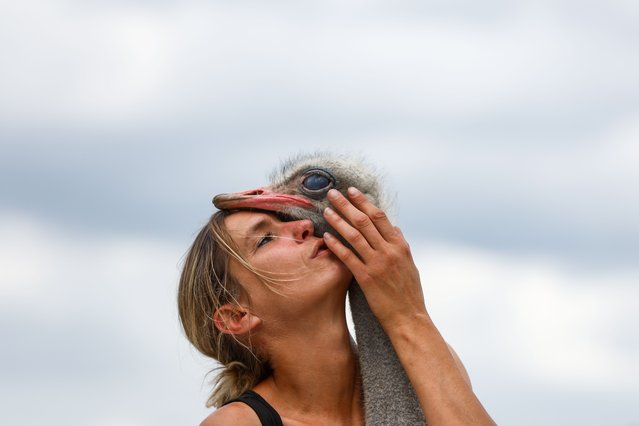
Wendy Adriaens, owner of animal rescue farm “De Passiehoeve” and nicknamed the Ostrich Whisperer, poses for a photo with three-year-old male ostrich Flodder, in Kalmthout, Belgium, 25 July 2022. Flodder and Wendy were separated for seven months since Wendy moved to a bigger farm in January. Flodder spent the seven months at another farm in order to ease the tension between the two ostriches Flodder and Blue who were fighting to the death and had to be separated. Wendy Adriaens has been taking in all kinds of animals that have been mistreated or neglected for some four years at her farm located in the Province of Antwerp. She lives mainly from donations from people who have known her via social networks. An entrance fee to the farm is requested if visitors want to spend some time there. This makes it possible to buy the necessary for the convalescence of the animals. (Photo by Stephanie Lecocq/EPA/EFE/Rex Features/Shutterstock)

Wendy Adriaens, owner of animal rescue farm “De Passiehoeve” and nicknamed the Ostrich Whisperer, poses for a photo with three-year-old male ostrich Flodder, in Kalmthout, Belgium, 25 July 2022. (Photo by Stephanie Lecocq/EPA/EFE/Rex Features/Shutterstock)
Details
31 Jul 2022 06:16:00
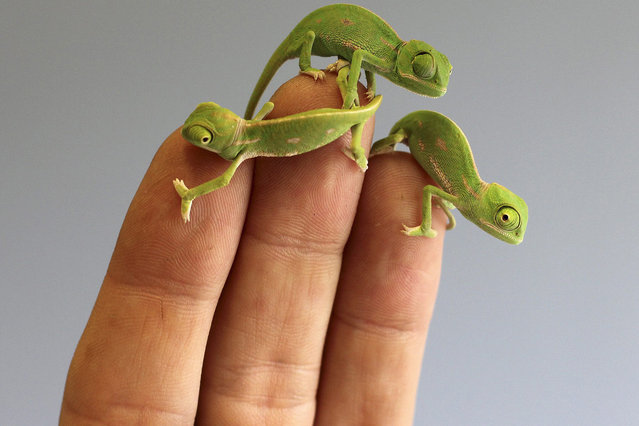
A handout image released by the Taronga Zoo shows Veiled Chameleon hatchlings at Taronga Zoo in Sydney, Australia, 11 March 2015. Taronga has welcomed more than 20 baby chameleons, with the last of three clutches of eggs hatching this week. Veiled Chameleons, or Chamaeleo calyptratus, are native to Saudi Arabia and Yemen and can live up to five years. (Photo by EPA/Taronga Zoo)

A handout image released by the Taronga Zoo shows Veiled Chameleon hatchlings at Taronga Zoo in Sydney, Australia, 11 March 2015. Taronga has welcomed more than 20 baby chameleons, with the last of three clutches of eggs hatching this week. Veiled Chameleons, or Chamaeleo calyptratus, are native to Saudi Arabia and Yemen and can live up to five years. (Photo by EPA/Taronga Zoo)
Details
21 Mar 2015 13:13:00
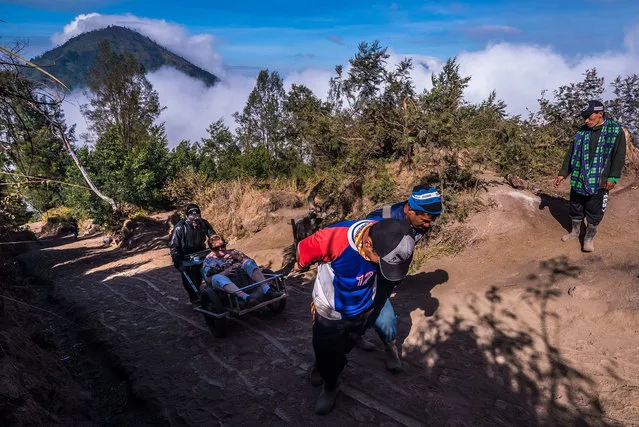
Miners pulling up lazy tourists to the rim of Kawah Ijen (Ijen Volcano), East Java, Indonesia on September 21, 2017. They will earn as much as they would bring down a load of sulfur. Nomadic Explorer, Cultural Lifestyle Photographer Claudio Sieber captured striking images of miners working at Ijen volcanic range in East Java, Indonesia. The sulphur miners risk their lives daily as they climb the active volcano carrying heavy loads, which they sell to sugar refineries. Shortly after midnight curious tourists are flocking in hundreds through the gate of Ijen's foothills to be right on time, driven by the images others took before them. Kawah Ijen is the one of the world's largest acidic volcanic crater lake; famous for its turquoise color as well as the unreal atmosphere it offers during darkness. A dusty path zigzags 3 kilometers up to the crater rim. This doesn't mean anything challenging; in particular, special sights have to be deserved anyway. The irritating smell of sulfur announces the near of the crater's existence. Arriving on the crater's rim the reward for the torture becomes visible. Blue fire darts its tongues through the fumes of sulfur dioxide. Somehow, the spectacle isn't as romantic as expected, since it is also the rough working space of approx. 150 sulfur miners who start their shift at 1 am. Lately, harvesting the abundance of devil's gold received international attention. This did obviously not really improve a miner's lifestyle; neither did it contribute to a better wage. (Photo by Claudio Sieber/Barcroft Images)

Miners pulling up lazy tourists to the rim of Kawah Ijen (Ijen Volcano), East Java, Indonesia on September 21, 2017. They will earn as much as they would bring down a load of sulfur. Nomadic Explorer, Cultural Lifestyle Photographer Claudio Sieber captured striking images of miners working at Ijen volcanic range in East Java, Indonesia. The sulphur miners risk their lives daily as they climb the active volcano carrying heavy loads, which they sell to sugar refineries. (Photo by Claudio Sieber/Barcroft Images)
Details
02 Oct 2017 08:31:00
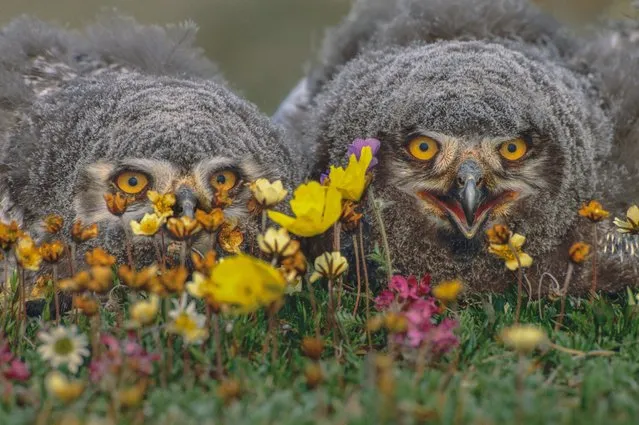
Snowy owlets (Bubo scandiacus), Arctic National Wildlife Refuge, Alaska, USA. “A pair of gray-feathered snowy owlets hunker down in the abundant flowers that flourish in the dropping-enriched soil of their nest mound”. (Photo by Art Wolfe/Art Wolfe Stock)

The photography of Art Wolfe covers the globe, capturing landscapes, wildlife, and cultures from every continent; here he talks through a selection of his favourite images. Art Wolfe is an American photographer and conservationist. His photographs have been noted by environmental advocacy groups for their “stunning” visual impact. Here: Snowy owlets (Bubo scandiacus), Arctic National Wildlife Refuge, Alaska, USA. (Photo by Art Wolfe/Art Wolfe Stock)
Details
19 Mar 2018 00:05:00
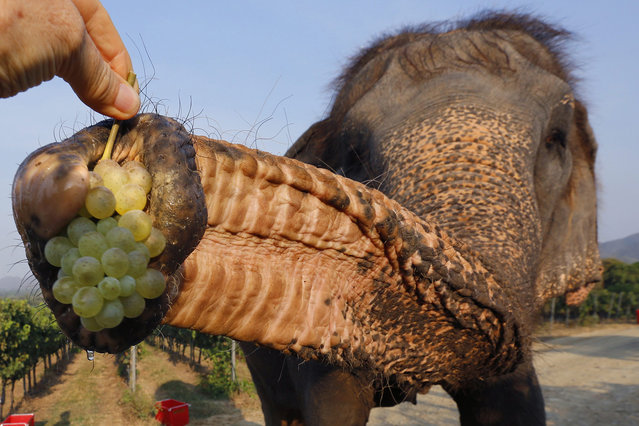
Tourists feed freshly picked grapes to 40-year-old elephant Boonruen, a long-term resident of the Hua Hin Hills vineyard, that used to be an elephant corral in Hua Hin, about 200km southwest of Bangkok, Thailand, 08 March 2016. The winery is among a handful of companies producing new latitude wines in non-traditional wine areas of the world near the equator. Harvest is only once a year in Thailand, this year in March. (Photo by Barbara Walton/EPA)

Tourists feed freshly picked grapes to 40-year-old elephant Boonruen, a long-term resident of the Hua Hin Hills vineyard, that used to be an elephant corral in Hua Hin, about 200km southwest of Bangkok, Thailand, 08 March 2016. The winery is among a handful of companies producing new latitude wines in non-traditional wine areas of the world near the equator. Harvest is only once a year in Thailand, this year in March. (Photo by Barbara Walton/EPA)
Details
20 Mar 2016 11:20:00