Loading...
Done
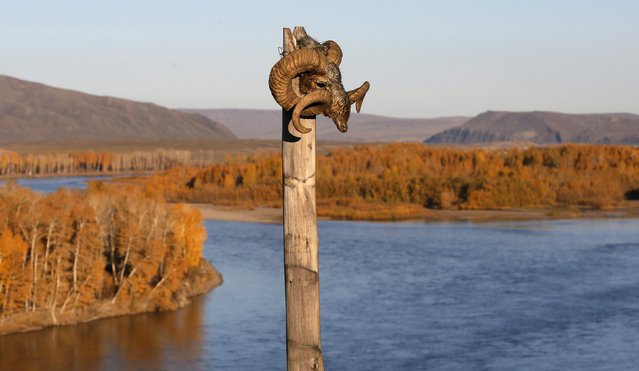
The head of a mountain ram is attached to a wooden column at the site used for shamans' rituals in the Aldyn Bulak area on the bank of the Yenisei River during sunset outside the village of Elegest, Tuva region, Southern Siberia, Russia, October 7, 2015. (Photo by Ilya Naymushin/Reuters)

The head of a mountain ram is attached to a wooden column at the site used for shamans' rituals in the Aldyn Bulak area on the bank of the Yenisei River during sunset outside the village of Elegest, Tuva region, Southern Siberia, Russia, October 7, 2015. The region is inhabited by Tuvans, historically cattle-herding nomads, who nowadays practise two main confessions – Buddhism and Shamanism. (Photo by Ilya Naymushin/Reuters)
Details
19 Oct 2015 08:05:00
Pedestrians stop to look at and photograph a DeLorean Motor Company DMC-12 customized to look identical to the car used in the film "Back to the Future Part II" and that will be part of a Lyft promotion in New York, October 21, 2015. (Photo by Lucas Jackson/Reuters)

Pedestrians stop to look at and photograph a DeLorean Motor Company DMC-12 customized to look identical to the car used in the film "Back to the Future Part II" and that will be part of a Lyft promotion in New York, October 21, 2015. In the 1989 movie, main character Marty McFly traveled to the future to October 21, 2015. (Photo by Lucas Jackson/Reuters)
Details
24 Oct 2015 08:03:00
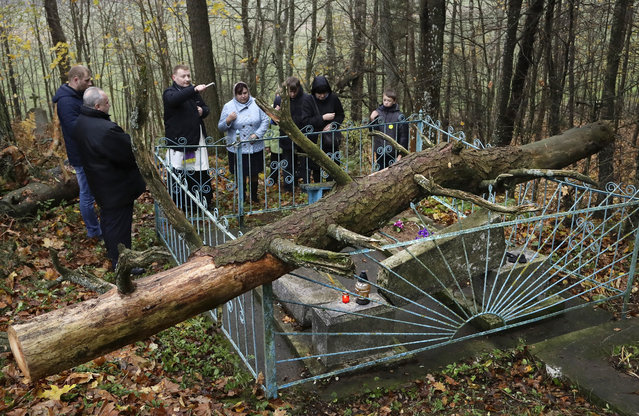
A Catholic priest blesses a grave, marking All Saints' Day as the people stand next to monument partially destroyed by an old fallen tree at a cemetery in the village of Zubkovo, 150 km (93 miles) west of Minsk, Belarus, Wednesday, November 1, 2017. Belarusian Catholics marked All Saints Day by visiting graves of their relatives. (Photo by Sergei Grits/AP Photo)

A Catholic priest blesses a grave, marking All Saints' Day as the people stand next to monument partially destroyed by an old fallen tree at a cemetery in the village of Zubkovo, 150 km (93 miles) west of Minsk, Belarus, Wednesday, November 1, 2017. Belarusian Catholics marked All Saints Day by visiting graves of their relatives. (Photo by Sergei Grits/AP Photo)
Details
02 Nov 2017 08:38:00
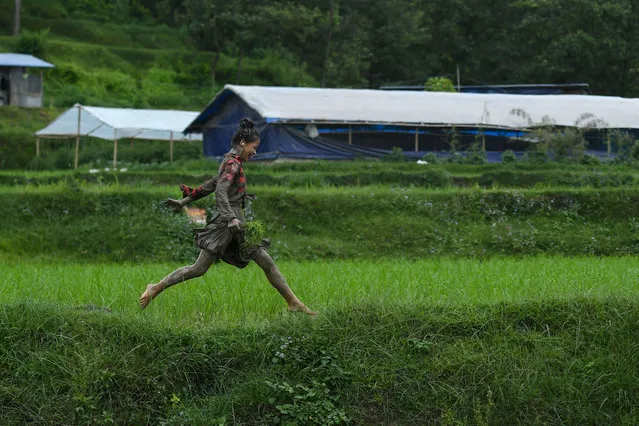
A girl walks along rice paddy fields during “National Paddy Day”, which marks the start of the annual rice planting season, in Tokha village on the outskirts of Kathmandu on June 29, 2020. Splashing mud and drinking local rice beer, Nepali farmers this week celebrated National Paddy Day to mark the beginning of the rice-planting season, despite some coronavirus lockdown measures still in place. Traditional farming songs and laughter echoed in the air as farmers waded into waterlogged fields to sow green paddy. (Photo by Prakash Mathema/AFP Photo)

A girl walks along rice paddy fields during “National Paddy Day”, which marks the start of the annual rice planting season, in Tokha village on the outskirts of Kathmandu on June 29, 2020. Splashing mud and drinking local rice beer, Nepali farmers this week celebrated National Paddy Day to mark the beginning of the rice-planting season, despite some coronavirus lockdown measures still in place. Traditional farming songs and laughter echoed in the air as farmers waded into waterlogged fields to sow green paddy. (Photo by Prakash Mathema/AFP Photo)
Details
02 Aug 2020 00:01:00
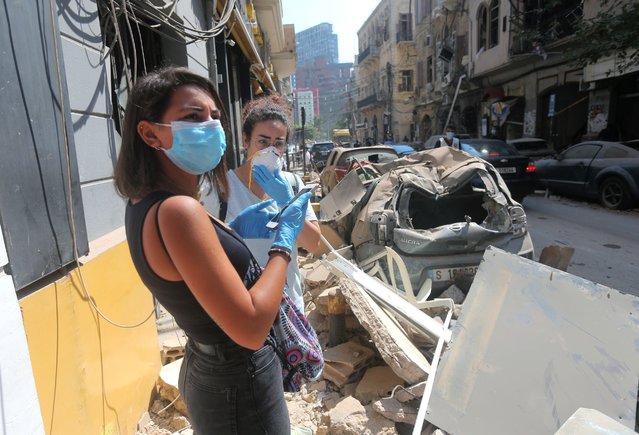
Young Lebanese women wearing protective masks and gloves against the coronavirus pandemic, stand on August 5, 2020 amid the rubble in Beirut's Gimmayzeh commercial district which was heavily damaged by the previous day's powerful explosion that tore through Lebanon's capital, resulting from the ignition of a huge depot of ammonium nitrate at the city's main port. Rescuers searched for survivors in Beirut after a cataclysmic explosion at the port sowed devastation across entire neighbourhoods, killing more than 100 people, wounding thousands and plunging Lebanon deeper into crisis. The blast, which appeared to have been caused by a fire igniting 2,750 tonnes of ammonium nitrate left unsecured in a warehouse, was felt as far away as Cyprus, some 150 miles (240 kilometres) to the northwest. (Photo by AFP Photo/Stringer)

Young Lebanese women wearing protective masks and gloves against the coronavirus pandemic, stand on August 5, 2020 amid the rubble in Beirut's Gimmayzeh commercial district which was heavily damaged by the previous day's powerful explosion that tore through Lebanon's capital, resulting from the ignition of a huge depot of ammonium nitrate at the city's main port. Rescuers searched for survivors in Beirut after a cataclysmic explosion at the port sowed devastation across entire neighbourhoods, killing more than 100 people, wounding thousands and plunging Lebanon deeper into crisis. The blast, which appeared to have been caused by a fire igniting 2,750 tonnes of ammonium nitrate left unsecured in a warehouse, was felt as far away as Cyprus, some 150 miles (240 kilometres) to the northwest. (Photo by AFP Photo/Stringer)
Details
10 Aug 2020 00:05:00
Igor Gavrilov, the main taxidermist of the Zoological centre at Tel Aviv University, works on a taxidermied animal, part of a collection which will be housed at the Steinhardt Museum of Natural History, a new Israeli natural history museum set to open next year in Tel Aviv, Israel June 8, 2016. Legions of insects, sea creatures and ancient fossils are lining up in a new museum shaped liked a giant Noah's Ark, telling the story of a crucial evolutionary byway across Israel. Experts say all humans and other animals had to pass through Israel on their first journey out of Africa into Europe and Asia. (Photo by Nir Elias/Reuters)

Igor Gavrilov, the main taxidermist of the Zoological centre at Tel Aviv University, works on a taxidermied animal, part of a collection which will be housed at the Steinhardt Museum of Natural History, a new Israeli natural history museum set to open next year in Tel Aviv, Israel June 8, 2016. Legions of insects, sea creatures and ancient fossils are lining up in a new museum shaped liked a giant Noah's Ark, telling the story of a crucial evolutionary byway across Israel. (Photo by Nir Elias/Reuters)
Details
25 Aug 2016 09:42:00
People cross a street against strong wind and heavy rainfall under the influence of Typhoon Haiyan, in Sanya, Hainan province November 10, 2013. One of the most powerful storms ever recorded killed at least 10,000 people in the central Philippines, a senior police official said on Sunday, with huge waves sweeping away entire coastal villages and devastating the region's main city. Despite weakening, the storm is likely to cause heavy rains, flooding, strong winds and mudslides as it makes its way north in the South China Sea. (Photo by Reuters/China Daily)

People cross a street against strong wind and heavy rainfall under the influence of Typhoon Haiyan, in Sanya, Hainan province November 10, 2013. One of the most powerful storms ever recorded killed at least 10,000 people in the central Philippines, a senior police official said on Sunday, with huge waves sweeping away entire coastal villages and devastating the region's main city. Despite weakening, the storm is likely to cause heavy rains, flooding, strong winds and mudslides as it makes its way north in the South China Sea. (Photo by Reuters/China Daily)
Details
16 Nov 2013 12:28:00
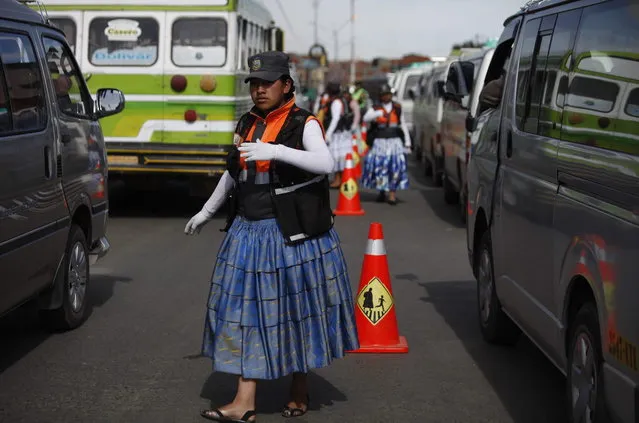
In this December 3, 2013 photo, an Aymara woman cops directs traffic on the streets of El Alto, Bolivia. The women wear the bright petticoats and shawls of indigenous women in the Andes, called cholitas in Bolivian slang, the main difference being that instead of bowler hats they wear khaki green police-style caps. Some don fluorescent traffic vests. (Photo by Juan Karita/AP Photo)

“This city in Bolivia's highlands has hired Aymara women dressed in traditional multilayered Andean skirts and brightly embroidered vests to work as traffic cops and bring order to its road chaos. About 20 of the “traffic cholitas” have been trained to direct cars and buses in El Alto, a teeming, impoverished sister city of La Paz in Bolivia's Andes mountains”. – El Alto via Associated Press. Photo: In this December 3, 2013 photo, an Aymara woman cops directs traffic on the streets of El Alto, Bolivia. The women wear the bright petticoats and shawls of indigenous women in the Andes, called cholitas in Bolivian slang, the main difference being that instead of bowler hats they wear khaki green police-style caps. Some don fluorescent traffic vests. (Photo by Juan Karita/AP Photo)
Details
25 Dec 2013 10:48:00