Loading...
Done
Micro or Macro? It's micro: this is an electron microscope image of the wing of a Green Darner dragonfly. (Photo by P. Kelly)

Macro or Micro? Scientists’ pictures baffle our sense of scale. It began when Stephen Young, a geography professor at Salem State University in Massachusetts, tricked his biologist colleague Paul Kelly into thinking a satellite image was one of his electron microscope scans. Can you guess whether they are close-up or very far away? (Photo by Paul Kelly)
Details
21 Apr 2014 10:24:00


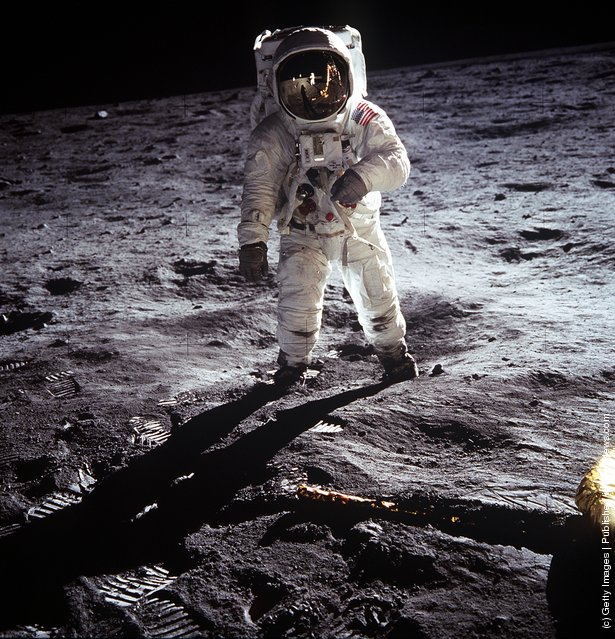
Astronaut Edwin E. Aldrin Jr. walks near the Lunar Module during the Apollo 11 extravehicular activity July 20, 1969 on the Moon. (Photo by NASA/Newsmakers)
Details
28 May 2011 11:04:00
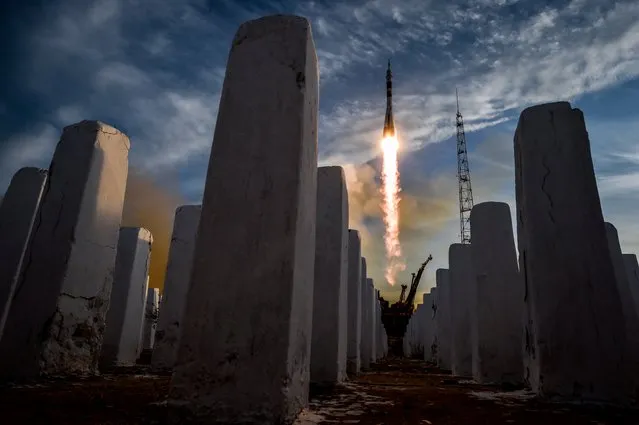
A Soyuz MS-11 rocket carrying Russian, American and Canadian astronauts takes off from the Baikonur Cosmodrome on December 3, 2018 before reached orbit later, the first manned mission since a failed launch in October. (Photo by Kirill Kudryavtsev/AFP Photo)

A Soyuz MS-11 rocket carrying Russian, American and Canadian astronauts takes off from the Baikonur Cosmodrome on December 3, 2018 before reached orbit later, the first manned mission since a failed launch in October. (Photo by Kirill Kudryavtsev/AFP Photo)
Details
05 Dec 2018 00:07:00
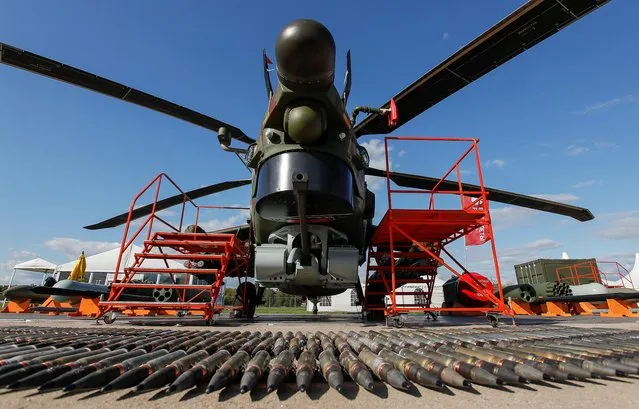
The Mil Mi-28 N military helicopter is seen at the MAKS 2019 air show in Zhukovsky, outside Moscow, Russia, August 27, 2019. (Photo by Maxim Shemetov/Reuters)

The Mil Mi-28 N military helicopter is seen at the MAKS 2019 air show in Zhukovsky, outside Moscow, Russia, August 27, 2019. (Photo by Maxim Shemetov/Reuters)
Details
30 Aug 2019 00:03:00
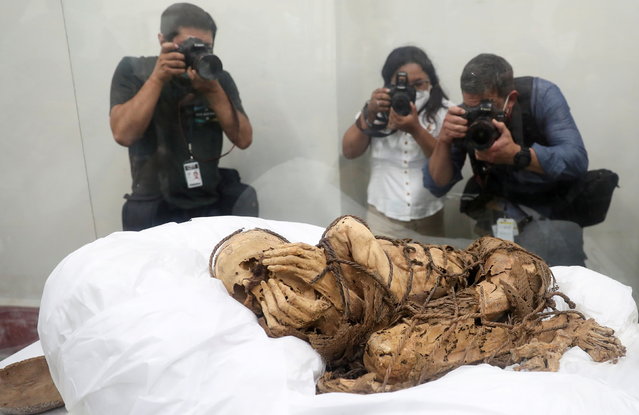
Members of the media take pictures of the pre-Inca “Mummy of Cajamarquilla”, which is presumed to be between 800 and 1200 years old, in Lima, Peru December 7, 2021. The “Mummy of Cajamarquilla” found by archaeologists from San Marcos inside a burial chamber of about three meters long and a depth of 1.40 meters in the Cajamarquilla archaeological site, east of Lima. (Photo by Sebastian Castaneda/Reuters)

Members of the media take pictures of the pre-Inca “Mummy of Cajamarquilla”, which is presumed to be between 800 and 1200 years old, in Lima, Peru December 7, 2021. The “Mummy of Cajamarquilla” found by archaeologists from San Marcos inside a burial chamber of about three meters long and a depth of 1.40 meters in the Cajamarquilla archaeological site, east of Lima. (Photo by Sebastian Castaneda/Reuters)
Details
09 Dec 2021 09:05:00
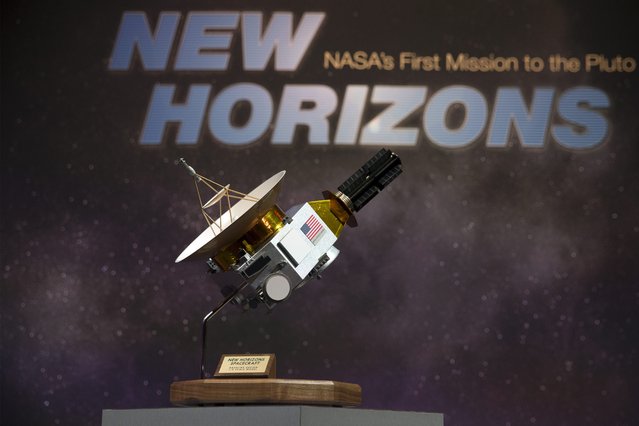
A model of the New Horizons spacecraft is seen at a live television program on NASA television celebrating the spacecraft's closest proximity to Pluto, at Johns Hopkins University Applied Physics Laboratory, site of the mission operations center, in Laurel, Maryland, USA, 14 July 2015. (Photo by Michael Reynolds/EPA)

A model of the New Horizons spacecraft is seen at a live television program on NASA television celebrating the spacecraft's closest proximity to Pluto, at Johns Hopkins University Applied Physics Laboratory, site of the mission operations center, in Laurel, Maryland, USA, 14 July 2015. At approximately 7:49 am ET (11:49 am GMT), 14 July, New Horizons was scheduled to be as close to Pluto as the spacecraft will get; about 7,800 miles (12,500 kilometers) above the surface, following a journey of more than nine years and three billion miles. This is the first mission to the Pluto System and the Kuiper Belt. (Photo by Michael Reynolds/EPA)
Details
15 Jul 2015 10:08:00
A view of the platform of the Leviathan natural gas field in the Mediterranean Sea is pictured from the Israeli northern coastal beach of Nasholim, on August 29, 2022. (Photo by Jack Guez/AFP Photo)

A view of the platform of the Leviathan natural gas field in the Mediterranean Sea is pictured from the Israeli northern coastal beach of Nasholim, on August 29, 2022. (Photo by Jack Guez/AFP Photo)
Details
21 Nov 2022 06:22:00
This artist's scoreboard displays a fictional game between Mars and Earth, with Mars in the lead. (Image by NASA/JPL-Caltech)

This artist's scoreboard displays a fictional game between Mars and Earth, with Mars in the lead. It refers to the success rate of sending missions to Mars, both as orbiters and landers. Of the previous 39 missions targeted for Mars from around the world, 15 have been successes and 24 failures. For baseball fans, that's a batting average of .385. The United States has had 13 successes out of 18 attempts, or a “batting average” of .722. NASA's Curiosity rover, set to land on the Red Planet the evening of Aug. 5, 2012 PDT (morning of Aug. 6 EDT), will mark the United States' 19th attempt to tackle the challenge of Mars, and the world's 40th attempt. (Image by NASA/JPL-Caltech)
Details
06 Aug 2012 09:47:00