Loading...
Done
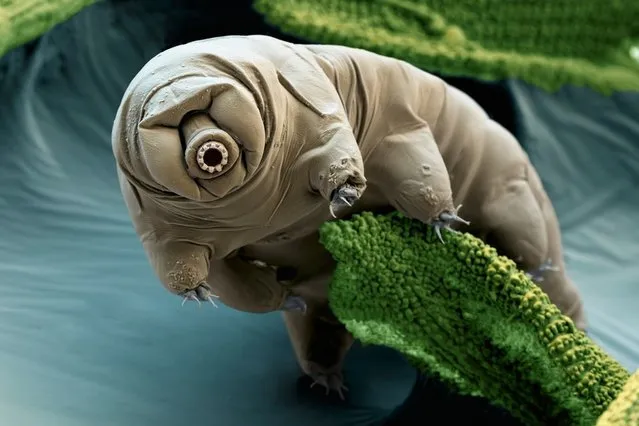
Tardigrades (commonly known as waterbears or moss piglets). (Photo by SPL/East News)

“Tardigrades (commonly known as waterbears or moss piglets) are small, water-dwelling, segmented animals with eight legs. Tardigrades were first discovered in 1773 by Johann August Ephraim Goeze, who called them kleiner Wasserbär, meaning “little water bear” in German. The name Tardigrada means “slow walker” and was given by Lazzaro Spallanzani in 1777. The name water bear comes from the way they walk, reminiscent of a bear's gait. The biggest adults may reach a body length of 1.5 millimetres (0.059 in), the smallest below 0.1 mm. Freshly hatched tardigrades may be smaller than 0.05 mm”. – Wikipedia. Photo: Tardigrades. (Photo by SPL/East News)
Details
26 Sep 2012 09:55:00
A woman poses next to two mailboxes along a street in Taipei on August 11, 2015 that were reportedly bent by strong winds brought by Typhoon Soudelor over the weekend. The two iron mailboxes have become an unlikely attraction, drawing thousands of snap-happy visitors and have even become a backdrop to a wedding photo shoot. (Photo by Benjamin Yeh/AFP Photo)

A woman poses next to two mailboxes along a street in Taipei on August 11, 2015 that were reportedly bent by strong winds brought by Typhoon Soudelor over the weekend. The two iron mailboxes have become an unlikely attraction, drawing thousands of snap-happy visitors and have even become a backdrop to a wedding photo shoot. The typhoon, which hit in the early hours of August 8 and was billed as the most powerful typhoon this year, uprooted trees, brought down electricity poles, knocking out power to a record 4.3 million households, while leaving eight dead and four missing. (Photo by Benjamin Yeh/AFP Photo)
Details
12 Aug 2015 13:44:00
Malabon Zoo owner Manny Tangco holds a full-grown but very small rooster named “Small But Terrible” from Malaysia to compare it with the giant red rooster from France named “Mr. Universe” as they are shown to the media as part of the “Roosters of the World” exhibition to celebrate the “Red Fire Rooster” in the Chinese lunar calendar Friday, January 27, 2017 in suburban Malabon city north of Manila, Philippines. The Roosters of the World exhibition features roosters from countries as the United States, Japan, United Kingdom, France, China, Malaysia, Indonesia and Poland. (Photo by Bullit Marquez/AP Photo)

Malabon Zoo owner Manny Tangco holds a full-grown but very small rooster named “Small But Terrible” from Malaysia to compare it with the giant red rooster from France named “Mr. Universe” as they are shown to the media as part of the “Roosters of the World” exhibition to celebrate the “Red Fire Rooster” in the Chinese lunar calendar Friday, January 27, 2017 in suburban Malabon city north of Manila, Philippines. The Roosters of the World exhibition features roosters from countries as the United States, Japan, United Kingdom, France, China, Malaysia, Indonesia and Poland. (Photo by Bullit Marquez/AP Photo)
Details
29 Jan 2017 11:42:00
A woman learns how to use an AK-47 assault rifle during a civilians self-defence course in the outskirts of Lviv, western Ukraine, on March 4, 2022. The Russian army occupied on March 4, 2022 the Ukrainian nuclear power plant of Zaporozhie (south), the largest in Europe, where bombings in the night have raised fears of a disaster as more than 1.2 million people have fled Ukraine into neighbouring countries since Russia launched its full-scale invasion on February 24, United Nations figures showed on March 4, 2022. (Photo by Daniel Leal/AFP Photo)

A woman learns how to use an AK-47 assault rifle during a civilians self-defence course in the outskirts of Lviv, western Ukraine, on March 4, 2022. The Russian army occupied on March 4, 2022 the Ukrainian nuclear power plant of Zaporozhie (south), the largest in Europe, where bombings in the night have raised fears of a disaster as more than 1.2 million people have fled Ukraine into neighbouring countries since Russia launched its full-scale invasion on February 24, United Nations figures showed on March 4, 2022. (Photo by Daniel Leal/AFP Photo)
Details
05 Mar 2022 05:55:00
8. NEW ZEALAND: A woman dives from a platform into a giant air bed at a park in Palmerston North September 29, 2011. (Photo by Marcos Brindicci/Reuters)

The report, prepared by the Sustainable Development Solutions Network (SDSN) and the Earth Institute at Columbia University, showed Syria, Afghanistan and eight sub-Saharan countries as the 10 least happy places on earth to live. The top 10 this year were Denmark, Switzerland, Iceland, Norway, Finland, Canada, Netherlands, New Zealand, Australia, and Sweden. Denmark was in third place last year, behind Switzerland and Iceland. The bottom 10 were Madagascar, Tanzania, Liberia, Guinea, Rwanda, Benin, Afghanistan, Togo, Syria and Burundi. The United States came in at 13, the United Kingdom at 23, France at 32, and Italy at 50. Here: #8. NEW ZEALAND: A woman dives from a platform into a giant air bed at a park in Palmerston North September 29, 2011. (Photo by Marcos Brindicci/Reuters)
Details
26 Mar 2016 13:19:00
People help a dancer as he falls on stilts in honor of Saint Mary Magdalene in a street for the traditional “Danza de Los Zancos” (Los Zancos Dance), in the small town of Anguiano, northern Spain, Saturday, July 23, 2016. (Photo by Alvaro Barrientos/AP Photo)

People help a dancer as he falls on stilts in honor of Saint Mary Magdalene in a street for the traditional “Danza de Los Zancos” (Los Zancos Dance), in the small town of Anguiano, northern Spain, Saturday, July 23, 2016. As an ancient tradition for more than 4th centuries, eight young people from the town balance on stilts down the old street, turning to the sound of folk music played on a pipe and drum. (Photo by Alvaro Barrientos/AP Photo)
Details
25 Jul 2016 11:36:00
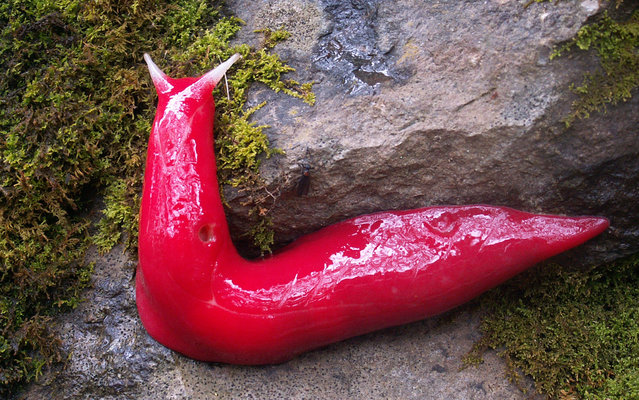
It would seem to be something you'd see only in a cartoon or at a Phish concert, but according to park rangers in New South Wales, Australia, dozens of giant, fluorescent pink slugs have been popping up on a mountaintop there. (Photo by Michael Murphy/AFP Photo/NSW Environment Office)

It would seem to be something you'd see only in a cartoon or at a Phish concert, but according to park rangers in New South Wales, Australia, dozens of giant, fluorescent pink slugs have been popping up on a mountaintop there. The eight-inch creatures have been spotted only on Mount Kaputar, a 5,000-foot peak in the Nandewar Range in northern New South Wales. Scientists believe the eye-catching organisms are survivors from an era when Australia was home to rainforests. A series of volcanoes, millions of years of erosion and other geological changes “have carved a dramatic landscape at Mount Kaputar”, the park service wrote on its Facebook page, and unique arid conditions spared the slugs from extinction. (Photo by Michael Murphy/AFP Photo/NSW Environment Office)
Details
01 Jun 2013 14:09:00
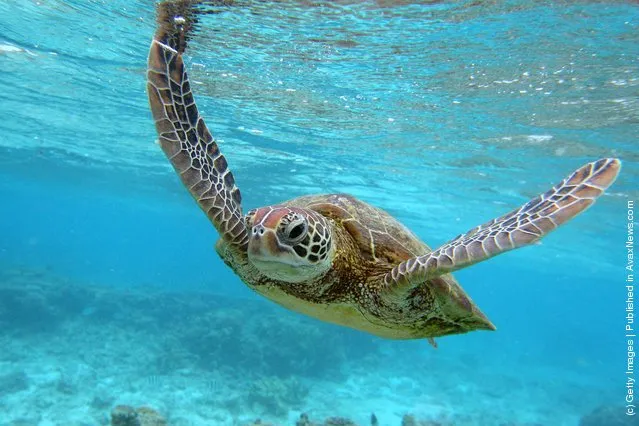
A Hawksbill sea turtle is seen swimming in Lady Elliot Island, Australia

“The Great Barrier Reef is one of the most important sea turtle habitats in the world, with Lady Elliot Island being a key part of that habitat. Every year between November and March the green and loggerhead turtles lumber up the same beach on which they were born more than 50 years ago. These turtles nest on Lady Elliot Island up to nine times in a season, laying between 80 and 120 eggs per clutch. About eight weeks later, young hatchlings leave their nests and head towards the ocean (January to April)”. – Wikipedia

Photo: A Hawksbill sea turtle is seen swimming on January 15, 2012 in Lady Elliot Island, Australia. (Photo by Mark Kolbe/Getty Images)
Details
02 Feb 2012 11:28:00