Loading...
Done
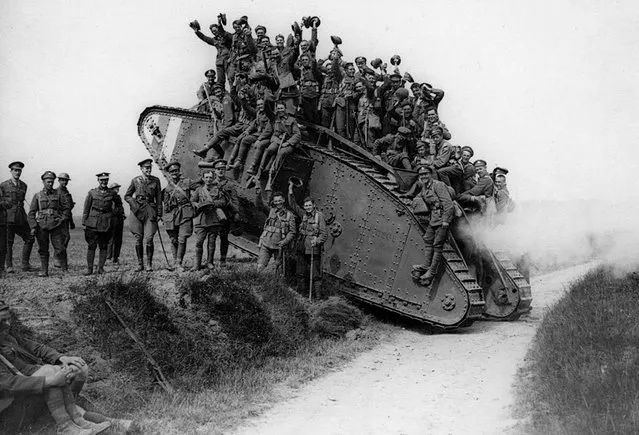
These black-and-white photos are taken from the new book “Armoured Warfare in the First World War 1916 – 1918” by Anthony Tucker-Jones and published by Pen & Sword Military. “Interestingly the British, French and Germans took completely different approaches with varying results”. The British military produced “Little Willie” in Autumn 1915 weighing 18 tonnes, which had a crew of two plus four gunners. “Inspired by a tracked artillery tractor “Little Willie” was referred to as a water tank – hence the name tank – to ensure secrecy”, said Anthony. “This led to the strange looking Mark I with its peculiar rhomboid shape, designed to cross trenches with guns in sponsons on either side. The Germans saw the tank as unchivalrous and were slow to grasp its utility. They favoured the Stormtrooper (specialist soldiers used to infiltrate enemy trenches) and artillery, not the tank”, said Anthony. “However, they didn’t hesitate to make use of captured British tanks. Although the tank helped secure victory and German soldiers dubbed it “Germany’s Downfall” the country was ultimately brought to its knees by the Allies blockade”. Here: British troops hitch a ride on a Mark IV after the massed tank fleet spearheading attack at Cambrai on November 20, 1917. (Photo by Anthony Tucker-Jones/Mediadrumworld.com)

These black-and-white photos are taken from the new book “Armoured Warfare in the First World War 1916 – 1918” by Anthony Tucker-Jones and published by Pen & Sword Military. Here: British troops hitch a ride on a Mark IV after the massed tank fleet spearheading attack at Cambrai on November 20, 1917. (Photo by Anthony Tucker-Jones/Mediadrumworld.com)
Details
23 Feb 2017 00:02:00
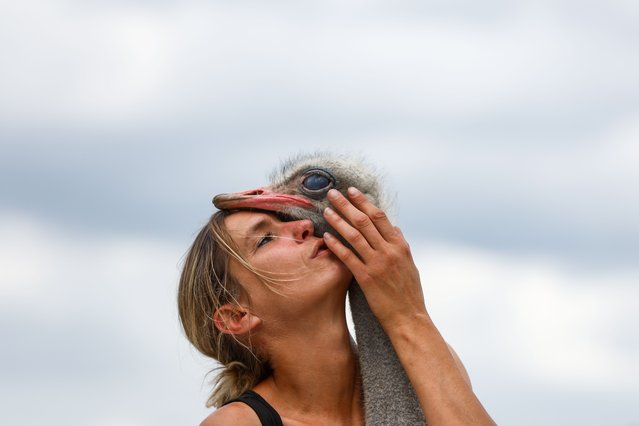
Wendy Adriaens, owner of animal rescue farm “De Passiehoeve” and nicknamed the Ostrich Whisperer, poses for a photo with three-year-old male ostrich Flodder, in Kalmthout, Belgium, 25 July 2022. Flodder and Wendy were separated for seven months since Wendy moved to a bigger farm in January. Flodder spent the seven months at another farm in order to ease the tension between the two ostriches Flodder and Blue who were fighting to the death and had to be separated. Wendy Adriaens has been taking in all kinds of animals that have been mistreated or neglected for some four years at her farm located in the Province of Antwerp. She lives mainly from donations from people who have known her via social networks. An entrance fee to the farm is requested if visitors want to spend some time there. This makes it possible to buy the necessary for the convalescence of the animals. (Photo by Stephanie Lecocq/EPA/EFE/Rex Features/Shutterstock)

Wendy Adriaens, owner of animal rescue farm “De Passiehoeve” and nicknamed the Ostrich Whisperer, poses for a photo with three-year-old male ostrich Flodder, in Kalmthout, Belgium, 25 July 2022. (Photo by Stephanie Lecocq/EPA/EFE/Rex Features/Shutterstock)
Details
31 Jul 2022 06:16:00
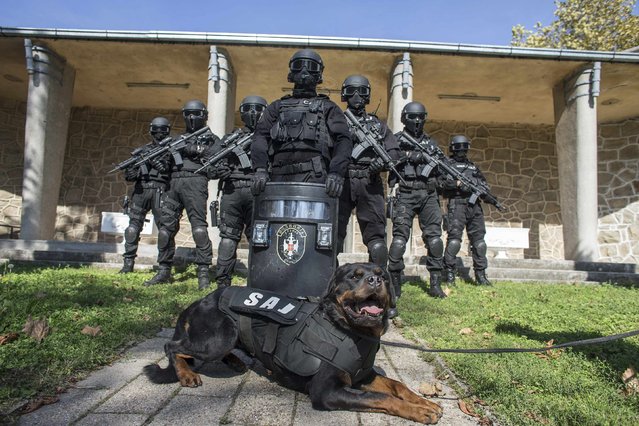
Serbian police officers of the Special Anti-Terrorist Unit pose for a picture in their base outside Belgrade October 8, 2014. (Photo by Marko Djurica/Reuters)

Serbian police officers of the Special Anti-Terrorist Unit pose for a picture in their base outside Belgrade October 8, 2014. When the killing of an unarmed black teenager by a white policeman in Ferguson, Missouri, in August sparked sometimes violent protests, the response of police in camouflage gear and armoured vehicles wielding stun grenades and assault rifles seemed more like a combat operation than a public order measure. Some U.S. police departments have recently acquired U.S. military-surplus hardware from wars abroad, but there are many law enforcers around the world whose rules of engagement also allow the use of lethal force with relatively few restrictions. But for every regulation that gives police wide scope to use firearms, there is another code that sharply limits their use. In Serbia, police may use measures ranging from batons to special vehicles, water cannon and tear gas on groups of people who have gathered illegally and are behaving in a way that is violent or could cause violence, but they may use firearms only when life is endangered. (Photo by Marko Djurica/Reuters)
Details
27 Nov 2014 14:53:00
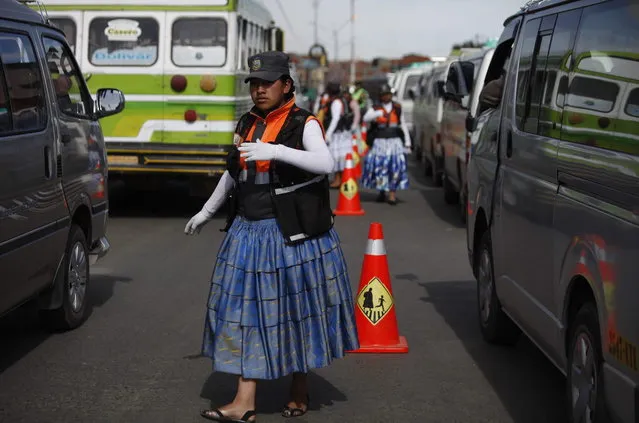
In this December 3, 2013 photo, an Aymara woman cops directs traffic on the streets of El Alto, Bolivia. The women wear the bright petticoats and shawls of indigenous women in the Andes, called cholitas in Bolivian slang, the main difference being that instead of bowler hats they wear khaki green police-style caps. Some don fluorescent traffic vests. (Photo by Juan Karita/AP Photo)

“This city in Bolivia's highlands has hired Aymara women dressed in traditional multilayered Andean skirts and brightly embroidered vests to work as traffic cops and bring order to its road chaos. About 20 of the “traffic cholitas” have been trained to direct cars and buses in El Alto, a teeming, impoverished sister city of La Paz in Bolivia's Andes mountains”. – El Alto via Associated Press. Photo: In this December 3, 2013 photo, an Aymara woman cops directs traffic on the streets of El Alto, Bolivia. The women wear the bright petticoats and shawls of indigenous women in the Andes, called cholitas in Bolivian slang, the main difference being that instead of bowler hats they wear khaki green police-style caps. Some don fluorescent traffic vests. (Photo by Juan Karita/AP Photo)
Details
25 Dec 2013 10:48:00
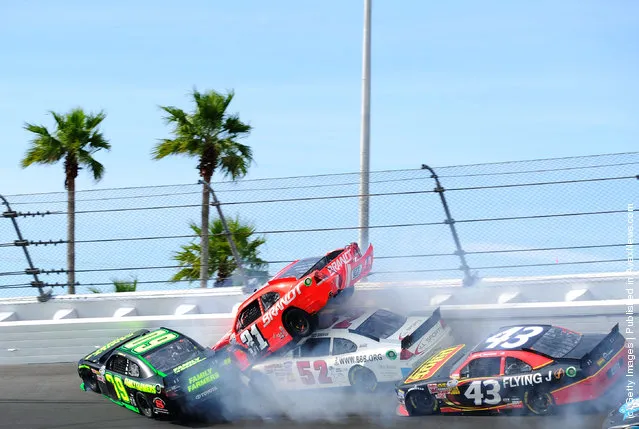
Kenny Wallace, driver of the #09 Family Farmers Toyota, spins into Justin Allgaier, driver of the #31 Brandt Chevrolet, who is lifted into the air by Reed Sorenson, driver of the #52 Means Racing Chevrolet, as Michael Annett, driver of the #43 Pilot Flying J Ford, tries to avoid the wreckage during the NASCAR Nationwide Series DRIVE4COPD 300 at Daytona International Speedway

Kenny Wallace, driver of the #09 Family Farmers Toyota, spins into Justin Allgaier, driver of the #31 Brandt Chevrolet, who is lifted into the air by Reed Sorenson, driver of the #52 Means Racing Chevrolet, as Michael Annett, driver of the #43 Pilot Flying J. Ford, tries to avoid the wreckage during the NASCAR Nationwide Series DRIVE4COPD 300 at Daytona International Speedway on February 25, 2012 in Daytona Beach, Florida. (Photo by John Harrelson/Getty Images for NASCAR)
Details
26 Feb 2012 11:42:00
Competitors release their hens during the World Championship Hen Racing Championships in Bonsall, Britain August 1, 2015. (Photo by Darren Staples/Reuters)

Competitors release their hens during the World Championship Hen Racing Championships in Bonsall, Britain August 1, 2015. (Photo by Darren Staples/Reuters)
Details
02 Aug 2015 13:16:00
Journalists practice social distancing outside a meeting to wrap up work on coronavirus economic aid legislation to prevent the spread of coronavirus disease (COVID-19) in Washington, U.S., March 21, 2020. (Photo by Mary F. Calvert/Reuters)

Journalists practice social distancing outside a meeting to wrap up work on coronavirus economic aid legislation to prevent the spread of coronavirus disease (COVID-19) in Washington, U.S., March 21, 2020. (Photo by Mary F. Calvert/Reuters)
Details
27 Mar 2020 00:01:00
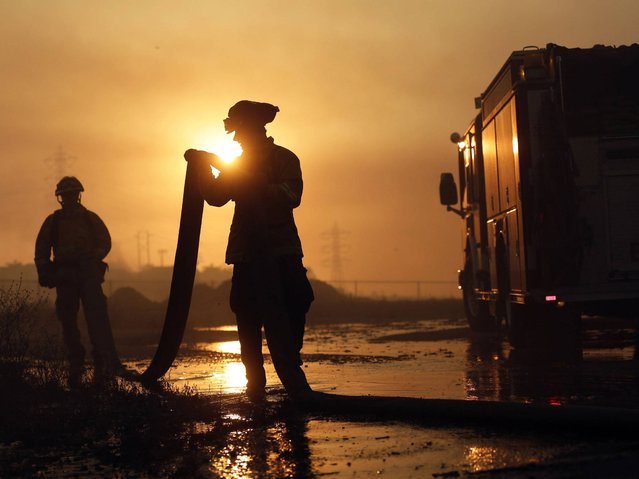
Del Mar firefighters roll up hose after a day fighting wildfires Wednesday, May 14, 2014, in Carlsbad, Calif. More wildfires broke out Wednesday in San Diego County, threatening homes in Carlsbad and forcing the evacuations of military housing and an elementary school at Camp Pendleton. (Photo by AP Photo)

Del Mar firefighters roll up hose after a day fighting wildfires Wednesday, May 14, 2014, in Carlsbad, Calif. More wildfires broke out Wednesday in San Diego County, threatening homes in Carlsbad and forcing the evacuations of military housing and an elementary school at Camp Pendleton. (Photo by AP Photo)
Details
19 May 2014 09:29:00