Loading...
Done
Palestinian plain-clothed security officers detain a man during a demonstration in the city of Ramallah in the occupied West Bank, on June 26, 2021, to protest the death of human rights activist Nizar Banat while in the custody of Palestinian Authority (PA) security forces. Thousands of mourners attended on June 25 the funeral of the 43-year-old Banat, a day after he died in custody following his violent arrest by Palestinian security forces, which sparked outrage in the occupied West Bank. He was known for social media videos denouncing alleged corruption within the PA. (Photo by Ahmad Gharabli/AFP Photo)

Palestinian plain-clothed security officers detain a man during a demonstration in the city of Ramallah in the occupied West Bank, on June 26, 2021, to protest the death of human rights activist Nizar Banat while in the custody of Palestinian Authority (PA) security forces. Thousands of mourners attended on June 25 the funeral of the 43-year-old Banat, a day after he died in custody following his violent arrest by Palestinian security forces, which sparked outrage in the occupied West Bank. He was known for social media videos denouncing alleged corruption within the PA. (Photo by Ahmad Gharabli/AFP Photo)
Details
08 Jul 2021 10:22:00
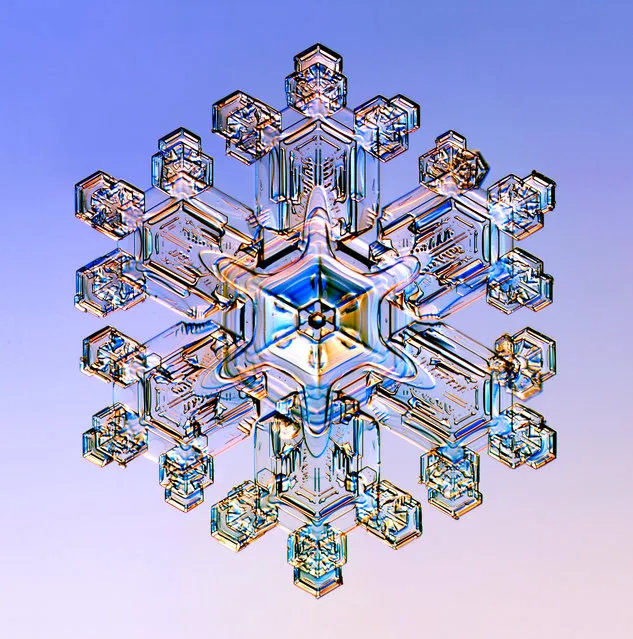
Nikon Small World Photomicrography Competition 2012. Honorable Mention. “Snow crystal, illuminated with colored lights (5x)”. (Photo by Dr. Kenneth Libbrecht, California Institute of Technology (Caltech), Department of Physics, Pasadena, California, USA)

Most people know Nikon as a purveyor of pro and consumer-grade digital cameras. But the company's expertise with optics bleeds over into related markets – it's one of the science community's major suppliers of microscopes. And each year the company asks the community to send it some of their favorite images of tiny objects. A panel of scientists and journalists have chosen the best of this past year's submissions, which Nikon has placed on its Small World site.

Photo: Honorable Mention. “Snow crystal, illuminated with colored lights (5x)”. (Photo by Dr. Kenneth Libbrecht, California Institute of Technology (Caltech), Department of Physics, Pasadena, California, USA)
Details
25 Oct 2012 13:49:00
Scientists say that a “Martian flower”, seen here in an image from the Curiosity rover's Mars Hand Lens Imager, is a 2-millimeter-wide grain or pebble that's embedded in the surrounding rock. Another, darker-colored mineral grain can be seen above and to the left. (Photo by NASA)

“The scientists behind NASA's $2.5 billion Curiosity rover mission on Mars on Tuesday explained the nature of a tiny, gleaming "flower" embedded in Red Planet rock, and revealed where they'll be using the SUV-sized robot's drill for the first time”. – Alan Boyle via NBCNews.com

Photo: Scientists say that a “Martian flower”, seen here in an image from the Curiosity rover's Mars Hand Lens Imager, is a 2-millimeter-wide grain or pebble that's embedded in the surrounding rock. Another, darker-colored mineral grain can be seen above and to the left. (Photo by NASA)
Details
16 Jan 2013 11:12:00
A Sorb egg painter decorates an Easter egg while using bent spoons full of melted wax as coloring at the annual Easter egg market on March 16, 2013 in Schleife, Germany. Easter is a particularly important time of year for Sorbs, a Slavic minority in eastern Germany, and the period includes the tradition of painting Easter eggs that include visual elements intended to ward off evil. Many Sorbs still speak Sorbian, a language closely related to Polish and Czech.  (Photo by Adam Berry)

A Sorb egg painter decorates an Easter egg while using bent spoons full of melted wax as coloring at the annual Easter egg market on March 16, 2013 in Schleife, Germany. Easter is a particularly important time of year for Sorbs, a Slavic minority in eastern Germany, and the period includes the tradition of painting Easter eggs that include visual elements intended to ward off evil. Many Sorbs still speak Sorbian, a language closely related to Polish and Czech. (Photo by Adam Berry)
Details
19 Mar 2013 06:41:00
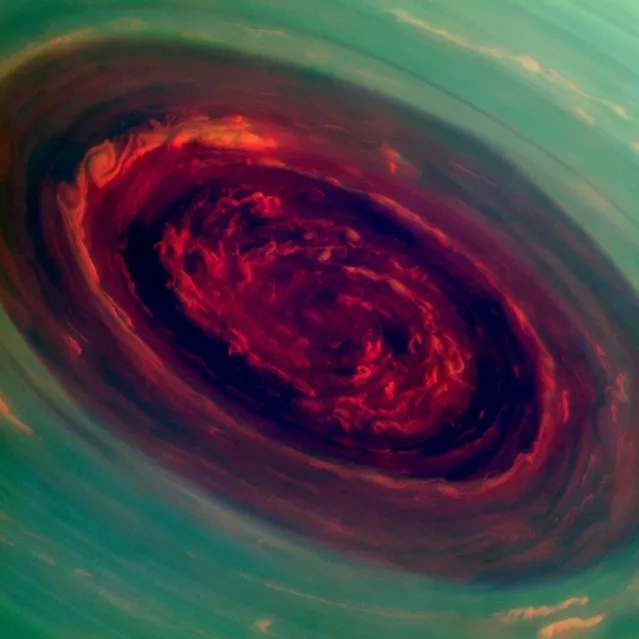
The spinning vortex of Saturn's north polar storm resembles a deep red rose of giant proportions surrounded by green foliage in this false-color image from NASA's Cassini spacecraft. (Photo by NASA/JPL-Caltech/SSI)

NASA's Cassini spacecraft has provided scientists the first close-up, visible-light views of a behemoth hurricane swirling around Saturn's north pole. In high-resolution pictures and video, scientists see the hurricane's eye is about 1,250 miles (2,000 kilometers) wide, 20 times larger than the average hurricane eye on Earth. Thin, bright clouds at the outer edge of the hurricane are traveling 330 mph(150 meters per second). The hurricane swirls inside a large, mysterious, six-sided weather pattern known as the hexagon. Photo: The spinning vortex of Saturn's north polar storm resembles a deep red rose of giant proportions surrounded by green foliage in this false-color image from NASA's Cassini spacecraft. (Photo by NASA/JPL-Caltech/SSI)
Details
31 May 2015 09:11:00
A young performer cries as she parades during the Bun Festival on Cheung Chau island in Hong Kong Tuesday, May 6, 2014. Bun Festival, the Taoist God of the Sea, is worshipped and evil spirits are believed to be scared away by loud gongs and drums during the procession. The celebration includes bun scrambling, parades, opera performances, and children dressed in colorful costumes. (Photo by Kin Cheung/AP Photo)

A young performer cries as she parades during the Bun Festival on Cheung Chau island in Hong Kong Tuesday, May 6, 2014. Bun Festival, the Taoist God of the Sea, is worshipped and evil spirits are believed to be scared away by loud gongs and drums during the procession. The celebration includes bun scrambling, parades, opera performances, and children dressed in colorful costumes. (Photo by Kin Cheung/AP Photo)
Details
08 May 2014 07:31:00
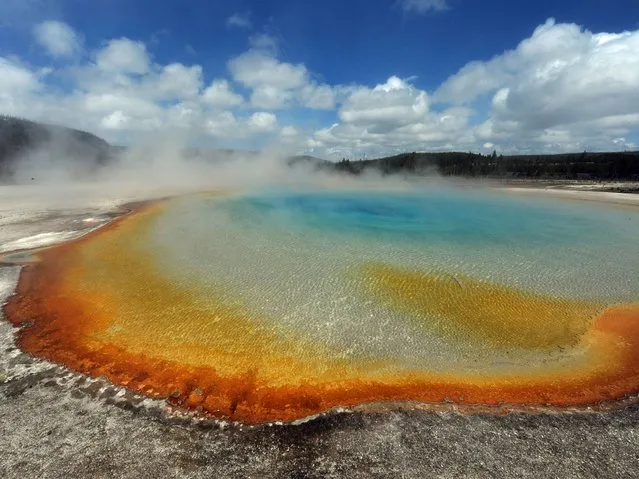
View of the “Sunset Lake” hot spring with it's unique colors caused by brown, orange and yellow algae-like bacteria called Thermophiles, that thrive in the cooling water turning the vivid aqua-blues to a murkier greenish brown, in the Yellowstone National Park, Wyoming on June 1, 2011. (Photo by Mark Ralston/AFP Photo)

View of the “Sunset Lake” hot spring with it's unique colors caused by brown, orange and yellow algae-like bacteria called Thermophiles, that thrive in the cooling water turning the vivid aqua-blues to a murkier greenish brown, in the Yellowstone National Park, Wyoming on June 1, 2011. Yellowstone National Park, was established by the U.S. Congress and signed into law by President Grant on March 1, 1872. The park is located primarily in the U.S. state of Wyoming, though it also extends into Montana and Idaho and was the first national park in the world. It is known for its wildlife and its many geothermal features, especially the Old Faithful Geyser. (Photo by Mark Ralston/AFP Photo)
Details
06 Apr 2014 08:02:00
In this January 29, 2017 photo, musicians perform for dancers on the shores of Lake Titicaca, as they practice before their presentation for the Virgin of Candelaria celebrations in Puno, Peru. Dancers in colorful masks and elaborate costume celebrate the Virgin of Candelaria, patron saint of communities along the shore of Lake Titicaca, in what's considered the largest Catholic festival in the Andes. (Photo by Rodrigo Abd/AP Photo)

In this January 29, 2017 photo, musicians perform for dancers on the shores of Lake Titicaca, as they practice before their presentation for the Virgin of Candelaria celebrations in Puno, Peru. Dancers in colorful masks and elaborate costume celebrate the Virgin of Candelaria, patron saint of communities along the shore of Lake Titicaca, in what's considered the largest Catholic festival in the Andes. (Photo by Rodrigo Abd/AP Photo)
Details
03 Feb 2017 06:50:00