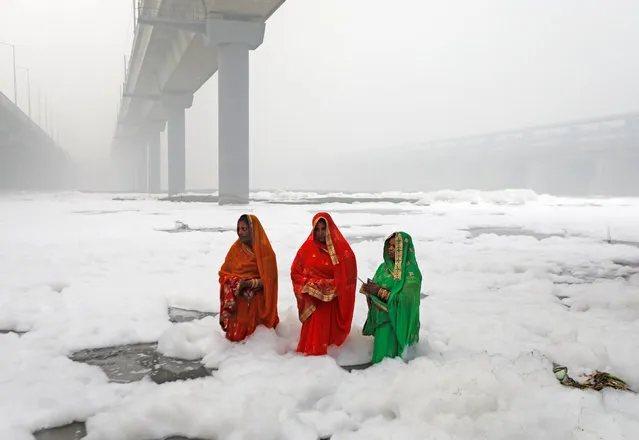
Hindu women worship the Sun god in the polluted waters of the river Yamuna during the Hindu religious festival of Chatth Puja in New Delhi, India, November 3, 2019. (Photo by Adnan Abidi/Reuters)
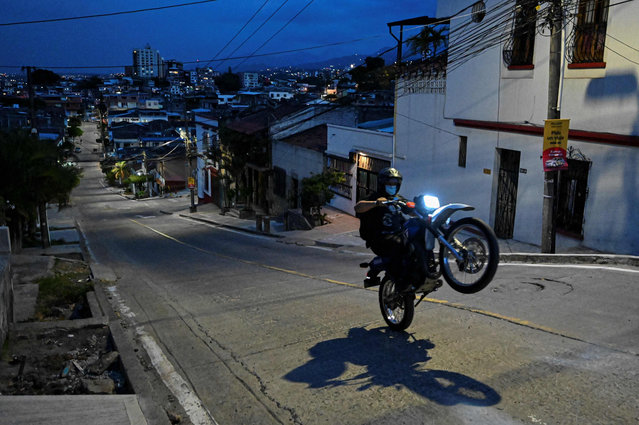
A man rides his motorcycle along an empty street in Cali on April 17, 2021, during a curfew imposed by the government to help curb infections of the novel coronavirus, COVID-19, as weekend partial lockdown takes effect in four Colombian cities. In recent weeks, the Colombian government has imposed, and then tightened, a series of restrictions to stem a third wave of infections that is bringing its health system to the brink of collapse. (Photo by Luis Robayo/AFP Photo)
Visitors take photos of the fluorescent sea in the waters of Paishi Village, Dalian City, Liaoning Province, China, May 24, 2020, from the night of May 24 to the early morning of May 25, 2020. The fluorescent sea in dalian is caused by noctilucent algae in the sea water. (Photo by Costfoto/Barcroft Media via Getty Images)
Meri Nirmala Sari, 11, poses in her traditional costume before a performance August 6, 2002 in Ubud, Bali, Indonesia. Meri dances with the Gunung Sari Peliatan dance group and has become a professional. She started dancing at age 5. (Photo by Paula Bronstein/Getty Images)
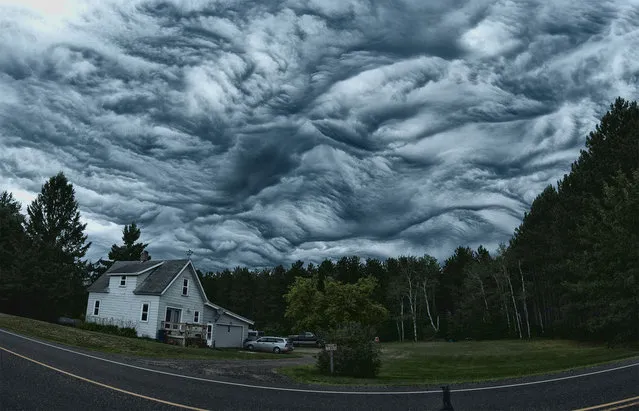
Undulatus asperatus (or alternately, asperatus) is a cloud formation, proposed in 2009 as a separate cloud classification by the founder of the Cloud Appreciation Society. If successful it will be the first cloud formation added since cirrus intortus in 1951 to the International Cloud Atlas of the World Meteorological Organization. The name translates approximately as “roughened or agitated waves”.
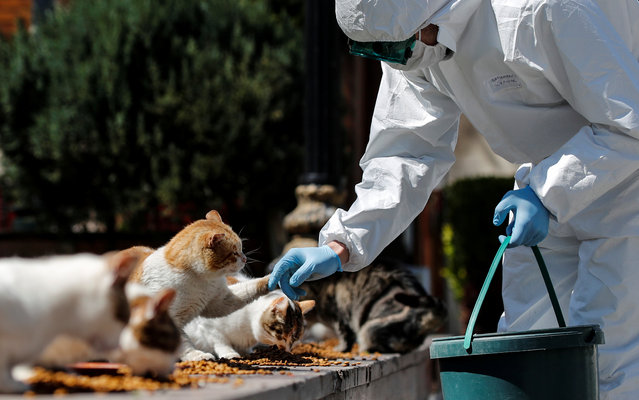
A municipality worker in a protective suit feeds street cats at Sultanahmet Square, as the spread of coronavirus disease (COVID-19) continues in Istanbul, Turkey, April 9, 2020. (Photo by Umit Bektas/Reuters)