Loading...
Done
Fishermen carry calabashes to attend Argungu fishing and cultural festival at Argungu Town, Kebbi State in northwestern Nigeria, on March 14, 2020. Argungu fishing and cultural festival is one of the oldest and most widely attended festivals in the country dating back many generations, featuring series of water competitions and traditional games. The festival returned after 10 years suspension due to insecurity in northwest Nigeria. (Photo by Pius Utomi Ekpei/AFP Photo)

Fishermen carry calabashes to attend Argungu fishing and cultural festival at Argungu Town, Kebbi State in northwestern Nigeria, on March 14, 2020. Argungu fishing and cultural festival is one of the oldest and most widely attended festivals in the country dating back many generations, featuring series of water competitions and traditional games. The festival returned after 10 years suspension due to insecurity in northwest Nigeria. (Photo by Pius Utomi Ekpei/AFP Photo)
Details
17 Mar 2020 00:01:00


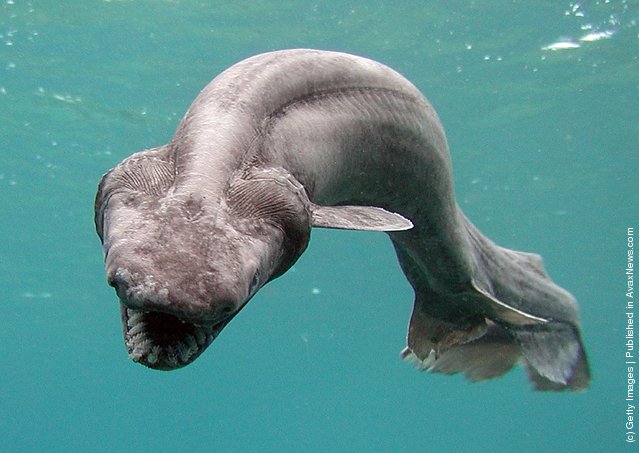
“The frilled shark (Chlamydoselachus anguineus) is one of two extant species of shark in the family Chlamydoselachidae, with a wide but patchy distribution in the Atlantic and Pacific Oceans. This uncommon species is found over the outer continental shelf and upper continental slope, generally near the bottom though there is evidence of substantial upward movements. It has been caught as deep as 1,570 m (5,150 ft), whereas in Suruga Bay, Japan it is most common at depths of 50–200 m (160–660 ft). Exhibiting several “primitive” features, the frilled shark has often been termed a «living fossil»”. – Wikipedia

Photo: A 1.6 meter long Frill shark swims in a tank after being found by a fisherman at a bay in Numazu, on January 21, 2007 in Numazu, Japan. The frill shark, also known as a Frilled shark usually lives in waters of a depth of 600 meters and so it is very rare that this shark is found alive at sea-level. It's body shape and the number of gill are similar to fossils of sharks which lived 350,000,000 years ago. (Photo by Awashima Marine Park/Getty Images)

Details
05 May 2011 10:01:00


“The Lovell Telescope is a radio telescope at Jodrell Bank Observatory, near Goostrey, Cheshire in the north-west of England. When it was constructed in 1955, the telescope was the largest steerable dish radio telescope in the world at 76.2 m (250 ft) in diameter; it is now the third largest, after the Green Bank telescope in West Virginia, USA, and the Effelsberg telescope in Germany. It was originally known as the 250 ft (76 m) telescope or the Radio Telescope at Jodrell Bank, before becoming the Mark I telescope around 1961 when future telescopes (the Mark II, III, and IV) were being discussed. It was renamed to the Lovell Telescope in 1987 after Bernard Lovell, and became a Grade I listed building in 1988. The telescope forms part of the MERLIN and European VLBI Network arrays of radio telescopes”. – Wikipedia

Photo: The Lovell Telescope listens to the night sky for radio signals from space at Jodrell Bank on June 22, 2011 in Holmes Chapel, England. Jodrell Bank Centre for Astrophysics and it's world famous Lovell Telescope is on the shortlist of Britain's submission for Unesco World Heritage Site status. (Photo by Christopher Furlong/Getty Images)
Details
24 Jun 2011 09:34:00
A driver competes in his tractor during the Tractor Pulling Euro Championships in the western German town of Fuechtorf September 9, 2012. Eighty teams from across Europe participated in the two-day competition where high-powered tractor prototypes must pull a trailer down a 100-metre (328 ft) track as far as possible. (Photo by Ina Fassbender/Reuters)

A driver competes in his tractor during the Tractor Pulling Euro Championships in the western German town of Fuechtorf September 9, 2012. Eighty teams from across Europe participated in the two-day competition where high-powered tractor prototypes must pull a trailer down a 100-metre (328 ft) track as far as possible. (Photo by Ina Fassbender/Reuters)
Details
22 Jul 2013 08:50:00
Members of the “Exit Point” amateur rope-jumping group stage a performance as they jump from a 44-metre high (144-ft) waterpipe bridge in the Siberian Taiga area outside Krasnoyarsk, November 3, 2013. Fans of rope-jumping, a kind of extreme sport involving a jump from a high point using an advanced leverage system combining mountaineering and rope safety equipment, marked the end of the group's jumping season and recent Halloween festivities. (Photo by Ilya Naymushin/Reuters)

Members of the “Exit Point” amateur rope-jumping group stage a performance as they jump from a 44-metre high (144-ft) waterpipe bridge in the Siberian Taiga area outside Krasnoyarsk, November 3, 2013. Fans of rope-jumping, a kind of extreme sport involving a jump from a high point using an advanced leverage system combining mountaineering and rope safety equipment, marked the end of the group's jumping season and recent Halloween festivities. (Photo by Ilya Naymushin/Reuters)
Details
09 Nov 2013 12:37:00
Daniel Sheridan, a council worker from Poole, Dorset, runs a side hustle snapping dogs living their best lives in the second decade of December 2024. (Photo by Daniel Sheridan/South West News Service)

Daniel Sheridan, a council worker from Poole, Dorset, runs a side hustle snapping dogs living their best lives in the second decade of December 2024. (Photo by Daniel Sheridan/South West News Service)
Details
29 Dec 2024 01:36:00
South African singer and songwriter Tyla poses with the award for Best Afrobeats for “Water” during the 2024 MTV Video Music Awards in Elmont, New York, U.S., September 11, 2024. (Photo by Andrew Kelly/Reuters)

South African singer and songwriter Tyla poses with the award for Best Afrobeats for “Water” during the 2024 MTV Video Music Awards in Elmont, New York, U.S., September 11, 2024. (Photo by Andrew Kelly/Reuters)
Details
20 Sep 2024 00:28:00
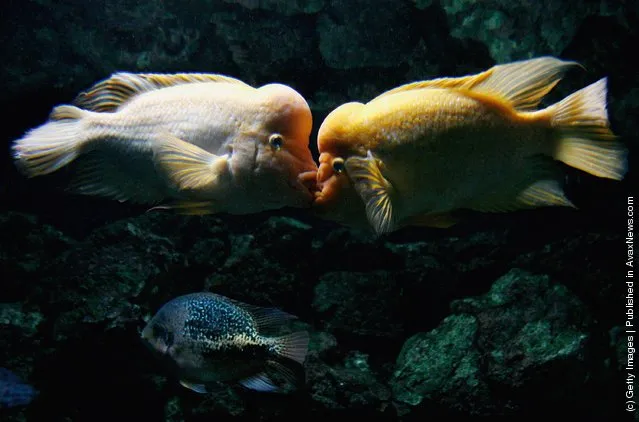
Midas Cichlid a.k.a. Amphilophus Citrinellus

“Amphilophus citrinellus is a large cichlid fish endemic to the San Juan River and adjacent watersheds in Costa Rica and Nicaragua. In the aquarium trade A. citrinellus is often sold under the trade name of Midas cichlid. A. citrinellus are omnivorous and their diet consists of plant material, molluscs and smaller fish”. – Wikipedia

Photo: Two Midas Cichlid (lat: amphilophus citrinellus) fish are seen in an aquarium at Hellabrunn zoo on December 23, 2009 in Munich, Germany. (Photo by Alexandra Beier/Getty Images)
Details
17 Aug 2011 11:29:00