Loading...
Done
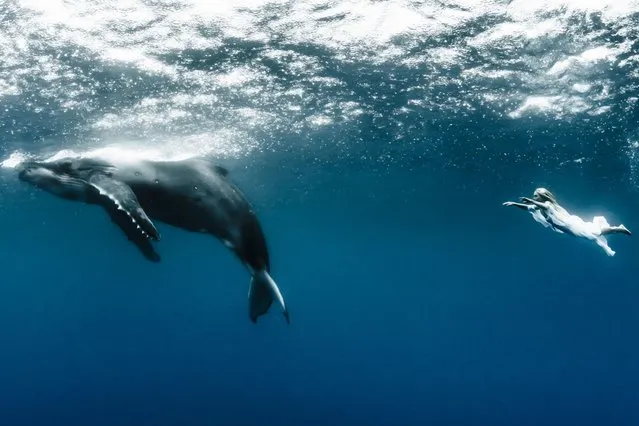
“In this startling image model Hannah Fraser appears to be “dancing” with the giant whale ”. (Photo by Shawn Heinrichs/Barcroft Media)

“Emmy” award-winning cinematographer, Shawn Heinrichs teamed up with model and diver Hannah Fraser to carry out a unique underwater conservation fashion shoot in a remote location in the South Pacific Ocean. The pair are aiming to raise awareness for the plight of the marine mammals at the hands of whalers. During the ten day shoot Fraser swam and glided with pilot and humpback whales. Photo: “In this startling image model Hannah Fraser appears to be “dancing” with the giant whale ”. (Photo by Shawn Heinrichs/Barcroft Media)
Details
12 Jun 2015 09:05:00
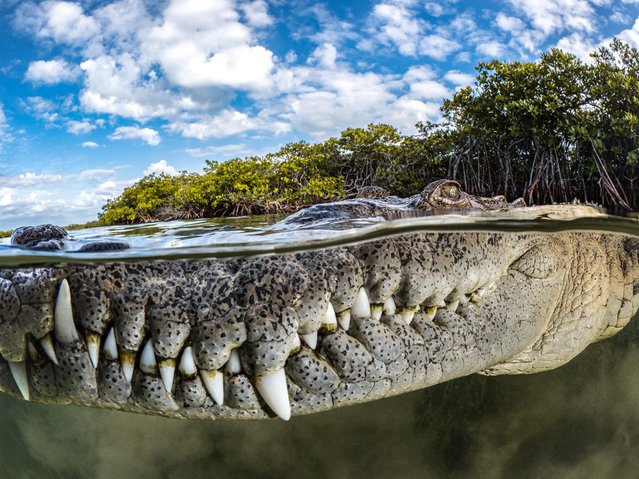
Guardian of the Mangroves – Overall Winner. Tanya Houppermans, Cuba. A curious American crocodile (Crocodylus acutus) swims right up to Tanya, at Gardens of the Queen (Jardines De La Reina), an archipelago off the coast of Cuba. It has been strictly protected since 1996, and is one of the most untouched marine ecosystems in the world. ‍ “The healthy population of American crocodiles is down to the pristine condition of the mangroves and I wanted to capture close ups of this gentle giant in its natural habitat. I hope this image can illustrate that protecting areas like this is so critical”. (Photo by Tanya Griffin Houppermans/Mangrove Photographer of the Year)

Guardian of the Mangroves – Overall Winner. Tanya Houppermans, Cuba. A curious American crocodile (Crocodylus acutus) swims right up to Tanya, at Gardens of the Queen (Jardines De La Reina), an archipelago off the coast of Cuba. It has been strictly protected since 1996, and is one of the most untouched marine ecosystems in the world. ‍ “The healthy population of American crocodiles is down to the pristine condition of the mangroves and I wanted to capture close ups of this gentle giant in its natural habitat. I hope this image can illustrate that protecting areas like this is so critical”. (Photo by Tanya Griffin Houppermans/Mangrove Photographer of the Year)
Details
05 Nov 2022 04:24:00
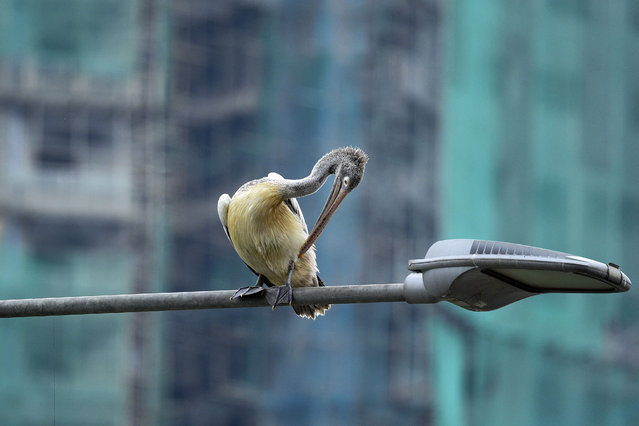
A spot-billed pelican sits on a street light in Colombo on March 16, 2021. (Photo by Ishara S. Kodikara/AFP Photo)

A spot-billed pelican sits on a street light in Colombo on March 16, 2021. (Photo by Ishara S. Kodikara/AFP Photo)
Details
10 Jun 2021 08:11:00
Lance Cpl. Blas Trevino of the 1st Battalion, 5th Marines, shouts out as he is rescued on a medevac helicopter from the U.S. Army's Task Force Lift “Dust Off”, Charlie Company 1-214 Aviation Regiment after he got shot in the stomach outside Sangin, in the Helmand Province of southern Afghanistan on June 11, 2011. The Army's 'Dust Off' crew needed two attempts to get him out, as they were fired upon and took five rounds of bullets into the tail of their aircraft. (Photo by Anja Niedringhaus/AP Photo/File)

Lance Cpl. Blas Trevino of the 1st Battalion, 5th Marines, shouts out as he is rescued on a medevac helicopter from the U.S. Army's Task Force Lift “Dust Off”, Charlie Company 1-214 Aviation Regiment after he got shot in the stomach outside Sangin, in the Helmand Province of southern Afghanistan on June 11, 2011. The Army's 'Dust Off' crew needed two attempts to get him out, as they were fired upon and took five rounds of bullets into the tail of their aircraft. (Photo by Anja Niedringhaus/AP Photo/File)
Details
17 May 2021 07:36:00
Gemma, right, and Joanne in their home in Angeles City. (Photo by Hannah Reyes Morales/The Washington Post)

Typhoon Yolanda – also known as Haiyan – struck the central part of the country November 8, 2013, leaving at least 6,300 people dead and over four million displaced. A month after Typhoon Haiyan, the United Nations Population Fund estimates that 5,000 women were subjected to sеxual violence. A study by the Health and Human Rights online publication shows the majority of young girls and women in Manila’s sеx industry come from poverty-stricken areas – such as Leyte, Samar, Cebu and southern Mindanao – and enter trafficking through force, deception, economic desperation and psychological manipulation. (Photo by Hannah Reyes Morales/The Washington Post)
Details
01 May 2017 09:59:00
Use SMILEX!

Use SMILEX! (Photo by Pawel Wewiorski)
Details
01 Oct 2012 12:14:00
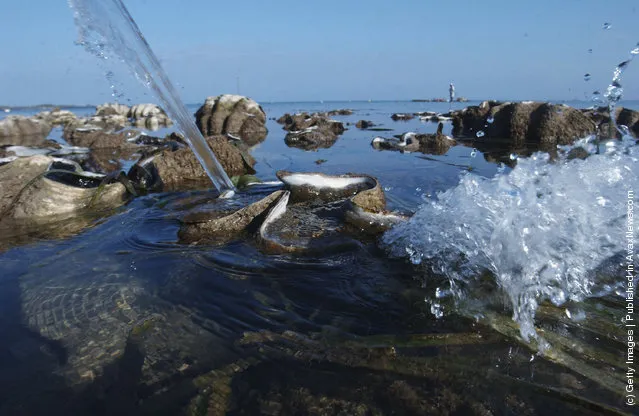
Tridacna Gigas, or Giant Clams

“The giant clam, Tridacna gigas (known as pā’ua in Cook Islands Māori), is the largest living bivalve mollusc. T. gigas is one of the most endangered clam species. It was mentioned as early as 1825 in scientific reports. One of a number of large clam species native to the shallow coral reefs of the South Pacific and Indian oceans, they can weigh more than 200 kilograms (440 lb) measure as much as 120 cm (47 in) across, and have an average lifespan in the wild of 100 years or more”. – Wikipedia

Photo: Tridacna Gigas, or Giant Clams spew water as a traditional fisherman passes by a small sanctuary on January 23, 2004 near Bolinao in the Northern Philippines. The clams, prime builders for coral reefs and providing shelter for spawning fish and other marine life, are exposed by low tides in the sanctuary. Overfishing and pollution throughout the country are not only threatening food security, but are also starting to choke one of the few working clam sanctuaries in the world. (Photo by David Greedy/Getty Images)
Details
01 Oct 2011 13:10:00


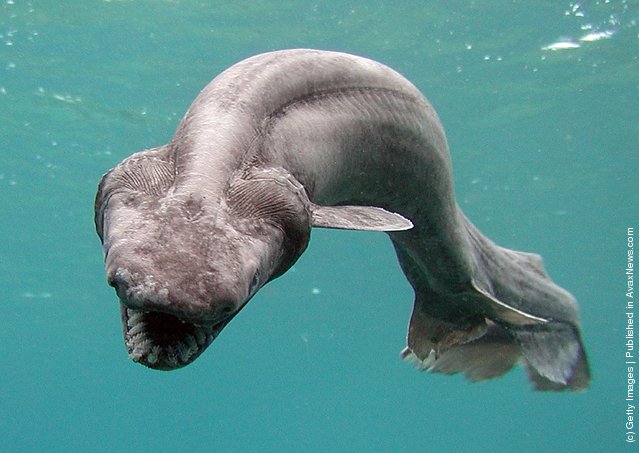
“The frilled shark (Chlamydoselachus anguineus) is one of two extant species of shark in the family Chlamydoselachidae, with a wide but patchy distribution in the Atlantic and Pacific Oceans. This uncommon species is found over the outer continental shelf and upper continental slope, generally near the bottom though there is evidence of substantial upward movements. It has been caught as deep as 1,570 m (5,150 ft), whereas in Suruga Bay, Japan it is most common at depths of 50–200 m (160–660 ft). Exhibiting several “primitive” features, the frilled shark has often been termed a «living fossil»”. – Wikipedia

Photo: A 1.6 meter long Frill shark swims in a tank after being found by a fisherman at a bay in Numazu, on January 21, 2007 in Numazu, Japan. The frill shark, also known as a Frilled shark usually lives in waters of a depth of 600 meters and so it is very rare that this shark is found alive at sea-level. It's body shape and the number of gill are similar to fossils of sharks which lived 350,000,000 years ago. (Photo by Awashima Marine Park/Getty Images)
Details
05 May 2011 10:01:00