Loading...
Done
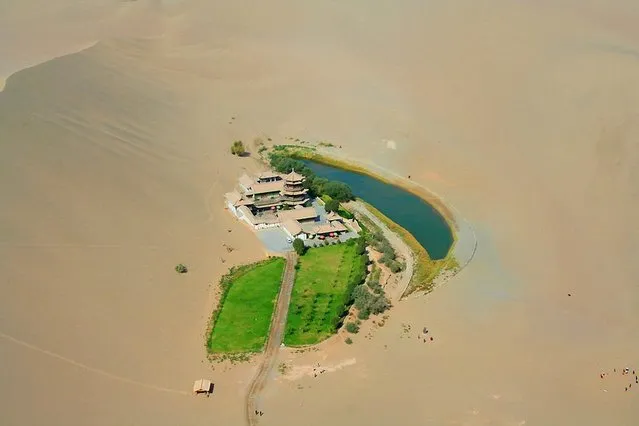
Crescent Lake In China

Yueyaquan is a crescent-shaped lake in an oasis, 6 km south of the city of Dunhuang in Gansu Province, China. It was named Yueyaquan in the Qing Dynasty. According to measurements made in 1960, the average depth of the lake was 4 to 5 meters, with a maximum depth of 7.5 metres In the following 40 years, the depth of the lake continually declined. In the early 1990s, its area had shrunk to only 5,500 m2 with an average depth of 0.9 meter (maximum 1.3 meter). In 2006, the local government with help of the central government started to fill the lake and restore its depth; its depth and size have been growing yearly since then. The lake and the surrounding deserts are very popular with tourists, who are offered camel and 4x4 rides.
Details
25 Jun 2013 10:29:00
A Ukrainian soldier smiles in front of a city sign reading ''I Love Izium'' in Izium, Kharkiv region, Ukraine, Tuesday, September 14, 2022. Ukrainian troops piled pressure on retreating Russian forces pressing deeper into occupied territory and sending more Kremlin troops fleeing ahead of the counteroffensive that has inflicted a stunning blow on Moscow's military prestige. (Photo by Kostiantyn Liberov/AP Photo)

A Ukrainian soldier smiles in front of a city sign reading ''I Love Izium'' in Izium, Kharkiv region, Ukraine, Tuesday, September 14, 2022. Ukrainian troops piled pressure on retreating Russian forces pressing deeper into occupied territory and sending more Kremlin troops fleeing ahead of the counteroffensive that has inflicted a stunning blow on Moscow's military prestige. (Photo by Kostiantyn Liberov/AP Photo)
Details
02 Dec 2023 04:08:00
A pedestrian wearing a face mask to protect against coronavirus, walks in front of a mural, at a metro station in Athens, Greece, Monday, November 15, 2021. Authorities say the rate of death related to COVID-19 in Greece has reached its highest level in six months as roughly one-third of the country's population remains unvaccinated. (Photo by Thanassis Stavrakis/AP Photo)

A pedestrian wearing a face mask to protect against coronavirus, walks in front of a mural, at a metro station in Athens, Greece, Monday, November 15, 2021. Authorities say the rate of death related to COVID-19 in Greece has reached its highest level in six months as roughly one-third of the country's population remains unvaccinated. (Photo by Thanassis Stavrakis/AP Photo)
Details
17 Dec 2021 10:18:00
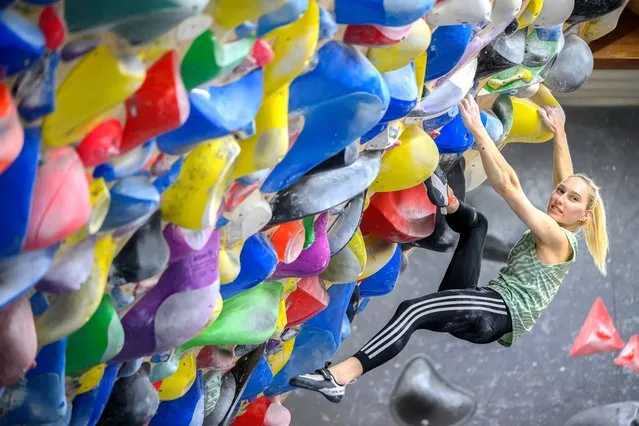
Slovenia’s Janja Garnbret climbs during a training session in Verd, some 20 km southwest of Ljubljana, on March 27, 2024. The eight-time world champion is looking to win another gold medal at the Paris 2024 Olympics Games this summer, just like she did in Tokyo 2020 when the sport debuted at the Olympics. (Photo by Jure Makovec/AFP Photo)

Slovenia’s Janja Garnbret climbs during a training session in Verd, some 20 km southwest of Ljubljana, on March 27, 2024. The eight-time world champion is looking to win another gold medal at the Paris 2024 Olympics Games this summer, just like she did in Tokyo 2020 when the sport debuted at the Olympics. (Photo by Jure Makovec/AFP Photo)
Details
11 Apr 2024 04:28:00
A harp seal pup

“The harp seal or saddleback seal is a species of earless seal native to the northernmost Atlantic Ocean and adjacent parts of the Arctic Ocean. Newborn pups weigh around 11 kilograms (24 lb) and are 80–85 centimetres (31–33 in) long. After birth, the mother only feeds that pup. During the 12 day nursing period, the mother does not eat, losing up to 3 kilograms (7 lb) per day. Harp seal milk contains up to 48% fat, so pups gain over 2.2 kilograms (4.9 lb) per day. During this time, the juvenile's “greycoat” grows in beneath the white neonatal coat, and it weighs 80 pounds (36 kg)”. – Wikipedia

Photo: A harp seal pup lies on an ice floe in the Gulf of Saint Lawrence March 24, 2008 in Charlottetown, Canada. (Photo by Joe Raedle/Getty Images)
Details
19 Sep 2011 15:49:00


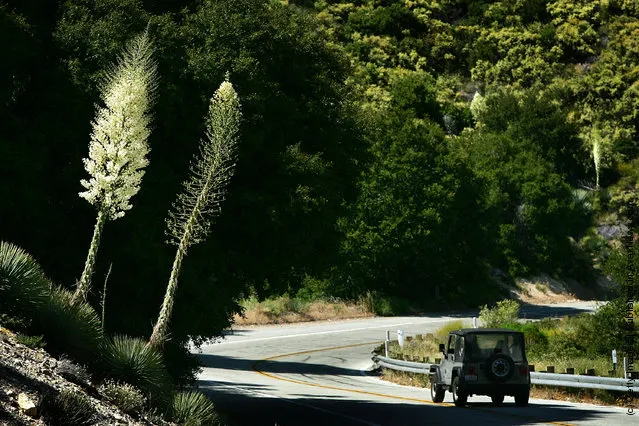
“Yucca is a genus of perennial shrubs and trees in the agave family, Agavaceae. Its 40-50 species are notable for their rosettes of evergreen, tough, sword-shaped leaves and large terminal panicles of white or whitish flowers. They are native to the hot and dry (arid) parts of North America, Central America, South America, and the Caribbean. Early reports of the species were confused with the cassava (Manihot esculenta). Consequently, Linnaeus mistakenly derived the generic name from the Carib word for the latter, yuca. It is also colloquially known in the midwest United States as “Ghosts in the graveyard”, as it is commonly found growing in rural graveyards and when in bloom the flowers appear as an apparition floating.” – Wikipedia

Photo: A yucca standing among flowers bursts forth a very large stalk of flowers as a heavy wildflower bloom on June 21, 2005 in the Angeles National Forest northwest of La Canada, California. (Photo by David McNew/Getty Images)
Details
29 Mar 2011 07:31:00


“A monowheel is a one-wheeled single-track vehicle similar to a unicycle. However, instead of sitting above the wheel, the rider sits either within it or next to it. The wheel is a ring, usually driven by smaller wheels pressing against its inner rim. Most are single-passenger vehicles, though multi-passenger models have been built.

Pedal-powered monowheels were built in the late 19th century; most built in the 20th century have been motorized. Some modern builders refer to these vehicles as monocycles, though that term is also sometimes used to describe motorized unicycles. Today, monowheels are generally built and used for fun and entertainment purposes, though from the 1860s through to the 1930s, they were proposed for use as serious transportation”. – Wikipedia

Photo: Cycle inventor Kerry McLean poses for the photographer 2000 in Walled Lake, Michigan. The “Monocycle” is equipped with a 40-horsepower engine, 4ft tire and is expected to reach speeds upwards of 100 mph. (Photo by Bill Pugliano/Liaison)
Details
02 Jul 2011 12:24:00
Liu Chunxia, a supporter of Xu Zhiyong, one of China's most prominent rights advocates, is detained by policemen while she gathers with other supporters nearby a court where Xu's trial is being held in Beijing January 22, 2014. (Photo by Kim Kyung-Hoon/Reuters)

Liu Chunxia, a supporter of Xu Zhiyong, one of China's most prominent rights advocates, is detained by policemen while she gathers with other supporters nearby a court where Xu's trial is being held in Beijing January 22, 2014. When dozens of activists unfurled banners across the country last March and April calling for officials to disclose their assets, they did so at the urging of one of China's most prominent rights advocates, Xu Zhiyong. Xu, 40, stands trial on Wednesday on a charge of “gathering a crowd to disturb public order” punishable by up to five years in prison. His case will almost certainly spark fresh criticism from Western governments over Beijing's crackdown on dissent. (Photo by Kim Kyung-Hoon/Reuters)
Details
26 Jan 2014 12:26:00