A hummingbird feeds on the nectar from a Mimosa tree in Saugus, Massachusetts on July 30, 2020. (Photo by Joseph Prezioso/ZUMA Wire/Rex Features/Shutterstock)
A Humboldt penguin swims in a pool during the annual stock take at ZSL London Zoo in London, Thursday, January 2, 2020. Caring for more than 500 different species, ZSL London Zoo's keepers face the challenging task of tallying up every animal large and small, every mammal, bird, reptile, fish and invertebrate at the Zoo. (Photo by Frank Augstein/AP Photo)
A common gallinule runs across the water to escape a nearby alligator at Green Cay Nature Center in Boynton Beach, Florida on September 4, 2025. Unlike most waterbirds, gallinules have long toes that allow them to walk on floating vegetation. The species is known for its loud, cackling calls that often echo through wetlands. (Photo by Ronen Tivony/NurPhoto/Rex Features/Shutterstock)
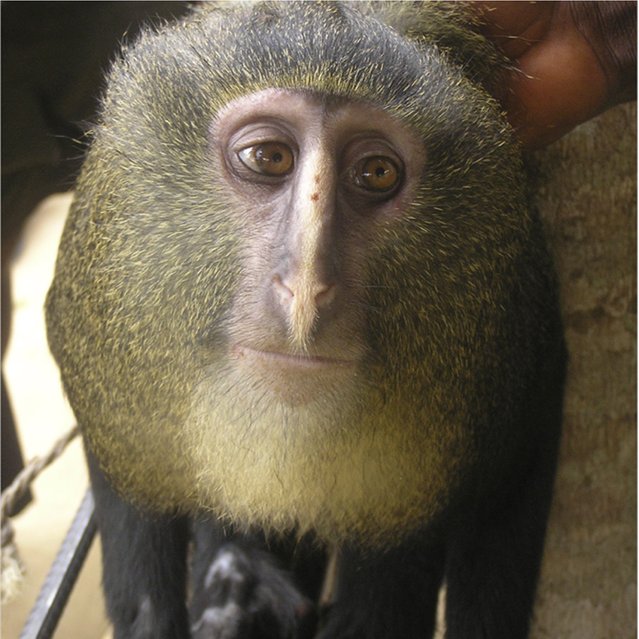
A new species of monkey found in the Democratic Republic of the Congo and identified as Lesula (Cercopithecus lomamiensis) is seen in this undated photograph from an article published September 12, 2012 in the science journal PLOS One. The monkey was first seen in 2007 by researchers John and Terese Hart of the Peabody Museum of Natural History at Yale Research Project. The finding of C. lomamiensis represents only the second new species of African monkey to be discovered in the past 28 years, according to the research article. (Photo by Hart J. A., Detwiler K. M., Gilbert C. C./Reuters)
In this photo released by the Newton Fire department, a juvenile raccoon looks out from a grate after getting stuck in Newton, Massachusetts on August 1, 2019. The fire department was able to rescue the raccoon and free him from the grate. (Photo by HO/Newton Fire Department/AFP Photo)
A girl carries utensils after filling them with water from a pipe that supplies water to trains at a railway station on the outskirts of Agartala, India, February 28, 2017. (Photo by Jayanta Dey/Reuters)
This huge male orangutan is having a right old laugh as he squints his eyes and shows his huge teeth. The orangutan, called Bimbo, was relaxing on a platform around 5m high in his enclosure when he broke out into a laugh. But his happy smile soon disappeared when another orangutan came over to see what was going on. Bimbo – the only male in the group of five apes at Leipzig Zoo, in Germany - appears to be laughing in much the same way as a human would. (Photo by Martina Radtke/Solent News)