Loading...
Done


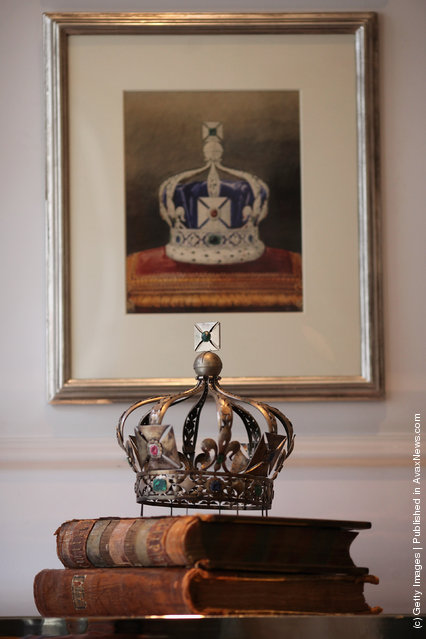
A preparatory model of the Imperial State Crown of India worn in 1911 by King George V stands next to original ledgers dating from 1735 in Garrard's flagship store in Mayfair on April 6, 2011 in London, England. Garrard is the world's oldest jewellers having been founded by George Wickes in 1735 and soon after appointed as goldsmith to the Prince of Wales. For over 160 years Garrard held the title of Crown Jeweller, bestowed by Queen Victoria in 1843, Garrard have served six successive monarchs. They have produced several royal crowns as well as the engagement ring presented to Kate Middleton by Prince William and formerly Princess Diana's engagement ring. (Photo by Oli Scarff/Getty Images)
Details
17 Apr 2011 10:22:00
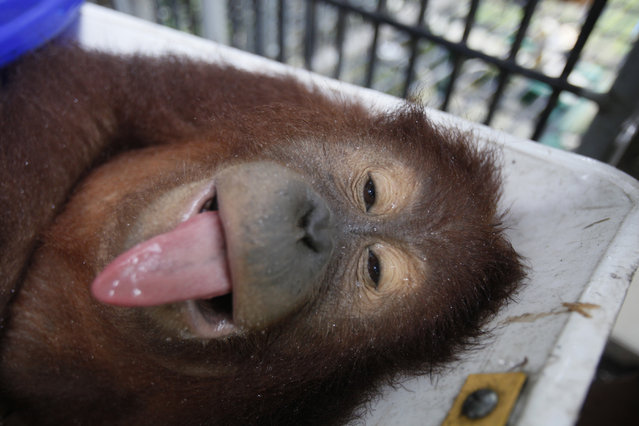
An approximately 8 year-old male orangutan named Siamang reacts under the influence of tranquilizer as it's being prepared to be released into the wild at a rehabilitation center in Kuta Mbelin, North Sumatra, Indonesia, Friday, July 10, 2015. (Photo by Binsar Bakkara/AP Photo)

An approximately 8 year-old male orangutan named Siamang reacts under the influence of tranquilizer as it's being prepared to be released into the wild at a rehabilitation center in Kuta Mbelin, North Sumatra, Indonesia, Friday, July 10, 2015. The orangutans at the center were mostly rescued from palm oil plantations or confiscated from homes where they were kept as pet animals. Orangutan populations in Indonesia's Borneo and Sumatra island are facing severe threats from habitat loss, illegal logging, fires and poaching. Conservationists predicted that without immediate action, orangutans are likely to be the first great ape to become extinct in the wild. (Photo by Binsar Bakkara/AP Photo)
Details
11 Jul 2015 13:57:00
An employee holds a plant with roots at the Plant Advanced Technologies (PAT) company greenhouse in Laronxe near Nancy, Eastern France, June 19, 2015. The farmers employed at the site in Laronxe are growing plants in a special way with a view to “milking” them for use in medicines, cosmetics and agrochemicals. (Photo by Vincent Kessler/Reuters)

An employee holds a plant with roots at the Plant Advanced Technologies (PAT) company greenhouse in Laronxe near Nancy, Eastern France, June 19, 2015. The farmers employed at the site in Laronxe are growing plants in a special way with a view to “milking” them for use in medicines, cosmetics and agrochemicals. Several major brands, including Germany's BASF and France's Chanel, have teamed up with Plant Advanced Technologies (PAT) in the hope of securing privileged access to the so-called “biomolecules” it extracts through the use of a patented technique. (Photo by Vincent Kessler/Reuters)
Details
23 Jul 2015 10:56:00
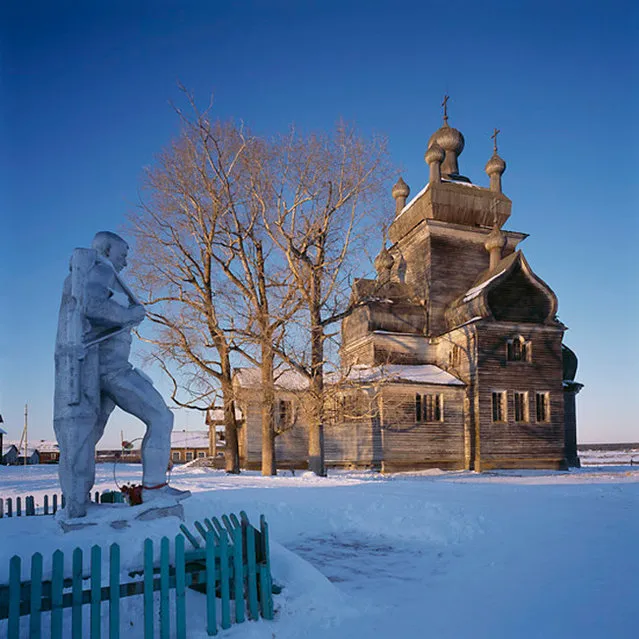
Wooden Churches - Travelling In The Russian North By Richard Davies Part 2

While communism, collectivism, worms, dry rot and casual looting failed to destroy the majestic wooden churches of Russia, it may be ordinary neglect that finally does them in. Dwindled now to several hundred remaining examples, these glories of vernacular architecture lie scattered amid the vastness of the world’s largest country. Just over a decade ago, Richard Davies, a British architectural photographer, struck out on a mission to record the fragile and poetic structures. Austerely beautiful and haunting, “Wooden Churches: Traveling in the Russian North” (White Sea Publishing; $132) is the result. Covering thousands of miles, Mr. Davies described how he and the writer Matilda Moreton tracked down the survivors from among the thousands of onion-domed structures built after Prince Vladimir converted to Christianity in 988.

See also: Wooden Churches Part1
Details
28 Nov 2013 12:13:00


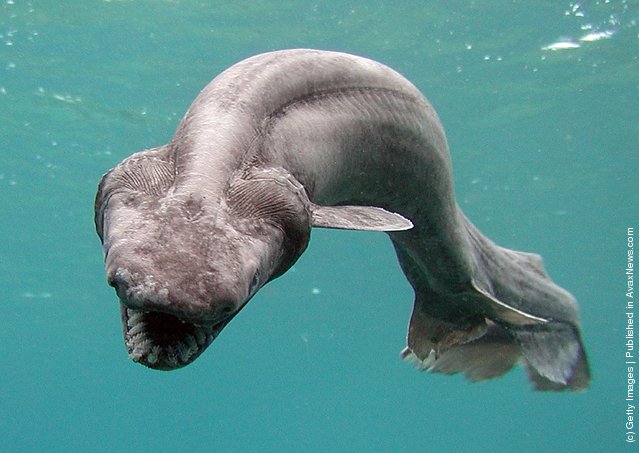
“The frilled shark (Chlamydoselachus anguineus) is one of two extant species of shark in the family Chlamydoselachidae, with a wide but patchy distribution in the Atlantic and Pacific Oceans. This uncommon species is found over the outer continental shelf and upper continental slope, generally near the bottom though there is evidence of substantial upward movements. It has been caught as deep as 1,570 m (5,150 ft), whereas in Suruga Bay, Japan it is most common at depths of 50–200 m (160–660 ft). Exhibiting several “primitive” features, the frilled shark has often been termed a «living fossil»”. – Wikipedia

Photo: A 1.6 meter long Frill shark swims in a tank after being found by a fisherman at a bay in Numazu, on January 21, 2007 in Numazu, Japan. The frill shark, also known as a Frilled shark usually lives in waters of a depth of 600 meters and so it is very rare that this shark is found alive at sea-level. It's body shape and the number of gill are similar to fossils of sharks which lived 350,000,000 years ago. (Photo by Awashima Marine Park/Getty Images)
Details
05 May 2011 10:01:00
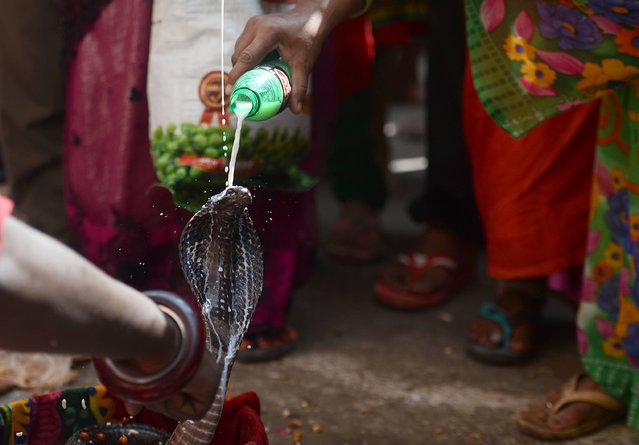
An Indian Hindu devotee pours milk on a snake as an offering during the annual Nag Panchami festival, dedicated to the worship of snakes outside the Nagvasuki temple, in Allahabad, on July 28, 2017. (Photo by Sanjay Kanojia/AFP Photo)

An Indian Hindu devotee pours milk on a snake as an offering during the annual Nag Panchami festival, dedicated to the worship of snakes outside the Nagvasuki temple, in Allahabad, on July 28, 2017. Officially the snake charmers' profession is banned in India, but many in the country offered prayers and milk blessings to cobras and other deadly serpents on July 28 in an annual tribute. The 800,000 charmers and their young apprentices come to the fore for the Nag Panchami festival which dates back several centuries. (Photo by Sanjay Kanojia/AFP Photo)
Details
31 Jul 2017 09:17:00
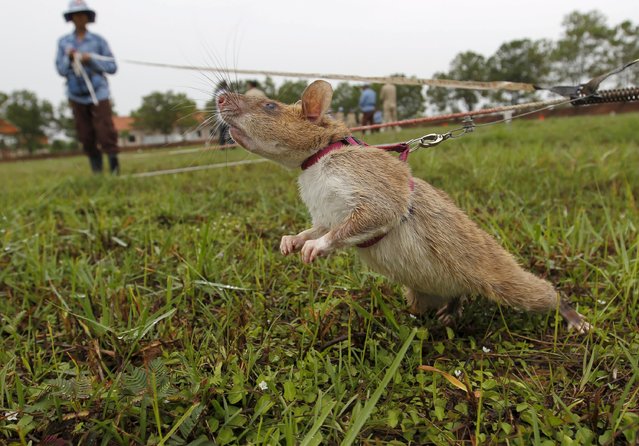
A rat being trained by the Cambodian Mine Action Centre (CMAC) is pictured on an inactive landmine field in Siem Reap province July 9, 2015. Gambian pouched rats were deployed to Cambodia from Tanzania in April by a Belgian non-profit organization, APOPO, to help clear mines. (Photo by Samrang Pring/Reuters)

A rat being trained by the Cambodian Mine Action Centre (CMAC) is pictured on an inactive landmine field in Siem Reap province July 9, 2015. Gambian pouched rats were deployed to Cambodia from Tanzania in April by a Belgian non-profit organization, APOPO, to help clear mines. They've been trained since they were 4 weeks old. Cambodia is still littered with landmines after emerging from decades of civil war, including the 1970s Khmer Rough “Killing Fields” genocide, leaving it with one of the world's highest disability rates. APOPO has used the rodents for mine-clearing projects in several countries, including Angola, Mozambique, Thailand, Laos, and Vietnam. (Photo by Samrang Pring/Reuters)
Details
14 Jul 2015 13:35:00
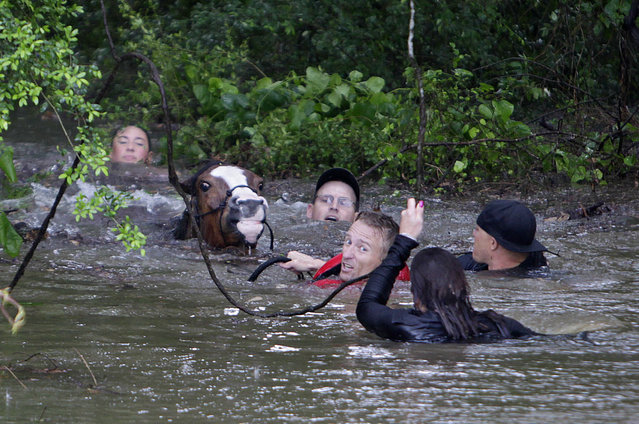
Justin Nelzen, in red vest, joins others as they work to rescue up to 70 horses along Cypresswood Drive near Humble along Cypress Creek, Monday, April 18, 2016, in Houston. (Photo by Mark Mulligan/Houston Chronicle via AP Photo)

Justin Nelzen, in red vest, joins others as they work to rescue up to 70 horses along Cypresswood Drive near Humble along Cypress Creek, Monday, April 18, 2016, in Houston. More than a foot of rain fell Monday in parts of Houston, submerging scores of subdivisions and several major interstate highways, forcing the closure of schools and knocking out power to thousands of residents who were urged to shelter in place. (Photo by Mark Mulligan/Houston Chronicle via AP Photo)
Details
19 Apr 2016 13:21:00