Loading...
Done
A reveler gets ready to perform at a carnival parade in Havana, Cuba August 7, 2015. (Photo by Alexandre Meneghini/Reuters)

A reveler gets ready to perform at a carnival parade in Havana, Cuba August 7, 2015. (Photo by Alexandre Meneghini/Reuters)
Details
08 Aug 2015 12:41:00
Kazakh troops march during a parade of the armed forces to mark the Defender of the Fatherland Day in Astana, May 7, 2014. (Photo by Mukhtar Kholdorbekov/Reuters)

Kazakh troops march during a parade of the armed forces to mark the Defender of the Fatherland Day in Astana, May 7, 2014. (Photo by Mukhtar Kholdorbekov/Reuters)
Details
24 Sep 2014 12:31:00
Belarusian beauty designers attend an annual national contest in Minsk, Belarus on November 7, 2019. (Photo by Vasily Fedosenko/Reuters)

Belarusian beauty designers attend an annual national contest in Minsk, Belarus on November 7, 2019. (Photo by Vasily Fedosenko/Reuters)
Details
09 Nov 2019 00:05:00
Dancers perform during La Paz Fashion Week in La Paz, Bolivia, February 7, 2019. (Photo by David Mercado/Reuters)

Dancers perform during La Paz Fashion Week in La Paz, Bolivia, February 7, 2019. (Photo by David Mercado/Reuters)
Details
15 Feb 2019 00:01:00
Celebrities Switch into their 2nd Outfits for the Met Gala After Parties on May 7, 2019. Pictured: Hailey Bieber. (Photo by DIGGZY/Splash News and Pictures)

Celebrities Switch into their 2nd Outfits for the Met Gala After Parties on May 7, 2019. Pictured: Hailey Bieber. (Photo by DIGGZY/Splash News and Pictures)
Details
12 May 2019 00:01:00
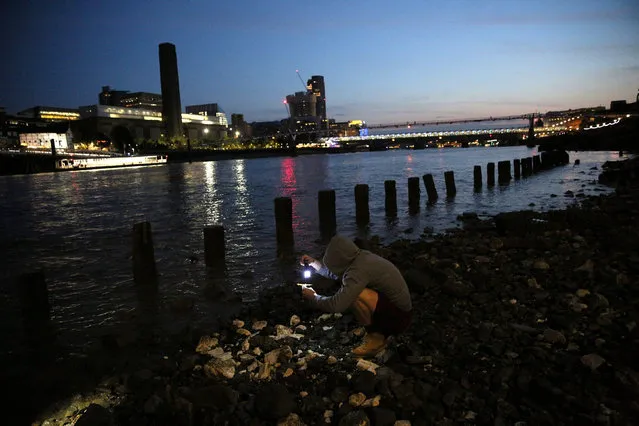
A mudlark uses a torch to look for items on the bank of the River Thames in London, Britain June 06, 2016. Mudlarking is believed to trace its origins to the 18th and 19th century, when scavengers searched the Thames' shores for items to sell. These days, history and archaeology fans are the ones hoping to find old relics such as coins, ceramics, artifacts or everyday items from across centuries. They wait for the low tide and then scour specific areas of exposed shores. "If you're in a field you could be out all day long, with the river you're restricted to about two or three hours," mudlark Nick Stevens said. While many just use the naked eye for their searches, others rely on metal detectors for which a permit from the Port of London Authority is needed. Digging also requires consent. (Photo by Neil Hall/Reuters)

A mudlark uses a torch to look for items on the bank of the River Thames in London, Britain June 06, 2016. Mudlarking is believed to trace its origins to the 18th and 19th century, when scavengers searched the Thames' shores for items to sell. These days, history and archaeology fans are the ones hoping to find old relics such as coins, ceramics, artifacts or everyday items from across centuries. their finds with the Portable Antiquities Scheme. Any item over 300 years old must be recorded. (Photo by Neil Hall/Reuters)

Details
27 Aug 2016 10:43:00
Four-month-old fox cubs squaring up to each other in Walthamstow, England on August 7, 2015. (Photo by Greg Morgan/Barcroft Media)

Four-month-old fox cubs squaring up to each other in Walthamstow, England on August 7, 2015. (Photo by Greg Morgan/Barcroft Media)
Details
09 Aug 2015 10:54:00
Sleeping Anthidium. Female Anthidium punctatum; Size: 7 mm. (John Hallmén)

Sleeping Anthidium. Female Anthidium punctatum; Size: 7 mm. (Photo by John Hallmén)
Details
30 Jun 2013 12:19:00