Loading...
Done
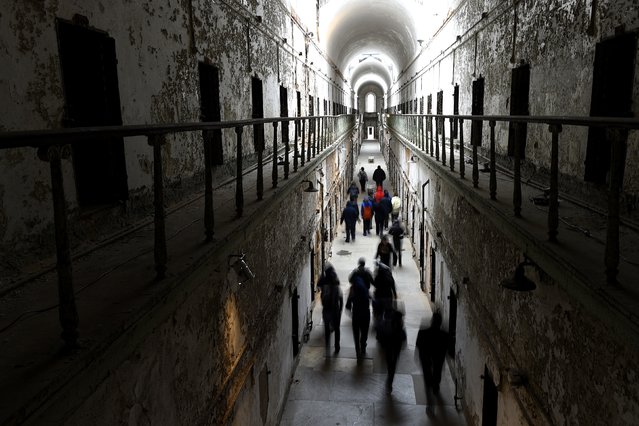
A tour group wanders through block 7 of Eastern State Penitentiary in Philadelphia, Pennsylvania April 30, 2014. Opened in 1829, with the original corrective system of “confinement in solitude with labor”, the penitentiary housed about 75,000 inmates in its 142 years of operation. At Eastern State reunions, former inmates, staff and guard gather to share memories and trade stories and get a chance to describe their experiences in question-and-answer sessions with the public. (Photo by Mark Makela/Reuters)

A tour group wanders through block 7 of Eastern State Penitentiary in Philadelphia, Pennsylvania April 30, 2014. Opened in 1829, with the original corrective system of “confinement in solitude with labor”, the penitentiary housed about 75,000 inmates in its 142 years of operation. At Eastern State reunions, former inmates, staff and guard gather to share memories and trade stories and get a chance to describe their experiences in question-and-answer sessions with the public. (Photo by Mark Makela/Reuters)
Details
07 May 2014 09:36:00
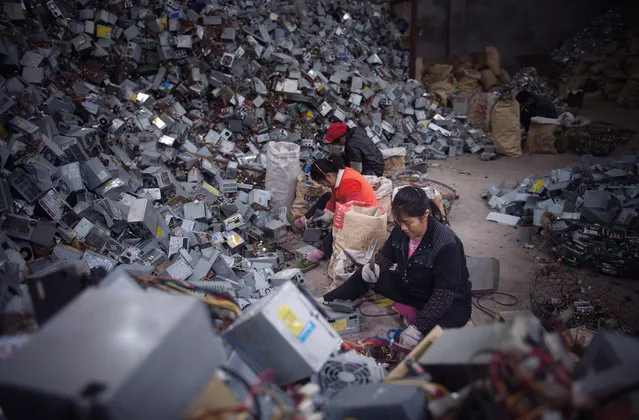
“The sustainable development goals cannot be met unless waste management is addressed as a priority”, says UK waste management charity Waste Aid. “E-waste is one of the fastest growing categories of the 7-10bn tonnes of waste produced globally every year”, adds director Mike Webster. “In our view, decent waste management is a basic right and we want governments around the world take this issue much more seriously – in 2012 only 0.2% of international aid went on improving solid waste management – it’s just not enough”. (Photo by Kai Loeffelbein/laif Agentur)

Sustainable development goal target 12.5 is to reduce waste. But with a planet increasingly dependent on technology, is that even possible? As of today, over 30m tonnes of electronic waste has been thrown out so far this year, according to the World Counts. Most e-waste is sent to landfills in Asia and Africa where it is recycled by hand, exposing the people who do it to environmental hazards. Kai Loeffelbein’s photographs of e-waste recycling in Guiyu, southern China show what happens to discarded computers. (Photo by Kai Loeffelbein/laif Agentur)
Details
19 Oct 2016 12:14:00
Men rest on a boat in the overflowed Ganges River under the Shastri Bridge in Allahabad on August 17, 2022, as water levels of the Ganges and Yamuna rivers rose following monsoon rainfalls. (Photo by Sanjay Kanojia/AFP Photo)

Men rest on a boat in the overflowed Ganges River under the Shastri Bridge in Allahabad on August 17, 2022, as water levels of the Ganges and Yamuna rivers rose following monsoon rainfalls. (Photo by Sanjay Kanojia/AFP Photo)
Details
24 Aug 2022 04:51:00
An ATF agent holds a generic unfinished receiver, back, and one that has been machined, front, at an ATF field office, on May, 06, 2014 in Washington, DC. Unfinished receivers can be turned into working automatic weapons that are untraceable. (Photo by Bill O'Leary/The Washington Post)

An unknown number of guns are being built with the mechanisms, causing problems for the police and ATF officials. Photo: An ATF agent holds a generic unfinished receiver, back, and one that has been manufactured, front, at an ATF field office in Washington, on May 06, 2014. The ATF is trying to crack down on the trade in the makeshift guns by targeting shops and individuals who offer to turn the unfinished receivers into functional pieces for firearms. (Photo by Bill O'Leary/The Washington Post)
Details
19 May 2014 09:22:00
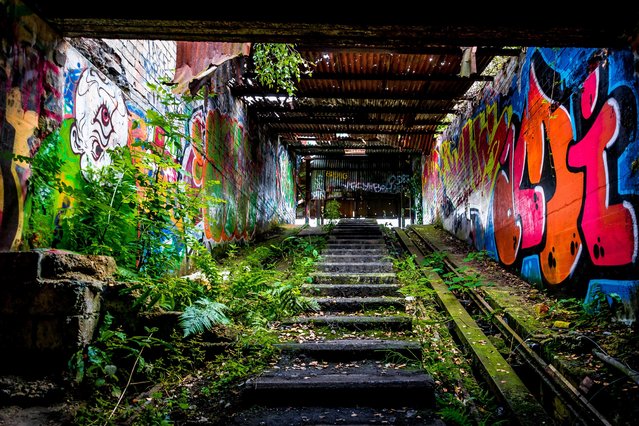
A railway siding in Wiltshire, UK where ammunition was transferred by tunnel to an underground storage facility. (Photo by MediaDrumWorld.com)

The series of shots show the bare steel infrastructure of the Bushfield army training camp near Winchester which was in operation during World War Two and was used to train Royal Green Jackets recruits in the sixties. The spectacular images were taken by an urban explorer who wished to remain anonymous. Here: A railway siding in Wiltshire, UK where ammunition was transferred by tunnel to an underground storage facility. (Photo by MediaDrumWorld.com)
Details
11 Jan 2017 14:18:00
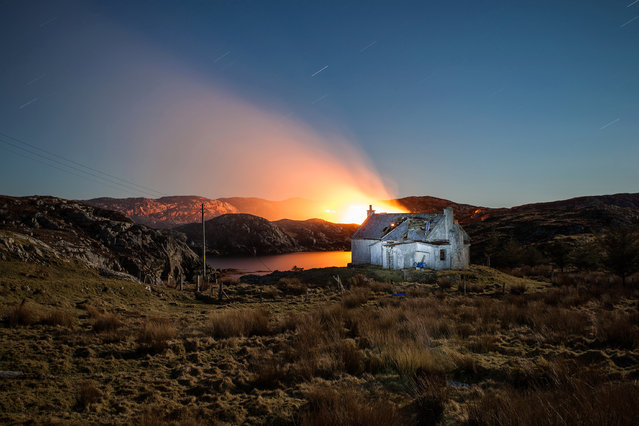
“Peat Fire”. Taken in March 2013 on the east coast of Harris. The fire is from muir-burning, when farmers burn off grasses and heather to improve grazing for their sheep. (Photo by John Maher/The Guardian)

Photographer John Maher, once the drummer with punk bank Buzzcocks, travelled to the Outer Hebrides to photograph abandoned crofters’ cottages – many of which, like this one, have seemingly been untouched since. Here: “Peat Fire”. Taken in March 2013 on the east coast of Harris. The fire is from muir-burning, when farmers burn off grasses and heather to improve grazing for their sheep. (Photo by John Maher/The Guardian)
Details
19 Aug 2016 11:39:00
A masked protester talks to a soldier during clashes after the funeral of Brig. Gen. Wissam al-Hassan October 21, 2012. Lebanese soldiers fired guns and tear gas to push back hundreds of protesters who broke through a police cordon and tried to storm the government headquarters in Beirut. (Photo by Hussein Malla/Associated Press)

A masked protester talks to a soldier during clashes after the funeral of Brig. Gen. Wissam al-Hassan October 21, 2012. Lebanese soldiers fired guns and tear gas to push back hundreds of protesters who broke through a police cordon and tried to storm the government headquarters in Beirut. (Photo by Hussein Malla/Associated Press)
Details
27 Oct 2012 12:03:00
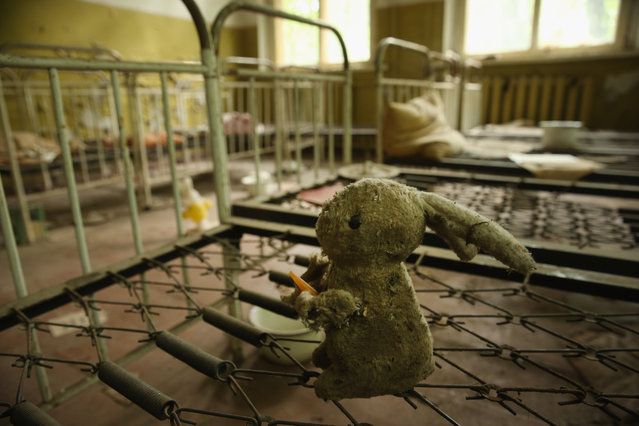
A stuffed rabbit doll sits among children's beds standing in the abandoned kindergarten of Kopachi village located inside the Chernobyl Exclusion Zone on September 29, 2015 near Chornobyl, Ukraine. Kopachi, a village that before 1986 had a population of 1,114, lies only a few kilometers south of the former Chernobyl nuclear power plant, where in 1986 workers inadvertantly caused reactor number four to explode, creating the worst nuclear accident in history. Radiation fallout was so high that authorities bulldozed and buried all of Kopachi's structures except for the kindergarten. (Photo by Sean Gallup/Getty Images)

A stuffed rabbit doll sits among children's beds standing in the abandoned kindergarten of Kopachi village located inside the Chernobyl Exclusion Zone on September 29, 2015 near Chornobyl, Ukraine. Kopachi, a village that before 1986 had a population of 1,114, lies only a few kilometers south of the former Chernobyl nuclear power plant, where in 1986 workers inadvertantly caused reactor number four to explode, creating the worst nuclear accident in history. (Photo by Sean Gallup/Getty Images)
Details
27 Apr 2016 09:28:00