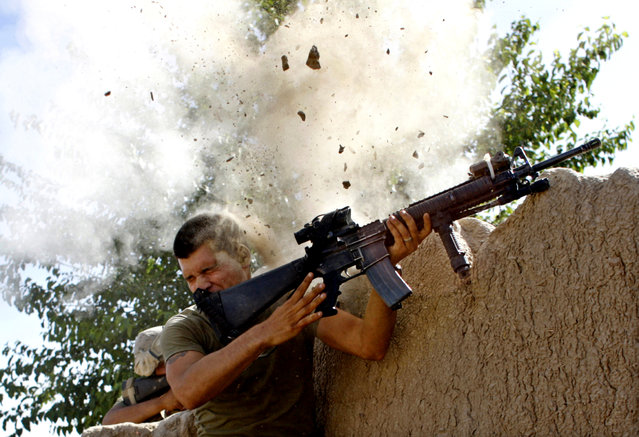
Sgt. William Olas Bee, a U.S. Marine from the 24th Marine Expeditionary Unit, has a close call after Taliban fighters opened fire near Garmsir in Helmand Province of Afghanistan, May 18, 2008. (Photo by Goran Tomasevic/Reuters)
Ethnic Miao women in traditional costumes take part in a tug of war as they celebrate the local ethnic Miao's new year at a village in Rongshui Miao Autonomous county, Guangxi Zhuang Autonomous Region, China January 5, 2019. (Photo by Reuters/China Stringer Network)
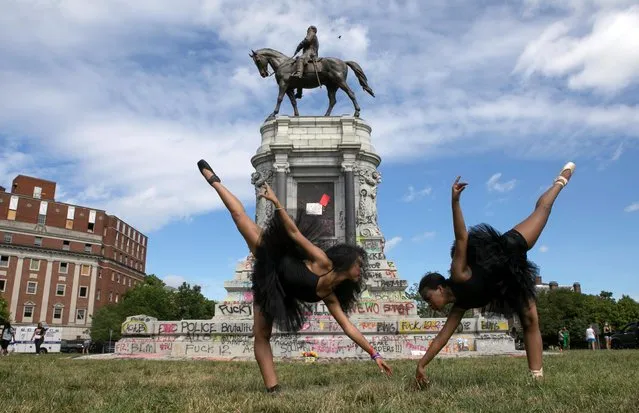
Ballerinas Kennedy George, 14, and Ava Holloway, 14, pose in front of a monument of Confederate general Robert E. Lee after Virginia Governor Ralph Northam ordered its removal after widespread civil unrest following the death in Minneapolis police custody of George Floyd, in Richmond, Virginia, U.S. June 5, 2020. (Photo by Julia Rendleman/Reuters)
An actor playing the role of the Conductor, poses for a photograph alongside the Polar Express Train Ride at the Swanage Railway in Dorset, UK on Thursday, November 16, 2023, a festive-themed train journey based on the Polar Express book and film, which invites visitors to travel in their pyjamas and dressing gowns as they journey from Swanage to the “North Pole”. (Photo by Andrew Matthews/PA Images via Getty Images)
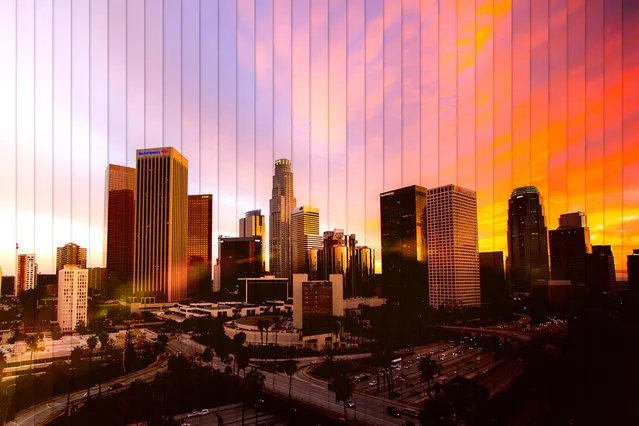
A photographer is using a unique method to show the shift from day to night across famous cities in spectacular images. Daniel Marker-Moors' take on time-lapse photography – which he calls time slice – sees the photographer snap image after image, before combining them to create beautiful, vibrant works. His images usually focus on a point in the day with the most dramatic change in light, such as sunrise or sunset. Marker-Moors, from Los Angeles, begins by shooting hundreds and sometimes thousands of images from the same spot. Here: Chicago – 35 photographs, 15 minutes. (Photo by Daniel Marker-Moors/Caters News)
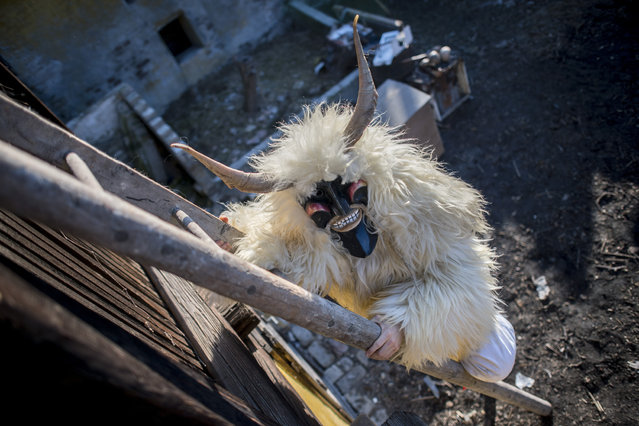
A man wears a busho mask and a costume made of sheep pelt while climbing up a ladder outside a barn in Mohacs, Hungary, 20 February 2020, on the first day of carnival. The traditional Busho carnival, which marks the end of winter, dates back to the 16th century. According to local legend, members of an ethnic South Slavic group living in Mohacs at the time dressed up in similar costumes and wore wooden masks to scare away Ottoman invaders, who mistook them for demons. (Photo by Tamas Soki/EPA/EFE)
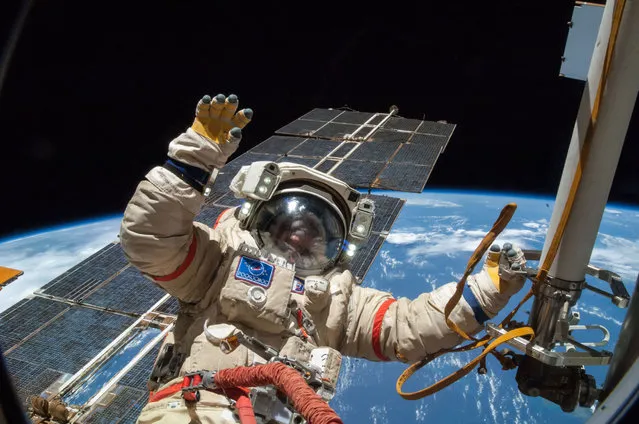
Russian cosmonaut Alexander Skvortsov, Expedition 40 flight engineer, attired in a Russian Orlan spacesuit, participates in a session of extravehicular activity (EVA) in support of science and maintenance on the International Space Station on August 18, 2014. During the five-hour, 11-minute spacewalk, Skvortsov and cosmonaut Oleg Artemyev (out of frame) deployed a small science satellite, retrieved and installed experiment packages and inspected components on the exterior of the orbital laboratory. (Photo by NASA)