Loading...
Done
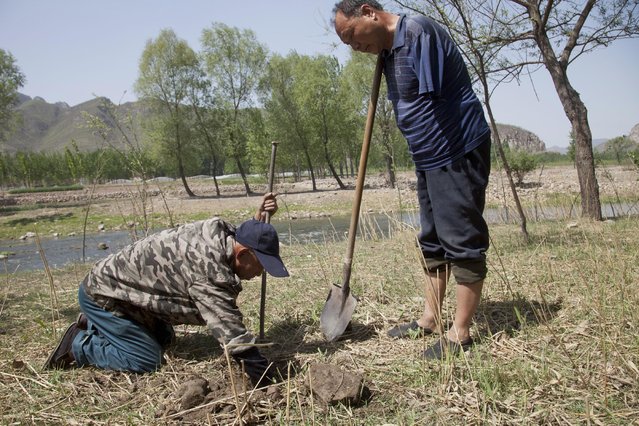
In this April 23, 2015 photo, friends Jia Haixia, left, and Jia Wenqi work to plant a tree in a field in Yeli village near Shijiazhuang city in northern China's Hebei province. For the past 13 years, Jia Wenqi, who has no arms, and Jia Haixia, who is blind, have worked together to plant and water more than 12,000 trees near their village. (Photo by Helene Franchineau/AP Photo)

In this April 23, 2015 photo, friends Jia Haixia, left, and Jia Wenqi work to plant a tree in a field in Yeli village near Shijiazhuang city in northern China's Hebei province. For the past 13 years, Jia Wenqi, who has no arms, and Jia Haixia, who is blind, have worked together to plant and water more than 12,000 trees near their village. (Photo by Helene Franchineau/AP Photo)
Details
13 May 2015 11:21:00
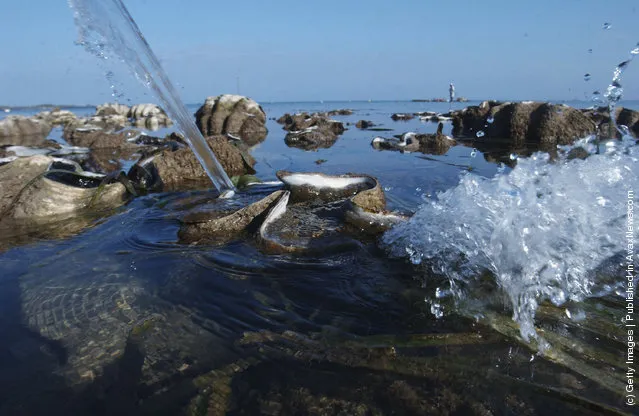
Tridacna Gigas, or Giant Clams

“The giant clam, Tridacna gigas (known as pā’ua in Cook Islands Māori), is the largest living bivalve mollusc. T. gigas is one of the most endangered clam species. It was mentioned as early as 1825 in scientific reports. One of a number of large clam species native to the shallow coral reefs of the South Pacific and Indian oceans, they can weigh more than 200 kilograms (440 lb) measure as much as 120 cm (47 in) across, and have an average lifespan in the wild of 100 years or more”. – Wikipedia

Photo: Tridacna Gigas, or Giant Clams spew water as a traditional fisherman passes by a small sanctuary on January 23, 2004 near Bolinao in the Northern Philippines. The clams, prime builders for coral reefs and providing shelter for spawning fish and other marine life, are exposed by low tides in the sanctuary. Overfishing and pollution throughout the country are not only threatening food security, but are also starting to choke one of the few working clam sanctuaries in the world. (Photo by David Greedy/Getty Images)
Details
01 Oct 2011 13:10:00
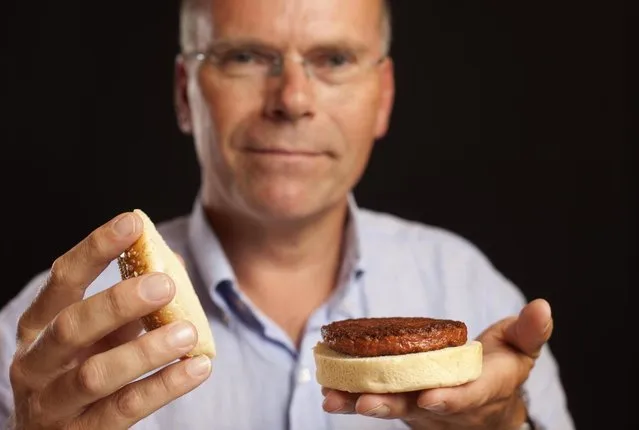
In this handout image provided by Ogilvy, a burger made from cultured beef, which has been developed by Professor Mark Post of Maastricht University in the Netherlands (pictured) is shown to the media during a press conference on August 5, 2013 in London, England. Cultured Beef could help solve the coming food crisis and combat climate change with commercial production of Cultured Beef beginning within ten to twenty years. (Photo by David Parry via Getty Images)

In this handout image provided by Ogilvy, a burger made from cultured beef, which has been developed by Professor Mark Post of Maastricht University in the Netherlands (pictured) is shown to the media during a press conference on August 5, 2013 in London, England. The in-vitro burger, cultured from cattle stem cells, the first example of what its creator says could provide an answer to global food shortages and help combat climate change, was fried in a pan and tasted by two volunteers. The burger is the result of years of research by Dutch scientist Mark Post, a vascular biologist at the University of Maastricht, who is working to show how meat grown in petri dishes might one day be a true alternative to meat from livestock.The meat in the burger has been made by knitting together around 20,000 strands of protein that has been cultured from cattle stem cells in Post's lab. (Photo by David Parry)
Details
06 Aug 2013 08:48:00
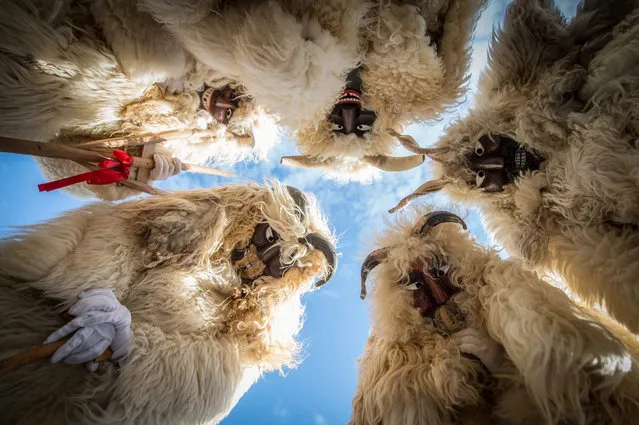
Participants wearing costumes and masks take part in the first day of the traditional carnival parade in Mohacs, Hungary, 23 February 2017. The carnival parade of so-called busos, dressed in costumes with frightening wooden masks and using various noisy wooden rattlers, is traditionally held on the seventh weekend before Easter to drive away winter. (Photo by Sandor Ujvari/EPA)

Participants wearing costumes and masks take part in the first day of the traditional carnival parade in Mohacs, Hungary, 23 February 2017. The carnival parade of so-called busos, dressed in costumes with frightening wooden masks and using various noisy wooden rattlers, is traditionally held on the seventh weekend before Easter to drive away winter. (Photo by Sandor Ujvari/EPA)
Details
25 Feb 2017 10:35:00
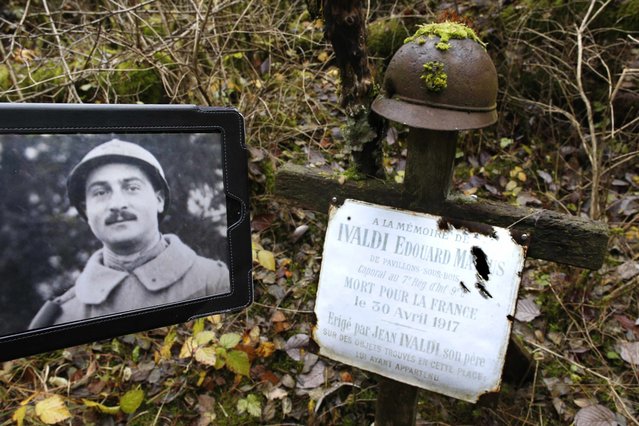
A portrait of French WWI soldier Edouard Marius Ivaldi is displayed on a tablet, in this illustration picture, alongside his battlefield grave memorial, a wooden cross with a battlefield helmet in Champagne, eastern France, November 3, 2015. (Photo by Charles Platiau/Reuters)

A portrait of French WWI soldier Edouard Marius Ivaldi is displayed on a tablet, in this illustration picture, alongside his battlefield grave memorial, a wooden cross with a battlefield helmet in Champagne, eastern France, November 3, 2015. (Photo by Charles Platiau/Reuters)
Details
09 Nov 2015 08:02:00
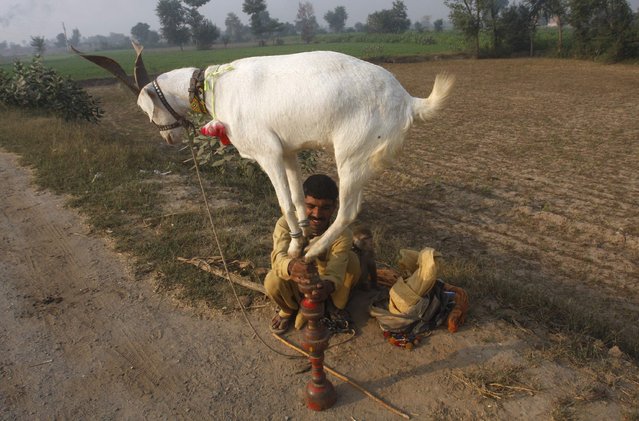
The goats are known to be good climbers, but this one is taking the climbing thing to a whole new level. It clambered on the tip of its owner’s stick, as a part of the roadside performance for a quick coin, on the outskirts of Faisalabad, Pakistan, November 5, 2012. (Photo by Fayyaz Hussain/Reuters)

The goats are known to be good climbers, but this one is taking the climbing thing to a whole new level. It clambered on the tip of its owner’s stick, as a part of the roadside performance for a quick coin, on the outskirts of Faisalabad, Pakistan, November 5, 2012. (Photo by Fayyaz Hussain/Reuters)
Details
10 Nov 2012 11:31:00
A girl broadcasts at live streaming talent agency Three Minute TV in Beijing, China on April 12, 2017. Three Minute TV also arranges cosmetic surgery at partner hospitals for its anchors, arranges small bank loans for the surgery, photographs and markets the anchors and helps them find acting opportunities Deng said. (Photo by Damir Sagolj/Reuters)

A girl broadcasts at live streaming talent agency Three Minute TV in Beijing, China on April 12, 2017. Three Minute TV also arranges cosmetic surgery at partner hospitals for its anchors, arranges small bank loans for the surgery, photographs and markets the anchors and helps them find acting opportunities Deng said. (Photo by Damir Sagolj/Reuters)
Details
16 Apr 2017 10:43:00
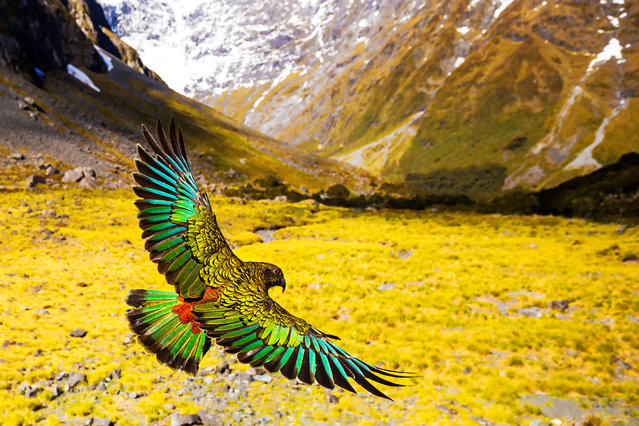
Kea are the only true alpine parrots in the world and thrive as cunning opportunists in the freezing conditions of the Southern Alps. Kea are thought to have developed their wide array of food-finding strategies during the last great ice age, where they learned to adapt using their unusual powers of curiosity. (Photo by Tom Walker/BBC Pictures/The Guardian)

Kea are the only true alpine parrots in the world and thrive as cunning opportunists in the freezing conditions of the Southern Alps. Kea are thought to have developed their wide array of food-finding strategies during the last great ice age, where they learned to adapt using their unusual powers of curiosity. (Photo by Tom Walker/BBC Pictures/The Guardian)
Details
19 Jul 2016 13:03:00