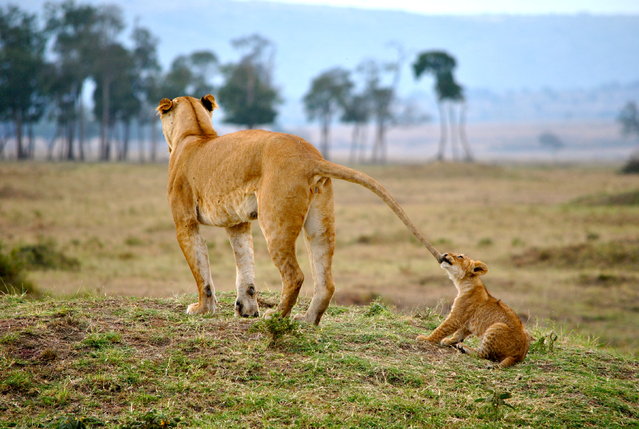
“A Mothers Tail”. A baby cub pulls on his mother's tail to get attention. Photo location: Masai Mara, Kenya. (Photo and caption by Tori Marsh/National Geographic Photo Contest)
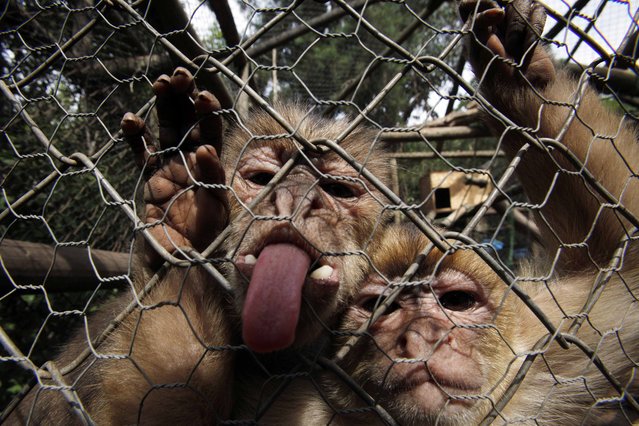
A couple of monkeys look from inside their cage at a rescue and rehabilitation center in Santiago, Chile, Saturday, November 22, 2014. Elba Munoz who runs the center, says that one of the goals of the Center for the Rescue and Rehabilitation of Primates is to stop the trafficking of the animals. (Photo by Luis Hidalgo/AP Photo)
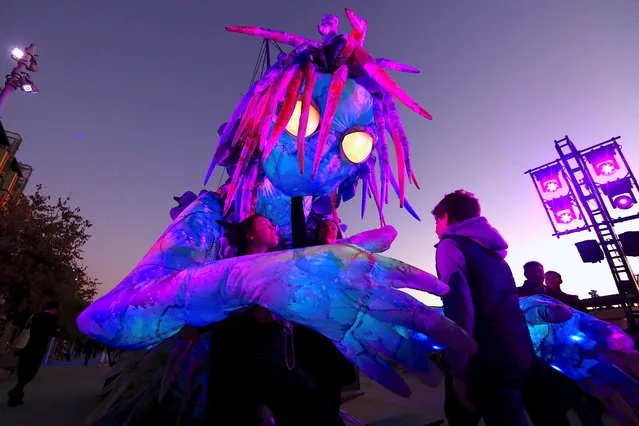
A boy looks at a six-metre tall luminescent puppet, operated by ten performers, during a preview of Vivid Sydney, promoted as the world's largest festival of light, music and ideas, in Sydney, Australia on May 23, 2018. “Vivid” is a major outdoor cultural event featuring light installations and projections with the annual event this year running from May 25 to June 16, 2018. (Photo by David Gray/Reuters)
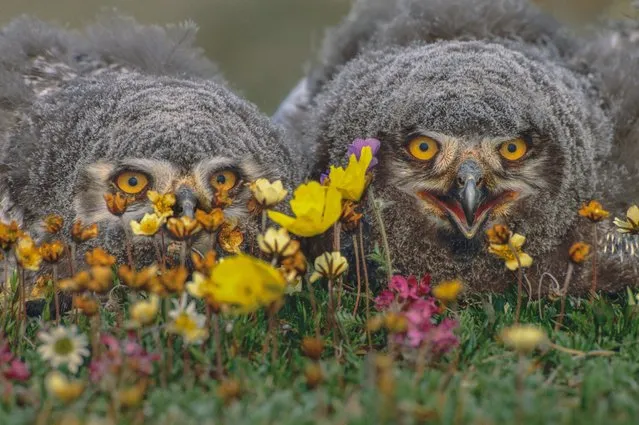
The photography of Art Wolfe covers the globe, capturing landscapes, wildlife, and cultures from every continent; here he talks through a selection of his favourite images. Art Wolfe is an American photographer and conservationist. His photographs have been noted by environmental advocacy groups for their “stunning” visual impact. Here: Snowy owlets (Bubo scandiacus), Arctic National Wildlife Refuge, Alaska, USA. (Photo by Art Wolfe/Art Wolfe Stock)
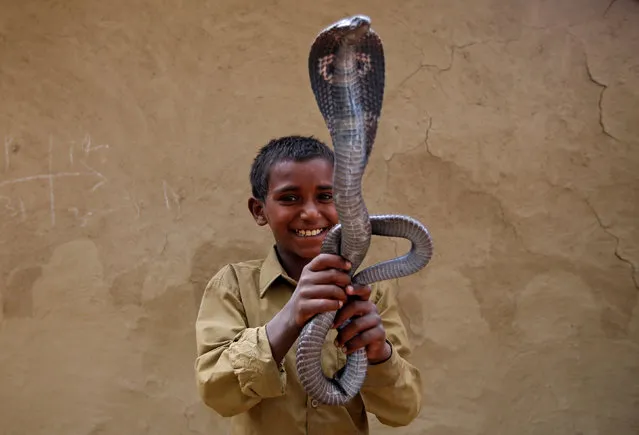
Ravi Nath poses for a photograph with a cobra snake in Jogi Dera (Snake charmers settlement), in the village of Baghpur, in the central state of Uttar Pradesh, India November 10, 2016. An ancient tribe of snake charmers, known as Saperas, have thrived over the generations by catching venomous snakes and making them dance to their music. Snakes are revered by Hindus in India and snake charmers are considered the followers of Lord Shiva, the blue-skinned Hindu god who is usually portrayed wearing a king cobra around his neck. (Photo by Adnan Abidi/Reuters)
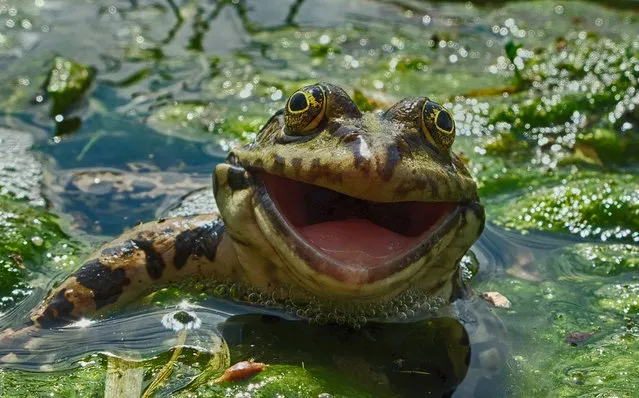
A frog appears to have a big smile for the camera, Russia. Things are heating up at the Comedy Wildlife Photography Awards as the shortlisted final 40 entries are revealed. This year's competition has featured over 2200 hilarious entries from around the world with photos including a fox face planting in the snow, a dancing brown bear and a pair of seemingly headless penguins – all beautifully photographed with perfect comedy timing and a strong conservation message. (Photo by Artyom Krivosheev/Barcroft Images/Comedy Wildlife Photography Awards 2016)
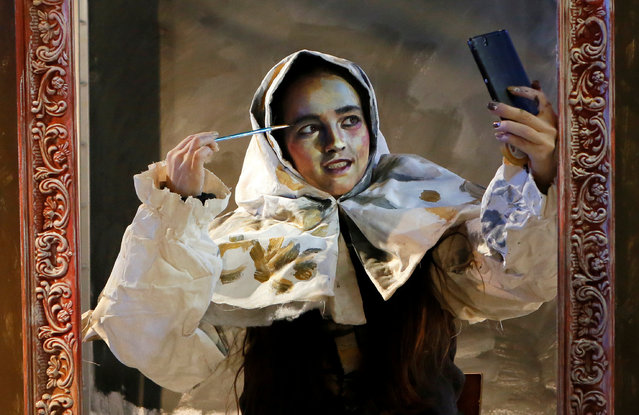
Russian artist Maria Gasanova adjusts her make-up as she finishes “The Siberian Beauty” body art work from her “The Alive Painting” series before the opening ceremony of the Cultural Universiade as part of preparation for the 2019 Winter Universiade Krasnoyarsk, in the Siberian city of Krasnoyarsk, Russia, December 9, 2016. (Photo by Ilya Naymushin/Reuters)
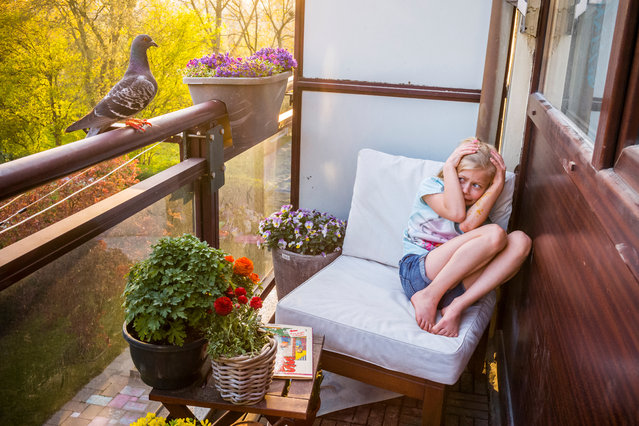
Nature – first prize, stories. Pandemic Pigeons – A Love Story. The photographer’s daughter, Merel, cowers after Dollie flies past and perches on the balcony before entering the house in Vlaardingen in the Netherlands on 6 April 2020. “She’s still frightened when Dollie suddenly lands on the balcony railing. I hide my smile behind the camera, as I try to comfort her by saying they won’t hurt you. “I thought he was going to attack me”, she replies. As the nesting pigeons keep coming back to our place, slowly my girls have started to appreciate them – perhaps not as much as I do, but it’s a start”. (Photo by Jasper Doest/World Press Photo 2021)