Loading...
Done
X Factor and Celebrity Big Brother starlet Chloe Khan is seen working up a sweat at her luxury home on August 30, 2016. The CBB star squeezed into a pair of super-tight leggings and a teeny crop top for a very public workout. She may be a self-made millionaire, but life wasn't always so good for Chloe Khan. The Celebrity Big Brother star, 25, has revealed she was brought up in poverty as a child in Wakefield, West Yorkshire, UK. Chloe lived with her mother on a council estate before she auditioned for the X Factor and became a playboy model. (Photo by Palace Lee)

X Factor and Celebrity Big Brother starlet Chloe Khan is seen working up a sweat at her luxury home on August 30, 2016. The CBB star squeezed into a pair of super-tight leggings and a teeny crop top for a very public workout. She may be a self-made millionaire, but life wasn't always so good for Chloe Khan. The Celebrity Big Brother star, 25, has revealed she was brought up in poverty as a child in Wakefield, West Yorkshire, UK. Chloe lived with her mother on a council estate before she auditioned for the X Factor and became a playboy model. (Photo by Palace Lee)
Details
31 Aug 2016 12:00:00
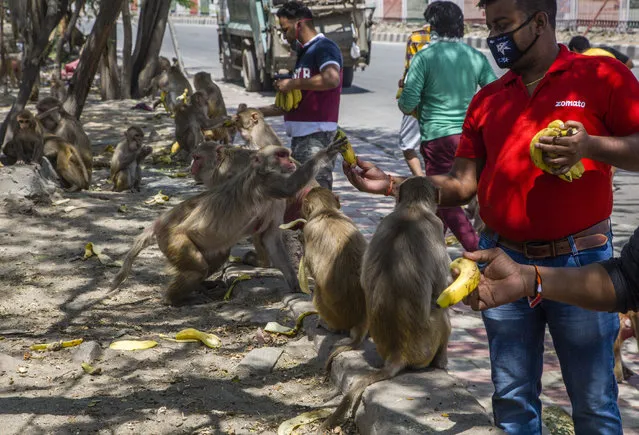
Men give bananas to monkeys gathered on the side of the road as India remains under an unprecedented lockdown over the highly contagious coronavirus (COVID-19) on April 08, 2020 in New Delhi, India. Wild animals, including monkeys, are roaming human settlements in India as people are staying indoors due to the 21-day lockdown. With India's 1.3 billion population and tens of millions of cars off the roads, wildlife is moving towards areas inhabited by humans. Wild animals in many countries have been seen roaming streets. A study says some 60 percent of the new diseases found around the globe every year are zoonotic, meaning they originate in animals and are passed on to humans. COVID-19 is a zoonotic disease that is suspected to have come from the wet markets of Wuhan, China. (Photo by Yawar Nazir/Getty Images)

Men give bananas to monkeys gathered on the side of the road as India remains under an unprecedented lockdown over the highly contagious coronavirus (COVID-19) on April 08, 2020 in New Delhi, India. Wild animals, including monkeys, are roaming human settlements in India as people are staying indoors due to the 21-day lockdown. (Photo by Yawar Nazir/Getty Images)
Details
12 Apr 2020 00:05:00
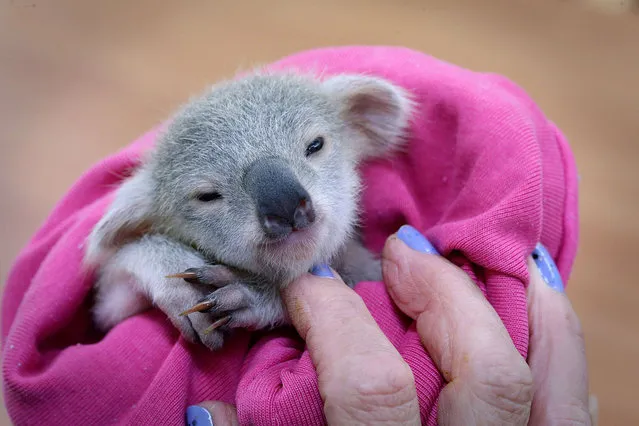
An adorable baby koala is seen enjoying a snooze after a traumatic start to life. The baby koala, nicknamed “Blondie Bumstead”, is being cared for by a volunteer from the Ipswich Koala protection society in Queensland after her mother was killed by a dog. (Photo by Jamie Hanson/Newspix/REX Features)

An adorable baby koala is seen enjoying a snooze after a traumatic start to life. The baby koala, nicknamed “Blondie Bumstead”, is being cared for by a volunteer from the Ipswich Koala protection society in Queensland after her mother was killed by a dog. Blondie, who was named for her light fur, was given just a 50-50 chance of pulling through after the attack. But after a course of antibiotics and some tender loving car from volunteer Marilyn Spletter she has now been given a clean bill of health. According to Marilyn she has hand-reared around 40 baby koalas but says that Blondie, who will be released back into the wild after 15 months, is one of her favourites. She said: “She's got a little character all of her own and she knows what she wants and what she doesn't. When she's stressed I kiss her on the nose or I rub my nose on hers and it relaxes her”. (Photo by Jamie Hanson/Newspix/REX Features)
Details
07 Aug 2014 10:26:00
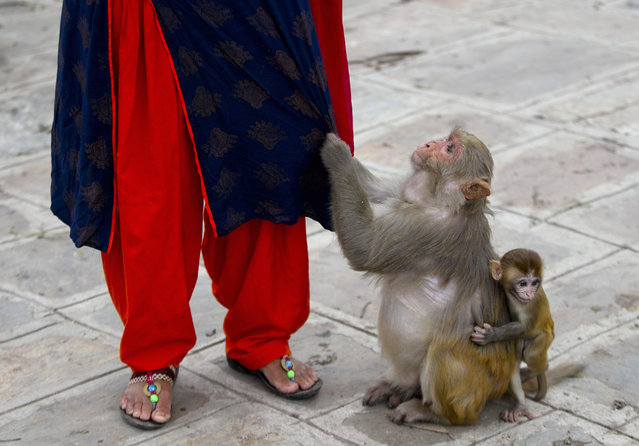
In this July 8, 2019, photo, a monkey pulls on the clothes of Saraswati Dangol as she arrives to feed monkeys in the forest near Pashupatinath temple in Kathmandu, Nepal. For the past four years, Dangol has been bringing the bread every day to feed the monkeys. As soon as they see her with her white sack, they gather around her, some patiently waiting for their turn while others less patiently snatching the bread from her hands. Many of Dangol's regulars are elderly, or are mother or baby monkeys who are unable to fight for their share of food in the wild. (Photo by Niranjan Shrestha/AP Photo)

In this July 8, 2019, photo, a monkey pulls on the clothes of Saraswati Dangol as she arrives to feed monkeys in the forest near Pashupatinath temple in Kathmandu, Nepal. For the past four years, Dangol has been bringing the bread every day to feed the monkeys. As soon as they see her with her white sack, they gather around her, some patiently waiting for their turn while others less patiently snatching the bread from her hands. Many of Dangol's regulars are elderly, or are mother or baby monkeys who are unable to fight for their share of food in the wild. (Photo by Niranjan Shrestha/AP Photo)
Details
26 Jul 2019 00:03:00
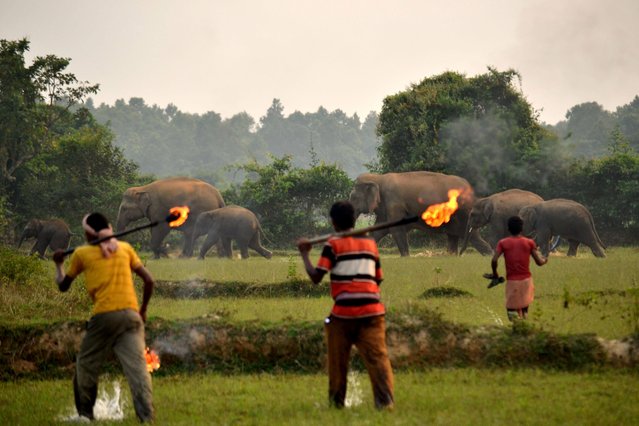
These heartbreaking photo show a confused family of elephants attempting to navigate a railway line built straight through their habitat on October 16, 2012. Taken by Biplab Hazra in Bishnupur, India, the images show the extreme lengths the inhabitants of the town go to to deter elephants from damaging their crops and property. As the images show, villagers often resort to extreme tactics in an effort to drive the elephants out  with one shocking photograph revealing firebombs being launched at a mother and calf as they cross the road. Elephants encroaching out of their habitats is an increasingly common occurrence with deforestation in much of India. (Photo by Biplab Hazra/Caters News Agency)

These heartbreaking photo show a confused family of elephants attempting to navigate a railway line built straight through their habitat on October 16, 2012. Taken by Biplab Hazra in Bishnupur, India, the images show the extreme lengths the inhabitants of the town go to to deter elephants from damaging their crops and property. As the images show, villagers often resort to extreme tactics in an effort to drive the elephants out with one shocking photograph revealing firebombs being launched at a mother and calf as they cross the road. Elephants encroaching out of their habitats is an increasingly common occurrence with deforestation in much of India. (Photo by Biplab Hazra/Caters News Agency)
Details
26 Jan 2019 00:05:00
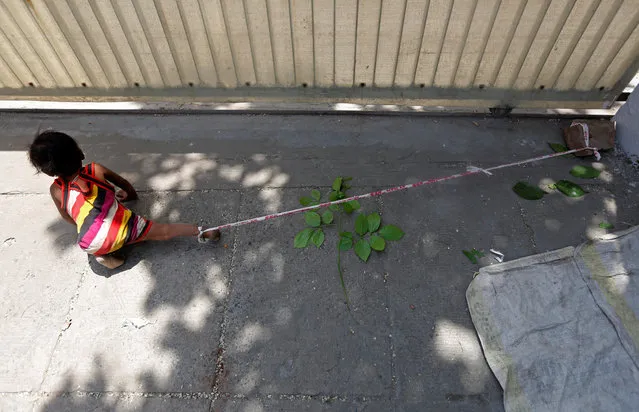
Barrier tape is tied around 15-month-old Shivani's ankle to prevent her from running away, while her mother Sarta Kalara works at a construction site nearby, in Ahmedabad, India, April 19, 2016. Kalara says she has no option but to tether her daughter Shivani to a stone despite her crying, while she and her husband work for 250 rupees ($3.8) each a shift digging holes for electricity cables in the city of Ahmedabad. There are about 40 million construction workers in India, at least one in five of them women, and the majority poor migrants who shift from site to site, building infrastructure for India's booming cities. Across the country it is not uncommon to see young children rolling in the sand and mud as their parents carry bricks or dig for new roads or luxury houses. (Photo by Amit Dave/Reuters)

Barrier tape is tied around 15-month-old Shivani's ankle to prevent her from running away, while her mother Sarta Kalara works at a construction site nearby, in Ahmedabad, India, April 19, 2016. Kalara says she has no option but to tether her daughter Shivani to a stone despite her crying, while she and her husband work for 250 rupees ($3.8) each a shift digging holes for electricity cables in the city of Ahmedabad. There are about 40 million construction workers in India, at least one in five of them women, and the majority poor migrants who shift from site to site, building infrastructure for India's booming cities. Across the country it is not uncommon to see young children rolling in the sand and mud as their parents carry bricks or dig for new roads or luxury houses. (Photo by Amit Dave/Reuters)
Details
14 Dec 2016 07:39:00
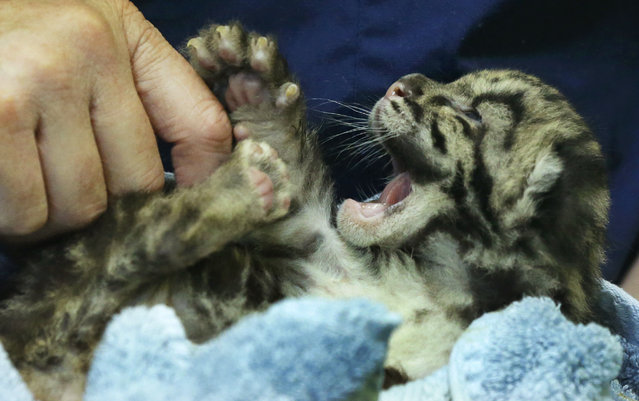
Andy Goldfarb, a staff biologist at the Point Defiance Zoo & Aquarium, plays with one of the four clouded leopard cubs currently at the zoo Friday, June 5, 2015 in Tacoma, Wash. The quadruplets were born on May 12, 2015 and now weigh about 1.7 lbs. each. Friday was their first official day on display for public viewing, usually during their every-four-hours bottle-feeding sessions, which were started after the cubs' mother did not show enough interest in continuing to nurse them. (AP Photo/Ted S. Warren)

Andy Goldfarb, a staff biologist at the Point Defiance Zoo & Aquarium, plays with one of the four clouded leopard cubs currently at the zoo Friday, June 5, 2015 in Tacoma, Wash. The quadruplets were born on May 12, 2015 and now weigh about 1.7 lbs. each. Friday was their first official day on display for public viewing, usually during their every-four-hours bottle-feeding sessions, which were started after the cubs' mother did not show enough interest in continuing to nurse them. (AP Photo/Ted S. Warren)
Details
19 Jun 2015 09:06:00


“The Red River Hog (Potamochoerus porcus), also known as the Bush Pig (but not to be confused with P. larvatus, common name “Bushpig”), is a wild member of the pig family living in Africa, with most of its distribution in the Guinean and Congolian forests. It is rarely seen away from rainforests, and generally prefers areas near rivers or swamps.

Red River Hogs eat grass, berries, roots, insects, molluscs, small vertebrates and carrion. They are capable of causing damage to plantations. Red River Hogs typically live in herds of 6-20 members led by a dominant boar. Sows rear 3-6 piglets at a time.”

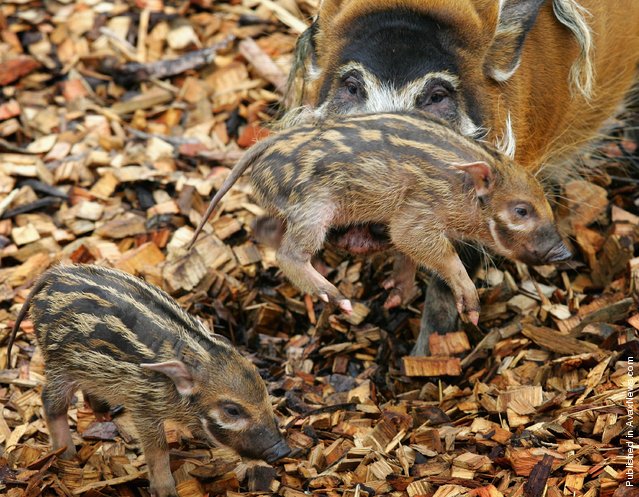
Photo: Two 17 day old red river hoglet twins forage for food next to their mother Bahiti at London Zoo on August 23, 2007 in London, England. Red River hoglets inhabit the forests and swamps of West and Central Africa. The recent additions to the London Zoo pig pen have been eagerly awaited by zoo keepers. (Photo by Chris Jackson/Getty Images)
Details
18 Mar 2011 15:15:00