Loading...
Done
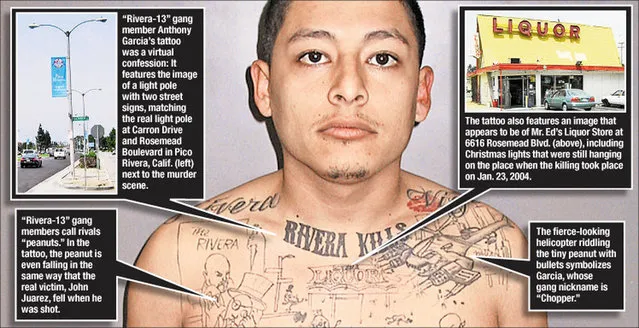
Crime Tatoo  Part 1

Tattoos are commonly used among criminals to show gang membership and record the wearer's personal history—such as his or her skills, specialties, accomplishments and convictions. They are also used as a means of personal expression. Certain designs have developed recognized coded meanings. The code systems can be quite complex and because of the nature of what they encode, the tattoo designs are not widely recognized.
Details
23 Apr 2013 10:29:00
Living In A Shell – Nautilus House

The Nautilus, designer Javier Senosiain’s bizarre, snail-shaped dwelling, is a mind-bending union of artistic experimentation and simplified living. Inspired by the work of Gaudí and Frank Lloyd Wright, Senosiain has brought to Mexico City another sparkling example of what he calls “Bio-Architecture” — the idea that buildings based on the natural principles of organic forms bring us back to local history, tradition and cultural roots, in turn creating harmony with nature.
Details
07 Jun 2013 10:15:00
Portraits Out Of Packing Tape By Mark Khaisman

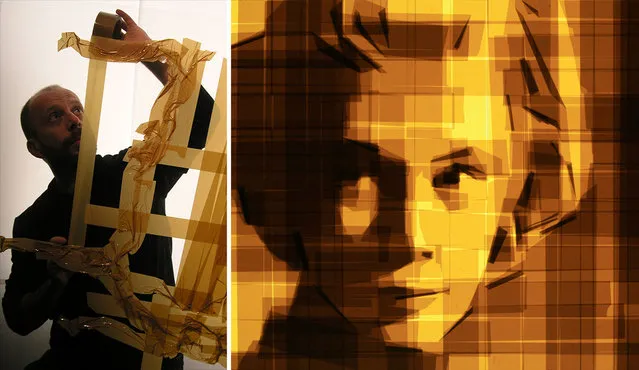
Born in 1958 in Kiev, Ukraine, artist Mark Khaisman studied Art and Architecture at the Moscow Architectural Institute in Russia. Now living in Philadelphia, USA, Khaisman uses rolls of brown packaging tape to create incredible works of art. Mark characterizes his work as ‘pictorial illusions formed by light and shadow’. The three key elements are: translucent packing tape, clear acrylic or film panels, and light. By superimposing layers of packaging tape Mark can ‘play on degrees of opacity that produces transparencies highlighted by the color, shading, and embossment’.
Details
31 Jul 2014 11:41:00
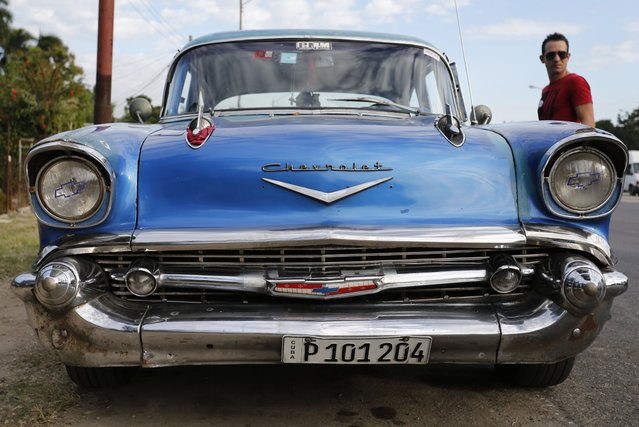
In this December 19, 2014 photo, a man stands beside his 1957 Chevrolet Bel-Air car in Havana, Cuba.  U.S. car sales have been banned in Cuba since 1959. Cubans have been have been forced to patch together Fords, Chevrolets and Chryslers that date back to before Fidel Castro's revolution which can make it appear like the country is stuck in a 1950s time warp. (Photo by Desmond Boylan/AP Photo)

In this December 19, 2014 photo, a man stands beside his 1957 Chevrolet Bel-Air car in Havana, Cuba. U.S. car sales have been banned in Cuba since 1959. Cubans have been have been forced to patch together Fords, Chevrolets and Chryslers that date back to before Fidel Castro's revolution which can make it appear like the country is stuck in a 1950s time warp. Since the Communist economic system isn't likely to change soon, many of those cars will have to stay on the road for years. (Photo by Desmond Boylan/AP Photo)
Details
26 Dec 2014 15:35:00
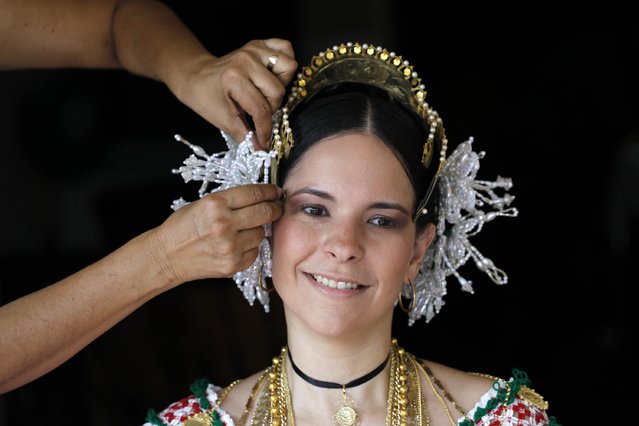
A woman is helped with adorning her hair with jewelry, part of the traditional clothing known as “Pollera”, before the annual Thousand Polleras parade in Las Tablas, in the province of Los Santos January 10, 2015. According to local residents, the Pollera dates back to the 18th century and was worn by the Spanish lower classes. (Photo by Carlos Jasso/Reuters)

A woman is helped with adorning her hair with jewelry, part of the traditional clothing known as “Pollera”, before the annual Thousand Polleras parade in Las Tablas, in the province of Los Santos January 10, 2015. According to local residents, the Pollera dates back to the 18th century and was worn by the Spanish lower classes. Today, it has become the Panamanian national costume. The dress is made entirely by hand and the jewellery worn is pure gold and worth thousands of dollars. (Photo by Carlos Jasso/Reuters)
Details
12 Jan 2015 15:46:00
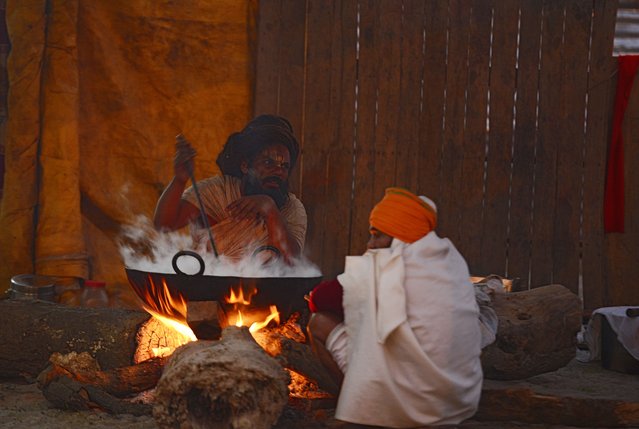
This picture taken on December 31, 2017 shows an Indian sadhu preparing food at a camp at Sangam, ahead of the Magh Mela festival, in Allahabad. The Magh Mela, which is known as a mini-Kumbh Mela, is scheduled to start January 2 and continue until February 13 with auspicious bathing dates throughout the 45 day period. (Photo by Sanjay Kanojia/AFP Photo)

This picture taken on December 31, 2017 shows an Indian sadhu preparing food at a camp at Sangam, ahead of the Magh Mela festival, in Allahabad. The Magh Mela, which is known as a mini-Kumbh Mela, is scheduled to start January 2 and continue until February 13 with auspicious bathing dates throughout the 45 day period. (Photo by Sanjay Kanojia/AFP Photo)
Details
02 Jan 2018 08:38:00
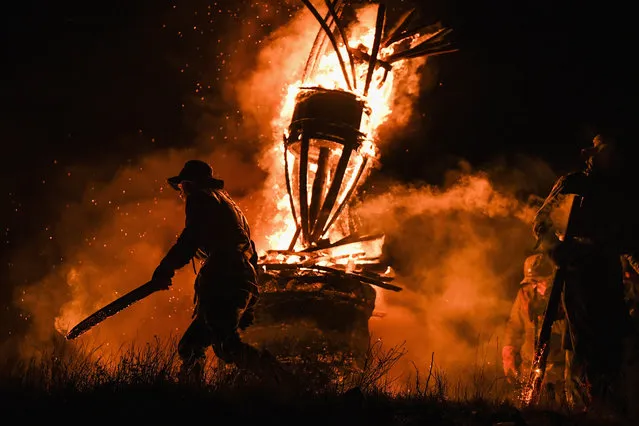
The Clavie, a burning barrel packed with tar soaked sticks fixed on the top of a pole, is surrounded by people at the Doorie Hill on January 11, 2018 in Burghead, Scotland. People welcome in the New Year with the fire ceremony which has ancient roots dating back to the 1750s, when the Julian calendar was reformed in Britain. It is believed to bring good luck for the coming year. (Photo by Jeff J. Mitchell/Getty Images)

The Clavie, a burning barrel packed with tar soaked sticks fixed on the top of a pole, is surrounded by people at the Doorie Hill on January 11, 2018 in Burghead, Scotland. People welcome in the New Year with the fire ceremony which has ancient roots dating back to the 1750s, when the Julian calendar was reformed in Britain. It is believed to bring good luck for the coming year. (Photo by Jeff J. Mitchell/Getty Images)
Details
12 Jan 2018 08:34:00
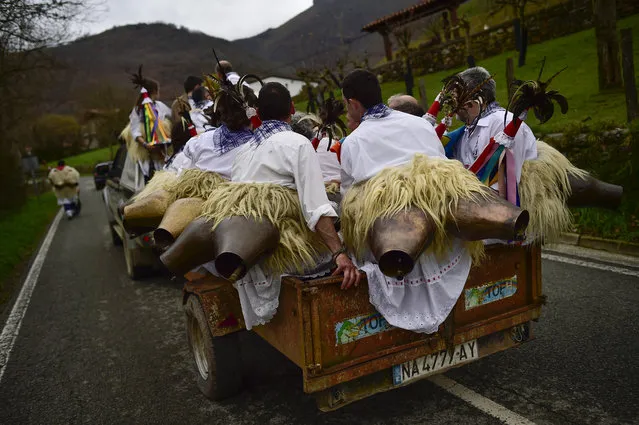
Joaldunaks return in a trailer to their town at the end of Carnival between of the Pyrenees villages of Ituren and Zubieta, northern Spain, Monday, February 1, 2016. In one of the most ancient carnivals in Europe, dating from before the Roman empire, companies of Joaldunak (cowbells) made up of residents of two towns, Ituren and Zubieta, parade the streets costumed in sandals, lace petticoats, sheepskins around the waist and shoulders, coloured neckerchiefs, conical caps with ribbons and a hyssop of horsehair in their right hands and cowbells hung across their lower back. (Photo by Alvaro Barrientos/AP Photo)

Joaldunaks return in a trailer to their town at the end of Carnival between of the Pyrenees villages of Ituren and Zubieta, northern Spain, Monday, February 1, 2016. In one of the most ancient carnivals in Europe, dating from before the Roman empire, companies of Joaldunak (cowbells) made up of residents of two towns, Ituren and Zubieta, parade the streets costumed in sandals, lace petticoats, sheepskins around the waist and shoulders, coloured neckerchiefs, conical caps with ribbons and a hyssop of horsehair in their right hands and cowbells hung across their lower back. (Photo by Alvaro Barrientos/AP Photo)
Details
02 Feb 2016 13:07:00