Lucinda Grange perches on the eagle's head on the corner of New York's iconic Chrysler Building in Manhattan, New York City. (Photo by Lucinda Grange/Barcroft Media USA)
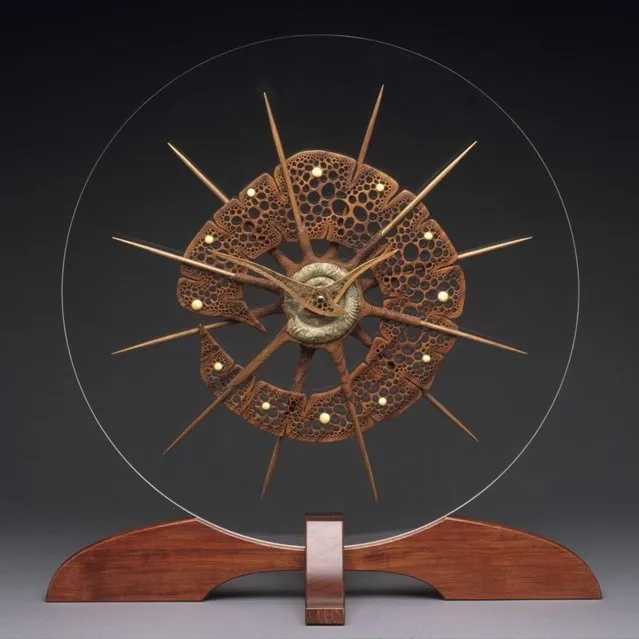
A large Mantle or Desk Clock featuring a fossil ammonite at its center, carved from the South American wood Keolbra with radiating Walnut spines. The clock hangs on a round, Plexiglass back supported by a wood base (Bubinga). The clockworks is a quartz, high-torque movement that runs on a single AA battery.
Lindsay Mann (L) and Anabella Mowbray kiss as they take photos of themselves laying in the confetti on 7th Avenue in Times Square on New Year's Eve in New York January 1, 2015. (Photo by Carlo Allegri/Reuters)
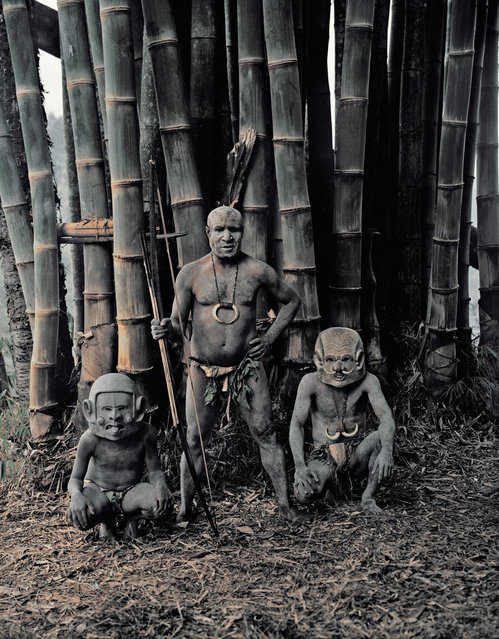
“Asaro from the Eastern Highlands”. The mudmen could not cover their faces with mud because the people of Papua New Guinea thought that the mud from the Asaro river was poisonous. So instead of covering their faces with this alleged poison, they made masks from pebbles that they heated and water from the waterfall, with unusual designs such as long or very short ears either going down to the chin or sticking up at the top, long joined eyebrows attached to the top of the ears, horns and sideways mouths. (Photo and caption by Jimmy Nelson)
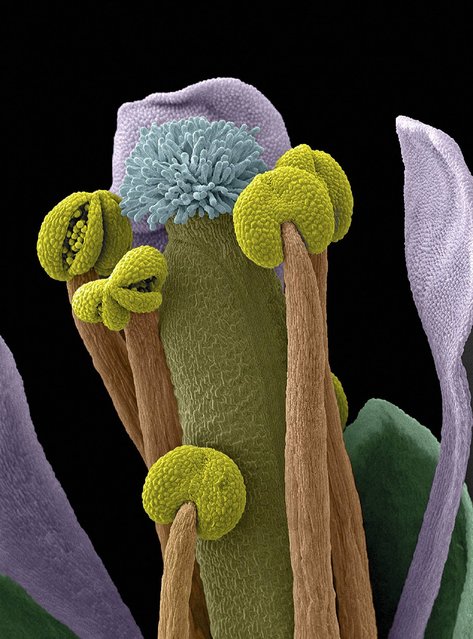
Beautiful, strange and occasionally alarming pictures from the shortlist for this year’s Wellcome image awards – which celebrate the very best in science photography and imaging – from an x-ray of a bat to a micrograph of a kidney stone. The exhibition opens on 12 March at three science centres and the Museum of Science and Industry in Manchester. Photo: Scanning electron micrograph (SEM) of an Arabidopsis thaliana flower, also commonly known as thale cress. Some of the anthers are open, revealing pollen grains ready for dispersal. Arabidopsis was the first plant to have its entire genome sequenced and is widely used as a model organism in molecular and plant biology. Horizontal width of image is 1200 microns. Magnification 100x. (Photo by Stefan Eberhard/Wellcome Images)
Martin Lacey Jr. with a lion during the premiere of the Circus Krone program “Circus der Preistraeger” at Circus Krone on February 2, 2016 in Munich, Germany. (Photo by Hannes Magerstaedt/Getty Images)
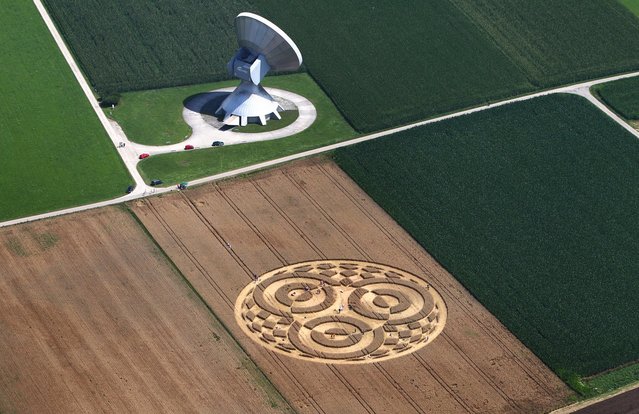
People walk through crop circles in a cornfield near Raisting, Germany, on July 28, 2014. According to media reports, a balloonist had discovered the circle some days ago. Since then, hundreds of people came to the field to watch it, however it is unclear who did create the pattern. (Photo by Karl-Josef Hildenbrand/DPA)