A young exhibitor arrives with her kitten on a lead at the National Cat Club show at Crystal Palace, London. (Photo by Fox Photos/Getty Images). 2nd December 1931
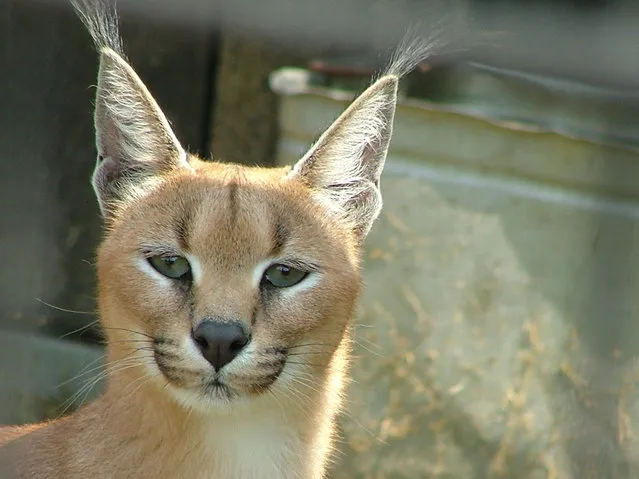
The caracal also known as the desert lynx, is a wild cat that is widely distributed across Africa, central Asia and southwest Asia into India. In 2002 the IUCN listed the caracal as Least Concern as it is widespread and relatively common. The felid is considered threatened in north Africa, and rare in the central Asian republics and India.
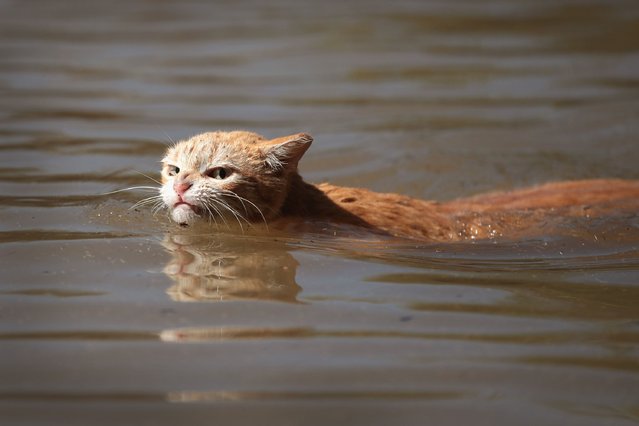
A cat tries to find dry ground around an apartment complex in Houston after Hurricane Harvey hit on Aug. 30. Harvey made landfall in South Texas on August 25, leading to days of downpours that dumped more than 50 inches of rain. Harvey damaged or destroyed about 200,000 homes as the storm system flooded much of Houston and smaller coastal communities. (Photo by Scott Olson/Getty Images)
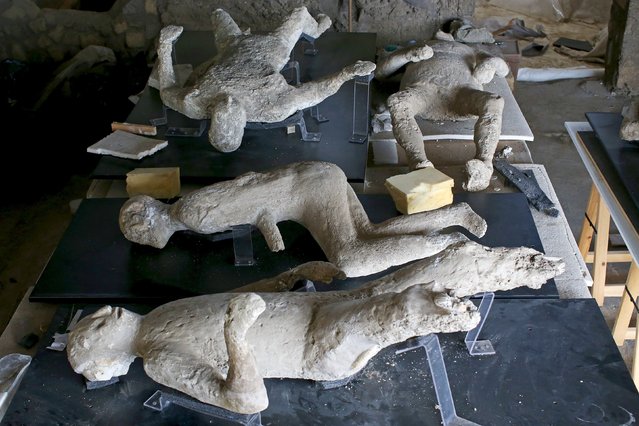
Plaster cast moulds of victims of the Mount Vesuvius eruption lie on a display table in a laboratory at Pompeii October 13, 2015. An expert team made up of archaeologists, radiologists, orthodontists and anthropologists began on September 2015 to use CAT scan technology (computerised axial tomography) to peer inside the plaster cast moulds of Pompeii's victims, in a study that has added more detail to previous findings. A 16-layer scan had to be used in order to penetrate the hardened plaster but the results showed up impressive skeletal remains and near perfect teeth. (Photo by Alessandro Bianchi/Reuters)
An actress dressed as Black Cat poses for a photo at the London Super Comic Convention at the ExCeL Centre on February 23, 2013 in London, England. Enthusiasts at the Comic Convention are encouraged to wear a costume of their favourite comic character and flock to the ExCeL to gather all the latest news in the world of comics, manga, anime, film, cosplay, games and cult fiction. (Photo by Jordan Mansfield)
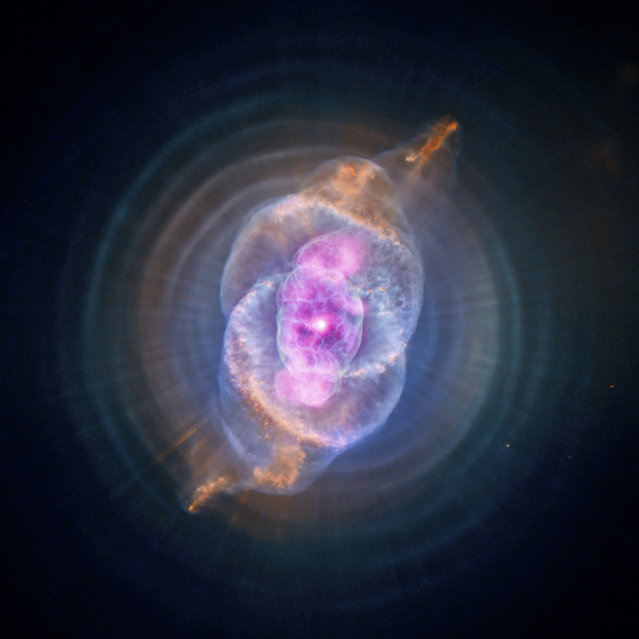
This image is NGC 6543 known as the Cat's Eye Nebula as it appears to the Chandra X-Ray Observatory and Hubble Telescope. A planetary nebula is a phase of stellar evolution that the sun should experience several billion years from now, when it expands to become a red giant and then sheds most of its outer layers, leaving behind a hot core that contracts to form a dense white dwarf star. This image was released October 10, 2012. (Photo by J. Kastner/NASA/CXC/RIT)