Loading...
Done
Takeoka Chisaka, Hiroshima, Japan. “One morning in August 1945, I was walking home from the night shift at a factory in Hiroshima. As I reached my door, there was a huge explosion. When I came to, my head was bleeding and I had been blasted 30m away”. (Photo and caption by Sasha Maslov)

Takeoka Chisaka, Hiroshima, Japan. “One morning in August 1945, I was walking home from the night shift at a factory in Hiroshima. As I reached my door, there was a huge explosion. When I came to, my head was bleeding and I had been blasted 30m away. The atomic bomb had detonated. When I found my mother, her eyes were badly burned. A doctor said they had to come out, but he didn’t have the proper tools so used a knife instead. It was hellish. I became a peace-worker after the war. In the 1960s, at a meeting at the UN, I met one of the people who created the atomic bomb. He apologised”. (Photo and caption by Sasha Maslov)
Details
11 May 2015 11:56:00
“The V-30 Warhawk was designed by Blackshaw Avionics as a long-range fighter and was primarily used by the Arcadian Air Force for escort duties. . (Jon Hall)

“The V-30 Warhawk was designed by Blackshaw Avionics as a long-range fighter and was primarily used by the Arcadian Air Force for escort duties. The plane pictured is the “Spirit of Freedom” and was one of the four planes that escorted the Arcadian Royal Airship during and after the Great War. The three other fighters were the “Spirit of Hope”, the “Spirit of Justice” and the “Spirit of Destiny”. All pilots were hand-picked by the Head of Airborne Forces and included some of the very finest pilots in the Kingdom. The crew consisted of one pilot and one gunner although both cabins were fitted so that if either crew member was killed the other could take over their duties. Each Warhawk was fitted with four Haverlock “Banshee” engines and four 24mm machine guns”. (Photo and comment by Jon Hall)


Details
11 Feb 2013 10:36:00
Tridacna Gigas, or Giant Clams

“The giant clam, Tridacna gigas (known as pā’ua in Cook Islands Māori), is the largest living bivalve mollusc. T. gigas is one of the most endangered clam species. It was mentioned as early as 1825 in scientific reports. One of a number of large clam species native to the shallow coral reefs of the South Pacific and Indian oceans, they can weigh more than 200 kilograms (440 lb) measure as much as 120 cm (47 in) across, and have an average lifespan in the wild of 100 years or more”. – Wikipedia

Photo: Tridacna Gigas, or Giant Clams spew water as a traditional fisherman passes by a small sanctuary on January 23, 2004 near Bolinao in the Northern Philippines. The clams, prime builders for coral reefs and providing shelter for spawning fish and other marine life, are exposed by low tides in the sanctuary. Overfishing and pollution throughout the country are not only threatening food security, but are also starting to choke one of the few working clam sanctuaries in the world. (Photo by David Greedy/Getty Images)
Details
01 Oct 2011 13:10:00
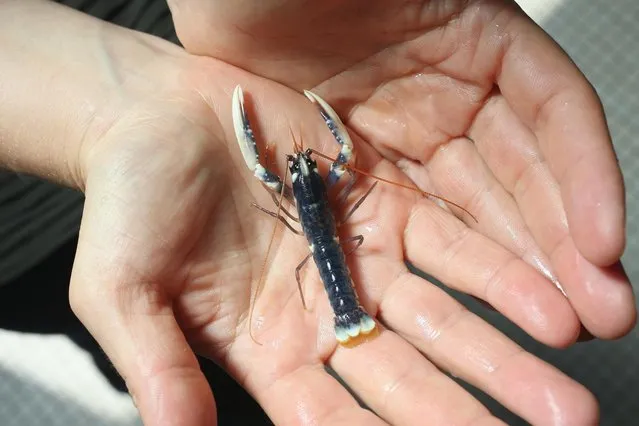
Isabel Schmalenbach, an environmental scientist with the Helgoland Biological Institute (Biologische Anstalt Helgoland), part of the Alfred Wegener Institute for Polar and Marine Research, holds a one-year old baby European lobster (Homarus gammarus) raised at the institute on August 3, 2013 on Helgoland Island, Germany. (Photo by Sean Gallup/Getty Images)

Isabel Schmalenbach, an environmental scientist with the Helgoland Biological Institute (Biologische Anstalt Helgoland), part of the Alfred Wegener Institute for Polar and Marine Research, holds a one-year old baby European lobster (Homarus gammarus) raised at the institute on August 3, 2013 on Helgoland Island, Germany. Later in the day Schmalenbach and her colleagues released a total of 415 one-year old lobsters into the North Sea as part of an effort to repopulate the lobster population around Helgoland (also called Heligoland). In the 19th century local fishermen caught up to 80,000 lobsters a year in the surrounding waters, combined with the heavy allied bombing of the island during and after World War II, as well as other environmental factors, decimated the lobster population. (Photo by Sean Gallup)
Details
05 Aug 2013 08:39:00
A member of the Indian company Margi Kathakali theatre performs during “Kijote Kathakali”, a Kathakali recital based on the Spanish classic “Don Quixote”, at the Niemeyer Center in Aviles, northern Spain, July 29, 2016. The performance and text captured the essence of the novel while sticking to the format of Kathakali. Kathakali is one of the major forms of classical Indian dance. It is another “story play” genre of art, but one distinguished by its elaborately colorful make-up, costumes and face masks wearing actor-dancers, who have traditionally been all males. (Photo by Eloy Alonso/Reuters)

A member of the Indian company Margi Kathakali theatre performs during “Kijote Kathakali”, a Kathakali recital based on the Spanish classic “Don Quixote”, at the Niemeyer Center in Aviles, northern Spain, July 29, 2016. The performance and text captured the essence of the novel while sticking to the format of Kathakali. Kathakali is one of the major forms of classical Indian dance. (Photo by Eloy Alonso/Reuters)
Details
31 Jul 2016 11:02:00
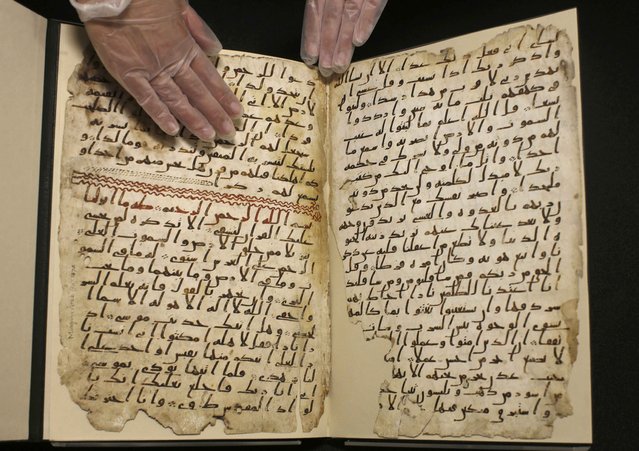
A fragment of a Koran manuscript is seen in the library at the University of Birmingham in Britain July 22, 2015. A British university said on Wednesday that fragments of a Koran manuscript found in its library were from one of the oldest surviving copies of the Islamic text in the world, possibly written by someone who might have known Prophet Mohammad. (Photo by Peter Nicholls/Reuters)

A fragment of a Koran manuscript is seen in the library at the University of Birmingham in Britain July 22, 2015. A British university said on Wednesday that fragments of a Koran manuscript found in its library were from one of the oldest surviving copies of the Islamic text in the world, possibly written by someone who might have known Prophet Mohammad. Radiocarbon dating indicated that the parchment folios held by the University of Birmingham in central England were at least 1,370 years old, which would make them one of the earliest written forms of the Islamic holy book in existence. (Photo by Peter Nicholls/Reuters)
Details
23 Jul 2015 11:00:00
Ultra-orthodox Jewish wedding in Israel. Tens of thousands of Ultra-Orthodox Jews of the Belz Hasidic dynasty gather at the wedding ceremony of Rabbi Shalom Rokach in Kiryat Belz, in Jerusalem, on May 22, 2013. Around 25,000 ultra-orthodox Jews took part, making it one of the biggest weddings of the past few years. (Photo by Gil Cohen)

“Coming back home at 5am sunrise, I was just beginning to digest the grand event I was lucky to witness and cover: the wedding of the grandson of one of the most influential spiritual leaders in Israel’s ultra-Orthodox community...”. – Ronen Zvulun via Reuters. Photo: Ultra-orthodox Jewish wedding in Israel. Tens of thousands of Ultra-Orthodox Jews of the Belz Hasidic dynasty gather at the wedding ceremony of Rabbi Shalom Rokach in Kiryat Belz, in Jerusalem, on May 21, 2013. Around 25,000 ultra-orthodox Jews took part, making it one of the biggest weddings of the past few years. (Photo by Gil Cohen)
Details
24 May 2013 08:02:00
Crowds look on as Xolo the Giant Dog, one of the giant Royal De Luxe street puppets taking part in Liverpool's World War I centenary commemorations, walks through the streets of Liverpool on July 25, 2014 in Liverpool, England. (Photo by Christopher Furlong/Getty Images)

Crowds look on as Xolo the Giant Dog, one of the giant Royal De Luxe street puppets taking part in Liverpool's World War I centenary commemorations, walks through the streets of Liverpool on July 25, 2014 in Liverpool, England. French street theatre company Royal de Luxe are putting on a show throughout the city as part of Liverpool's World War I centenary commemorations from July 23-27. The giant puppet grandmother has slept in the hall for two days as part of “Memories of August 1914”. As the giants tour the city the Little Girl Giant and her dog Xolo will meet up with the giant Grandmother telling the story of life leading up to World War One. (Photo by Christopher Furlong/Getty Images)
Details
27 Jul 2014 10:52:00