Members of Barcelona's Latin community perform traditional dances in the city center on the occasion of the national day of Spain on October 12, 2023. (Photo by Jordi Boixareu/Alamy Live News)
Zoi Karangelou of Greece compete in the Women's Solo Technical final on day one of World Aquatics Artistic Swimming World Cup Super Final 2025 at Xi'an Olympic Sports Centre on June 13, 2025 in Xi An, China. (Photo by Lintao Zhang/Getty Images)
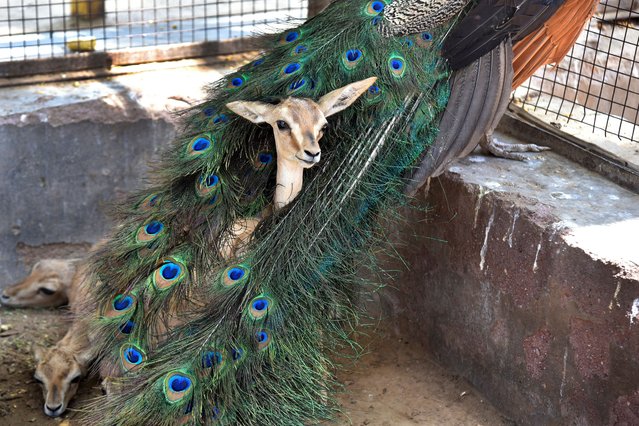
A Chinkara gazelle fawn rests in the plumage of a peacock at an animal rescue center on a hot summer day in Bikaner, Rajasthan, India, Thursday, May 23, 2024. (Photo by Dinesh Gupta/AP Photo)
Grinders are on display for sale during the HempCon 2011 Medical Marijuana Expo at the Los Angeles Convention Center on August 26, 2011 in Los Angeles, California. The three-day event includes exhibits, evaluation services, legal services, equipment, and accessories. (Photo by Kevork Djansezian/Getty Images)
O Santa Claus of Australia competes in the mens 80–84 years 100 metres heats during day two of the 2009 Sydney World Masters Games at Sydney Olympic Park on October 11, 2009 in Sydney, Australia. (Photo by Mark Nolan/Getty Images)
Geordie Shore babe Chantelle Connelly enjoys a wild night out in Benidorm, Spain on September 20, 2016 which ended at a strip club with a group of girls for her sisters birthday. (Photo by Danny Ryan/iCelebTV.com)
Nuns react at the arrival of Pope Francis at the St. Mary's school to attend a meeting of clergy and religious in Nairobi, Kenya, 26 November 2015. Pope Francis is on a six days visit that will take him to Kenya, Uganda and the Repulic of Central Africa from 25 to 30 November. (Photo by Daniel Dal Zennaro/EPA)
This Thursday, January 22, 2015 photo made with a long exposure shows the glow from a Noctiluca scintillans algal bloom along the seashore in Hong Kong. The luminescence, also called Sea Sparkle, is triggered by farm pollution that can be devastating to marine life and local fisheries, according to University of Georgia oceanographer Samantha Joye. Noctiluca itself does not produce neurotoxins like other similar organisms do. But its role as both prey and predator tends can eventually magnify the accumulation of toxins in the food chain, according to R. Eugene Turner at Louisiana State University. (Photo by Kin Cheung/AP Photo)