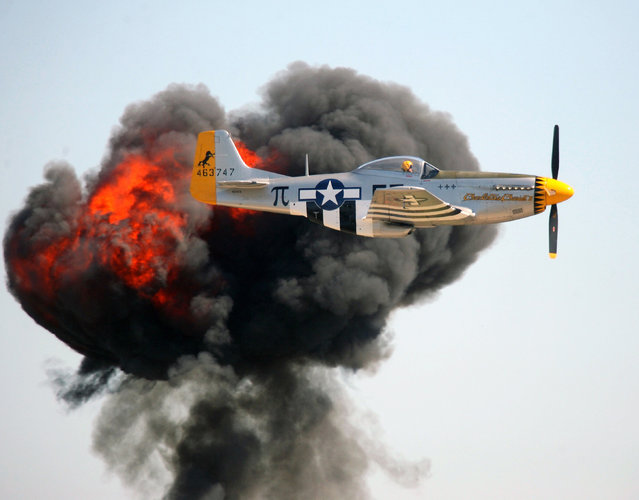
A P-51 Mustang named “Charlotte's Chariot” from the Southern Heritage Air Foundation flies past a cloud of smoke and fire from a nearby battle reenactment during the Wings Over Houston Airshow in Houston, on Saturday, November 1, 2014. Battle reenactments are part of the yearly show held at Ellington Airport. (Photo by Kar Hlava/AP Photo/Bay Area Citizen)
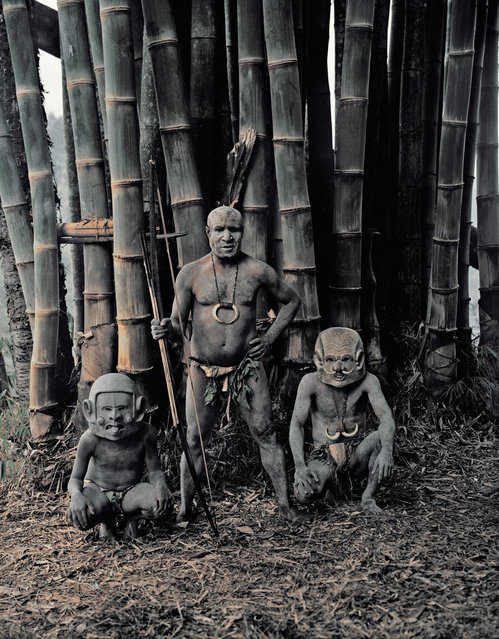
“Asaro from the Eastern Highlands”. The mudmen could not cover their faces with mud because the people of Papua New Guinea thought that the mud from the Asaro river was poisonous. So instead of covering their faces with this alleged poison, they made masks from pebbles that they heated and water from the waterfall, with unusual designs such as long or very short ears either going down to the chin or sticking up at the top, long joined eyebrows attached to the top of the ears, horns and sideways mouths. (Photo and caption by Jimmy Nelson)
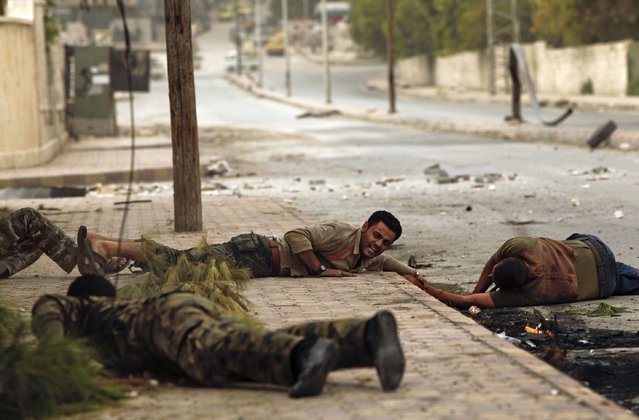
Members of the Al-Baraa bin Malek batallion, part of the Free Syria Army's Al-Fatah brigade, duck to the ground as they pull a man (R) who was shot by a sniper twice in the Bustan al-Basha district of the northern city of Aleppo on October 20, 2012. (Photo by Javier Manzano/AFP Photo)
A frog sits on a leaf and instead of seeing a reflection of itself in the water below, it sees a snail, attached to the bottom of the leaf, in a fish tank in Vietnam. (Photo by Duong Quoc Dinh/Solent Ne/SIPA Press)
Russia's Maria Sharapova carries the torch during the opening ceremony of the 2014 Winter Olympics in Sochi, Russia, Friday, February 7, 2014. (Photo by Matt Dunham/Associated Press)
Sjinkie Knegt of Netherlands, left, and Park Se-Yeong of South Korea crash out as they compete in a men's 1500m short track speedskating final at the Iceberg Skating Palace during the 2014 Winter Olympics, Monday, February 10, 2014, in Sochi, Russia. (Photo by Bernat Armangue/AP Photo)
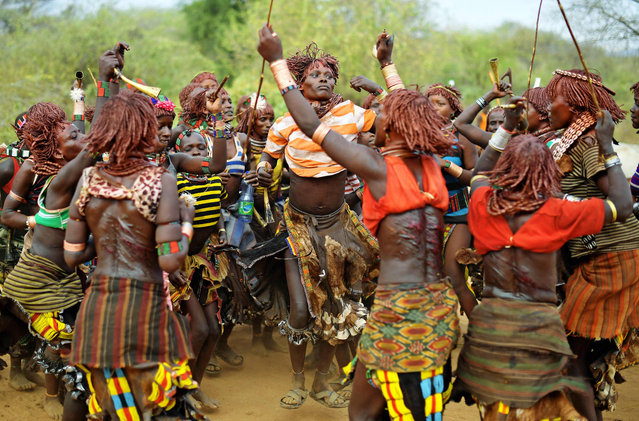
Hamar women dance before a bull jumping ceremony in Ethiopia's southern Omo Valley region near Turmi on September 19, 2016. The Hamar are a Nilotic ethnic group in Ethiopia. The construction of the Gibe III dam, the third largest hydroelectric plant in Africa, and large areas of very “thirsty” cotton and sugar plantations and factories along the Omo river are impacting heavily on the lives of tribes living in the Omo Valley who depend on the river for their survival and way of life. (Photo by Carl De Souza/AFP Photo)