Loading...
Done
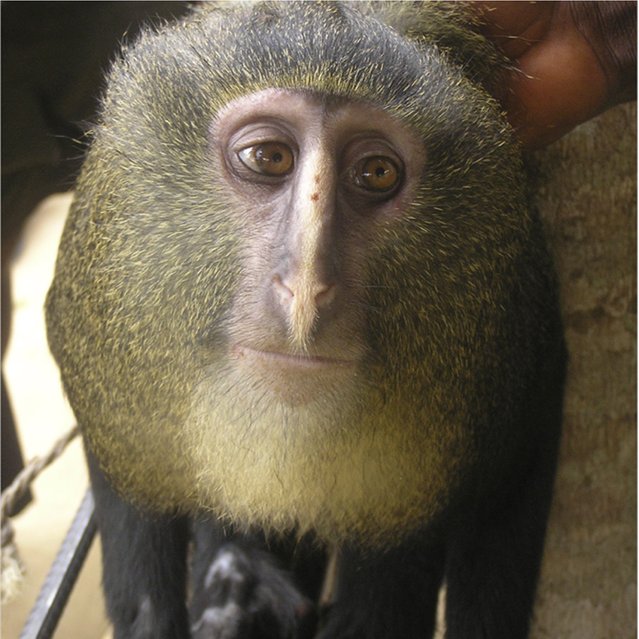
A new species of monkey found in the Democratic Republic of the Congo and identified as Lesula (Cercopithecus lomamiensis) is seen in this undated photograph from an article published September 12, 2012 in the science journal PLOS One. (Photo by Hart J. A., Detwiler K. M., Gilbert C. C./Reuters)

A new species of monkey found in the Democratic Republic of the Congo and identified as Lesula (Cercopithecus lomamiensis) is seen in this undated photograph from an article published September 12, 2012 in the science journal PLOS One. The monkey was first seen in 2007 by researchers John and Terese Hart of the Peabody Museum of Natural History at Yale Research Project. The finding of C. lomamiensis represents only the second new species of African monkey to be discovered in the past 28 years, according to the research article. (Photo by Hart J. A., Detwiler K. M., Gilbert C. C./Reuters)
Details
27 Sep 2012 08:17:00
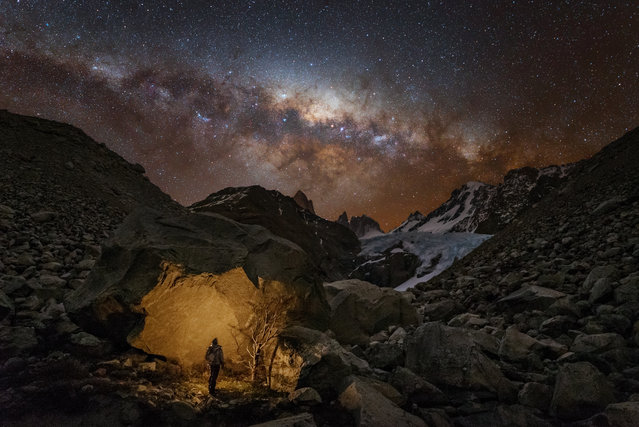
“People and Space”. Winner: Wanderer in Patagonia by Yuri Zvezdny (Russia) A lone stargazer stares up at the stars of our galaxy, the Milky Way, as they stretch across the night sky over the glacier “White Stones” (Piedras Blancas) in the Los Glaciares National Park, Argentina. El Chaltén, Santa Cruz Province, Argentina, 27 September 2016 iOptron Sky-Tracker mount, Sony A7S camera, 18 mm f/2.8 lens, ISO 5000, 30-second exposure Wanderer in Patagonia. (Photo by Yuri Zvezdny/Insight Astronomy Photographer of the Year 2017)

“People and Space”. Winner: Wanderer in Patagonia by Yuri Zvezdny (Russia) A lone stargazer stares up at the stars of our galaxy, the Milky Way, as they stretch across the night sky over the glacier “White Stones” (Piedras Blancas) in the Los Glaciares National Park, Argentina. El Chaltén, Santa Cruz Province, Argentina, 27 September 2016 iOptron Sky-Tracker mount, Sony A7S camera, 18 mm f/2.8 lens, ISO 5000, 30-second exposure Wanderer in Patagonia. (Photo by Yuri Zvezdny/Insight Astronomy Photographer of the Year 2017)
Details
18 Sep 2017 07:09:00
Dancers wearing new bikinis perform in front of passers-by and a line of photographers during a promotional flash mob event on a square outside Shinjuku station in Tokyo on July 18, 2016. The event was organized by the Japan Swimsuit Association to promote new swimwear. (Photo by Toru Yamanaka/AFP Photo)

Dancers wearing new bikinis perform in front of passers-by and a line of photographers during a promotional flash mob event on a square outside Shinjuku station in Tokyo on July 18, 2016. The event was organized by the Japan Swimsuit Association to promote new swimwear. (Photo by Toru Yamanaka/AFP Photo)
Details
19 Jul 2016 13:17:00
Two models sit in an acrylic “ZF-Car” from the German manufacturer of the same name at the Automechanika automotive service industry trade fair in Frankfurt am Main, Germany, 12 September 2016. The Automechanika Fair runs from 13 to 17 September 2016. (Photo by Boris Rössler/EPA)

Two models sit in an acrylic “ZF-Car” from the German manufacturer of the same name at the Automechanika automotive service industry trade fair in Frankfurt am Main, Germany, 12 September 2016. The Automechanika Fair runs from 13 to 17 September 2016. (Photo by Boris Rössler/EPA)
Details
13 Sep 2016 10:17:00
Kristina Elekes, 23, races on her ski during the Bikini Race contest held at Arena Platos Paltinis winter resort, near Sibiu city, 275 Km north from Bucharest, Romania, 06 March 2016. Bikini Race is a timed show on the slopes, at the fourth edition, for women dressed only in swimmsuits and some winter accessories. (Photo by Mihaela Bobar/EPA)

Kristina Elekes, 23, races on her ski during the Bikini Race contest held at Arena Platos Paltinis winter resort, near Sibiu city, 275 Km north from Bucharest, Romania, 06 March 2016. Bikini Race is a timed show on the slopes, at the fourth edition, for women dressed only in swimmsuits and some winter accessories. (Photo by Mihaela Bobar/EPA)
Details
08 Mar 2016 13:50:00
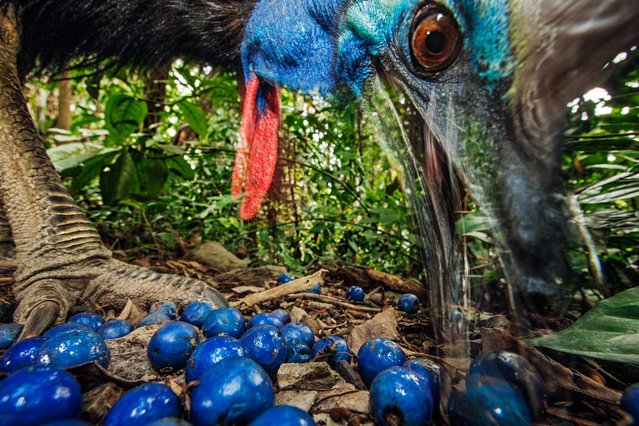
“Cassowaries are large, flightless birds related to emus and (more distantly) to ostriches, rheas, and kiwis”, writes Olivia Judson in the September issue of National Geographic magazine. (Photo by Christian Ziegler/National Geographic)

“Cassowaries are large, flightless birds related to emus and (more distantly) to ostriches, rheas, and kiwis”, writes Olivia Judson in the September issue of National Geographic magazine. How large? People-size: Adult males stand well over five foot five and top 110 pounds. Females are even taller, and can weigh more than 160 pounds. Dangerous when roused, they’re shy and peaceable when left alone. But even birds this big and tough are prey to habitat loss. The dense New Guinea and Australia rain forests where they live have dwindled. Today cassowaries might number 1,500 to 2,000. And because they help shape those same forests – by moving seeds from one place to another – “if they vanish”, Judson writes, “the structure of the forest would gradually change” too. (Photo by Christian Ziegler/National Geographic)
Details
06 Jan 2014 12:21:00
A Muslim woman wearing a hijab walks past a lingerie advertisement in downtown Vancouver, British Columbia April 26, 2013. (Photo by Andy Clark/Reuters)

A Muslim woman wearing a hijab walks past a lingerie advertisement in downtown Vancouver, British Columbia April 26, 2013. (Photo by Andy Clark/Reuters)

P.S. All pictures are presented in high resolution. To see Hi-Res images – just TWICE click on any picture. In other words, click small picture – opens the BIG picture. Click BIG picture – opens VERY BIG picture (if available; this principle works anywhere on the site AvaxNews)
Details
27 Apr 2013 14:37:00
Iranian demonstrators burn an Israeli flag during a rally marking al-Quds (Jerusalem) Day in Tehran July 10, 2015. (Photo by Reuters/Stringer/TIMA)

Iranian demonstrators burn an Israeli flag during a rally marking al-Quds (Jerusalem) Day in Tehran July 10, 2015. (Photo by Reuters/Stringer/TIMA)
Details
12 Jul 2015 13:46:00