Loading...
Done
Family members mourn the passing of Manuela Chavez, who died from symptoms related to the new coronavirus at the age of 88, as a government team prepares to remove her body from inside her home, in the Shipibo Indigenous community of Pucallpa, in Peru's Ucayali region, Monday, August 31, 2020. While the lucky are cured with ancestral ailments, the less fortunate often die at home. A government team travels from one spartan, thatch-roofed home to the next, removing the dead from their homes where they took their last breaths. (Photo by Rodrigo Abd/AP Photo)

Family members mourn the passing of Manuela Chavez, who died from symptoms related to the new coronavirus at the age of 88, as a government team prepares to remove her body from inside her home, in the Shipibo Indigenous community of Pucallpa, in Peru's Ucayali region, Monday, August 31, 2020. While the lucky are cured with ancestral ailments, the less fortunate often die at home. A government team travels from one spartan, thatch-roofed home to the next, removing the dead from their homes where they took their last breaths. (Photo by Rodrigo Abd/AP Photo)
Details
18 Sep 2020 00:03:00
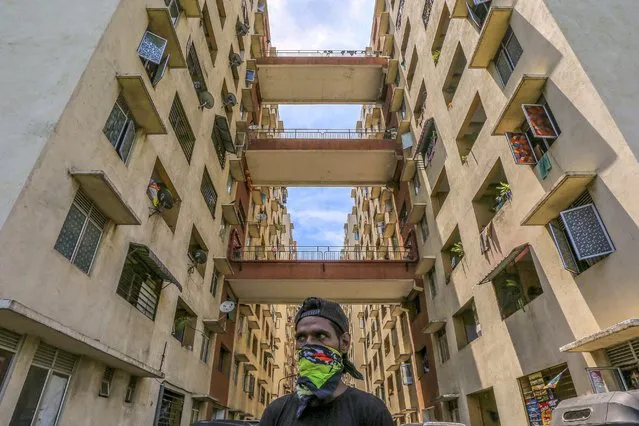
A Sri Lankan man use a scarf as a protective mask as he waits for a swab test at a locked-down area in Colombo, Sri Lanka, 14 May 2020. The Sri Lankan government has started lifting most of the restrictions implemented nearly two months ago in a bid to slow down the spread of the SARS-CoV-2 coronavirus causing the COVID-19 disease and is preparing for a full reopening of businesses and a resumption of activities to avoid an economic slump. (Photo by Chamila Karunarathne/EPA/EFE/Rex Features/Shutterstock)

A Sri Lankan man use a scarf as a protective mask as he waits for a swab test at a locked-down area in Colombo, Sri Lanka, 14 May 2020. The Sri Lankan government has started lifting most of the restrictions implemented nearly two months ago in a bid to slow down the spread of the SARS-CoV-2 coronavirus causing the COVID-19 disease and is preparing for a full reopening of businesses and a resumption of activities to avoid an economic slump. (Photo by Chamila Karunarathne/EPA/EFE/Rex Features/Shutterstock)
Details
02 Jul 2020 00:05:00
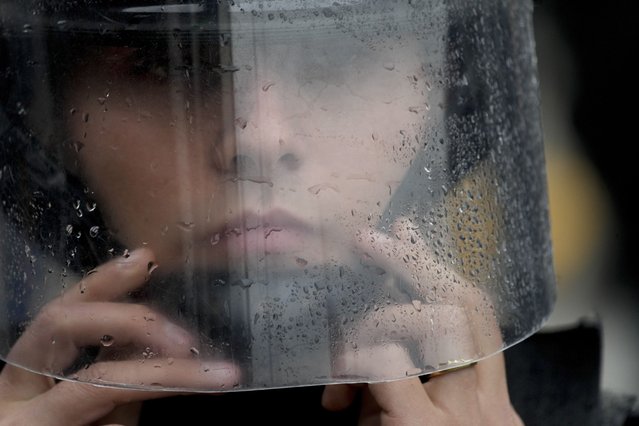
A police officer adjusts her helmet on the sidelines of an anti-government protest against food scarcity at soup kitchens and economic reforms proposed by President Javier Milei, in Buenos Aires, Argentina, May 7, 2024. (Photo by Natacha Pisarenko/AP Photo)

A police officer adjusts her helmet on the sidelines of an anti-government protest against food scarcity at soup kitchens and economic reforms proposed by President Javier Milei, in Buenos Aires, Argentina, May 7, 2024. (Photo by Natacha Pisarenko/AP Photo)
Details
15 Sep 2025 05:02:00
A racoon jumps over a fence in almost deserted Central Park in Manhattan on April 16, 2020 in New York City. Gone are the softball games, horse-drawn carriages and hordes of tourists. In their place, pronounced birdsong, solitary walks and renewed appreciation for Central Park's beauty during New York's coronavirus lockdown. The 843-acre (341-hectare) park – arguably the world's most famous urban green space – normally bustles with human activity as winter turns to spring, but this year due to Covid-19 it's the wildlife that is coming out to play. (Photo by Johannes Eisele/AFP Photo)

A racoon jumps over a fence in almost deserted Central Park in Manhattan on April 16, 2020 in New York City. Gone are the softball games, horse-drawn carriages and hordes of tourists. In their place, pronounced birdsong, solitary walks and renewed appreciation for Central Park's beauty during New York's coronavirus lockdown. The 843-acre (341-hectare) park – arguably the world's most famous urban green space – normally bustles with human activity as winter turns to spring, but this year due to Covid-19 it's the wildlife that is coming out to play. (Photo by Johannes Eisele/AFP Photo)
Details
14 Dec 2025 07:04:00
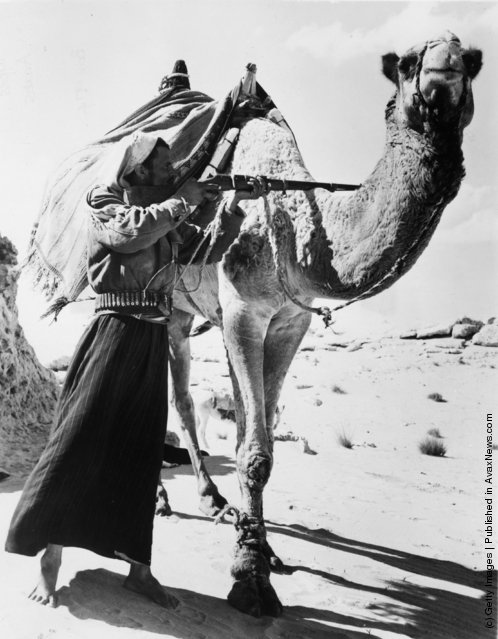
1955: A Bedouin rifleman hides behind his camel while he carefully takes aim in the Sahara desert

A Bedouin rifleman hides behind his camel while he carefully takes aim in the Sahara desert. (Photo by Three Lions/Getty Images). Circa 1955
Details
30 Nov 2011 12:12:00
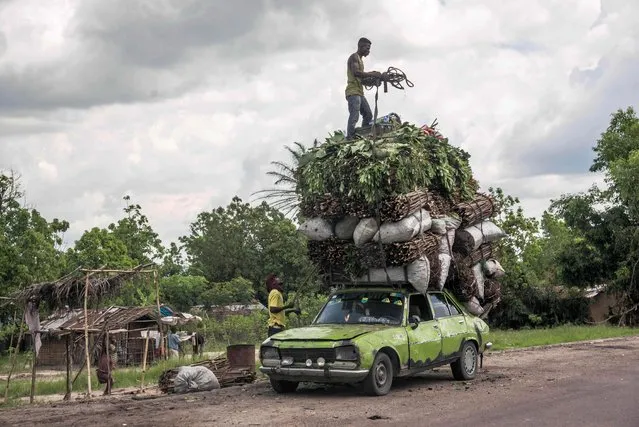
Vegetables, wood and charcoal are loaded onto the roof of a battered Peugeot on November 7, 2018 in Matadi, Democratic Republic of the Congo. From the port of Matadi to the capital Kinshasa, a 350 km road crosses the south-west of the Democratic Republic of Congo. (Photo by Junior D. Kannah/AFP Photo)

Vegetables, wood and charcoal are loaded onto the roof of a battered Peugeot on November 7, 2018 in Matadi, Democratic Republic of the Congo. From the port of Matadi to the capital Kinshasa, a 350 km road crosses the south-west of the Democratic Republic of Congo. (Photo by Junior D. Kannah/AFP Photo)
Details
07 Jan 2019 00:01:00
A woman poses after she got an image of a lion tattooed on her back as part of awareness campaign to save Asiatic lions and in preparations for the upcoming Navratri festival in Ahmedabad, India, October 5, 2018. (Photo by Amit Dave/Reuters)

A woman poses after she got an image of a lion tattooed on her back as part of awareness campaign to save Asiatic lions and in preparations for the upcoming Navratri festival in Ahmedabad, India, October 5, 2018. (Photo by Amit Dave/Reuters)
Details
15 Oct 2018 00:05:00
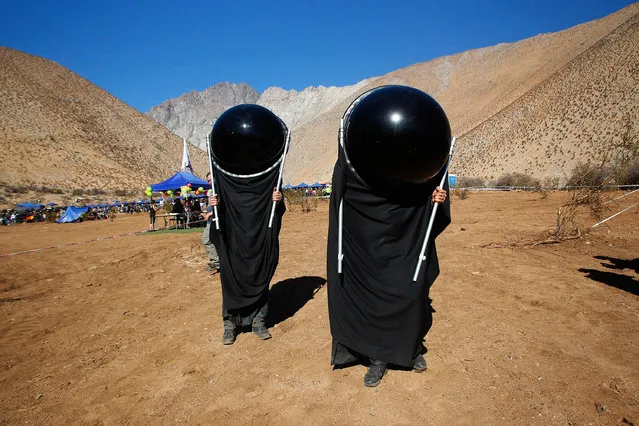
Chileans watch the sky with special suits prior to a total solar eclipse on July 2, 2019 in Paiguano, Chile. Around 25,0000 tourists arrived to Paiguano, a small town of around 1,000 inhabitants in the Elqui Valley, 650 km away Santiago. This is the only Earth's total solar eclipse of 2019 and the first one since 2017. From this point, the sun will fully disappear for around two minutes. It is best visible from a stripe in the South Pacific, Chile and Argentina. (Photo by Marcelo Hernandez/Getty Images)

Chileans watch the sky with special suits prior to a total solar eclipse on July 2, 2019 in Paiguano, Chile. Around 25,0000 tourists arrived to Paiguano, a small town of around 1,000 inhabitants in the Elqui Valley, 650 km away Santiago. This is the only Earth's total solar eclipse of 2019 and the first one since 2017. From this point, the sun will fully disappear for around two minutes. It is best visible from a stripe in the South Pacific, Chile and Argentina. (Photo by Marcelo Hernandez/Getty Images)
Details
04 Jul 2019 00:05:00