Loading...
Done
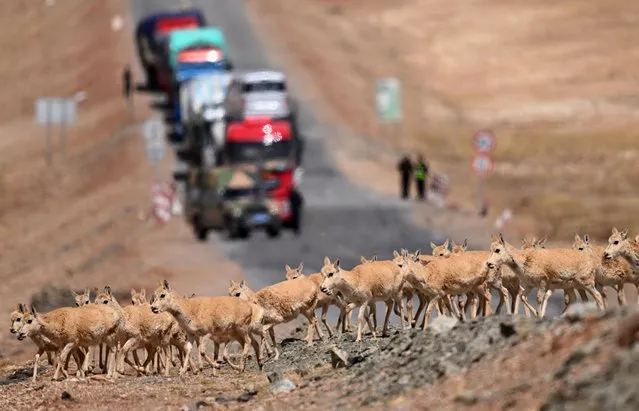
Pregnant Tibetan antelopes move across the Qinghai-Tibet highway in Hoh Xil, northwest China's Qinghai Province, May 29, 2023. A growing number of pregnant Tibetan antelopes are migrating to the heart of northwest China's Hoh Xil National Nature Reserve to give birth, according to the reserve's management office. Every year, tens of thousands of pregnant Tibetan antelopes start their migration to Hoh Xil in around May to give birth and leave with their offspring in late July. Under the first-class state protection in China, the once-endangered species is found in Tibet Autonomous Region, Qinghai Province, and Xinjiang Uygur Autonomous Region. Their population has increased over the past three decades thanks to the ban on illegal hunting and other measures implemented to improve its habitat. (Photo by Xinhua News Agency/Rex Features/Shutterstock)

Pregnant Tibetan antelopes move across the Qinghai-Tibet highway in Hoh Xil, northwest China's Qinghai Province, May 29, 2023. A growing number of pregnant Tibetan antelopes are migrating to the heart of northwest China's Hoh Xil National Nature Reserve to give birth, according to the reserve's management office. Every year, tens of thousands of pregnant Tibetan antelopes start their migration to Hoh Xil in around May to give birth and leave with their offspring in late July. (Photo by Xinhua News Agency/Rex Features/Shutterstock)
Details
08 Jun 2023 02:20:00
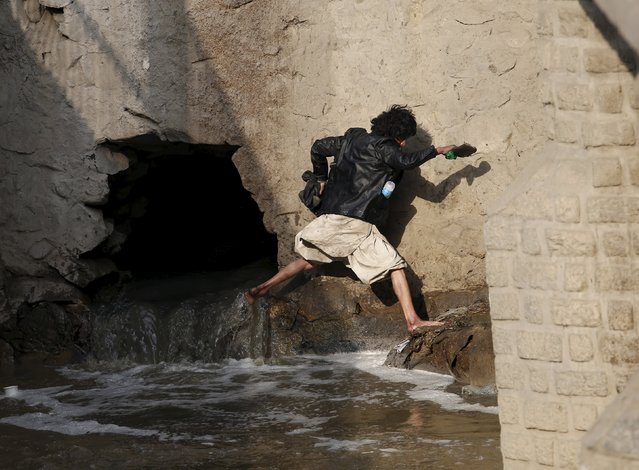
A man runs away during a police round up of suspected drug addicts in Kabul, Afghanistan December 27, 2015. Afghan officials have opened a new drug treatment centre in an abandoned NATO military base in Kabul, in the latest attempt to stamp out the country's massive problem of drug abuse. Camp Phoenix, a former training camp on the edges of Kabul set up by the U.S. army in 2003, will take in around 1,000 homeless drug addicts who will receive food, medical attention and treatment, said Public Health Minister Ferozuddin Feroz. (Photo by Ahmad Masood/Reuters)

A man runs away during a police round up of suspected drug addicts in Kabul, Afghanistan December 27, 2015. Afghan officials have opened a new drug treatment centre in an abandoned NATO military base in Kabul, in the latest attempt to stamp out the country's massive problem of drug abuse. Camp Phoenix, a former training camp on the edges of Kabul set up by the U.S. army in 2003, will take in around 1,000 homeless drug addicts who will receive food, medical attention and treatment, said Public Health Minister Ferozuddin Feroz. (Photo by Ahmad Masood/Reuters)
Details
11 Jan 2016 08:00:00
A view of one of the dioramas contained inside iron boxes as part of the “S.A.C.R.E.D” installation by Chinese artist Ai Weiwei during a media preview at the cathedral in Cuenca, Spain, July 21, 2016. (Photo by Susana Vera/Reuters)

A view of one of the dioramas contained inside iron boxes as part of the “S.A.C.R.E.D” installation by Chinese artist Ai Weiwei during a media preview at the cathedral in Cuenca, Spain, July 21, 2016. Ai Weiwei has reproduced scenes of his incarceration for a new art installation, a series of almost life-size dioramas – encased in steel boxes – showing his life in jail. (Photo by Susana Vera/Reuters)
Details
26 Jul 2016 10:25:00
Auditioning performers follow resident choreographer Erik Sorensen, center back, at the Sydney Dance Company in a routine during castings in Moulin Rouge's current show “Féerie”, in Sydney, Australia, Thursday, July 28, 2016. (Photo by Rob Griffith/AP Photo)

Auditioning performers follow resident choreographer Erik Sorensen, center back, at the Sydney Dance Company in a routine during castings in Moulin Rouge's current show “Féerie”, in Sydney, Australia, Thursday, July 28, 2016. The show's artistic team is in Australia to choose new talent to perform with one of the most famous cabarets that has been illuminating Paris since 1889. (Photo by Rob Griffith/AP Photo)
Details
29 Jul 2016 13:05:00
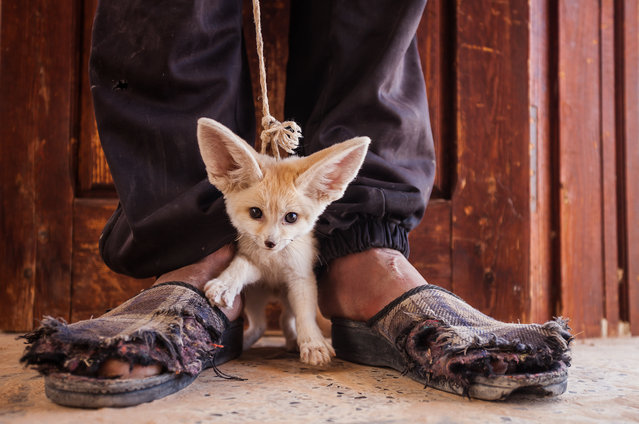
Fennec foxes are captured for the illegal pet trade. This three-month-old pup was for sale in a market in southern Tunisia. (Photo by Bruno D'Amicis/Photographers Against Wildlife Crime/Wildscreen/The Guardian)

In a new project, an international group of photographers have joined forces to use their powerful images to raise awareness and funds to help stop the illegal wildlife trade. Here: Fennec foxes are captured for the illegal pet trade. This three-month-old pup was for sale in a market in southern Tunisia. (Photo by Bruno D'Amicis/Photographers Against Wildlife Crime/Wildscreen/The Guardian)
Details
17 Oct 2017 06:05:00
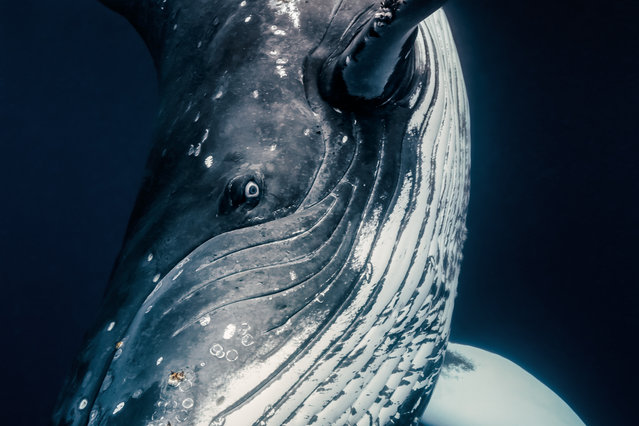
“To look into a whale’s eye is life-changing and humbling. Well, it’s the same with dolphins but they are mostly very fast in the water. A whale’s eye is unexpectedly looking, just like a human eye, kinda checking you out”. (Photo by Rita Kluge/The Guardian)

With the humpback calving season drawing to a close, here’s a look at some of Rita Kluge’s distinctive marine photos from the south Pacific. The Sydney-based photographer fell in love with whales after witnessing southern rights from the New South Wales coastline as they travelled to and from their feeding grounds in the Antarctic. She has since been to Tonga, where humpbacks breed and calf in winter months, to photograph them in the water. (Photo by Rita Kluge/The Guardian)
Details
26 Oct 2016 11:09:00
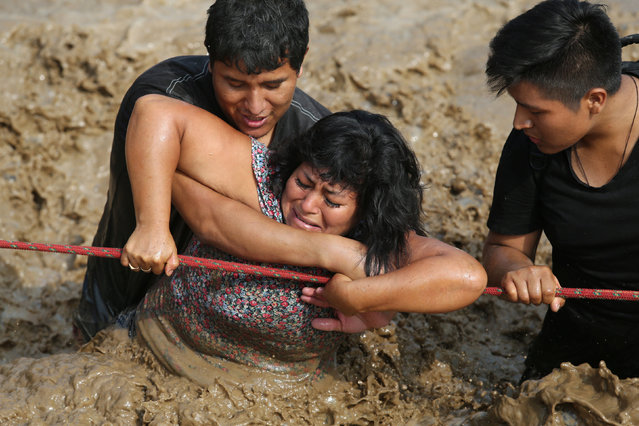
A woman is assisted while crossing a flooded street after the Huayco river overflooded its banks sending torrents of mud and water rushing through the streets, in Huachipa, Peru on March 17, 2017. (Photo by Guadalupe Pardo/Reuters)

A woman is assisted while crossing a flooded street after the Huayco river overflooded its banks sending torrents of mud and water rushing through the streets, in Huachipa, Peru on March 17, 2017. Muddy water spilled onto streets and into homes on Thursday in a new round of unusually heavy rains that has killed at least a dozen people in Peru and now threatens flooding in the capital. (Photo by Guadalupe Pardo/Reuters)
Details
18 Mar 2017 10:24:00
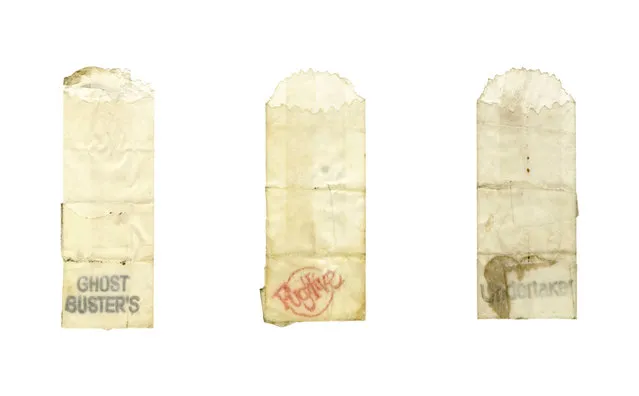
All In By Graham MacIndoe

In order to get a glimpse into the visual culture of drug trade in New York City, a British photographer Graham MacIndoe collected more than one hundred bags, which were used to sell heroin. These bags feature references to various movies, fast-food restaurants, and luxury brands. This could be a way to mark various purities of heroin, or maybe different drug dealers use different markers to distinguish between each other. We can only wonder where Graham has acquired all these heroin bags. Hopefully, he picked them up after their contents were emptied. (Photo by Graham MacIndoe)
Details
01 Dec 2014 14:15:00