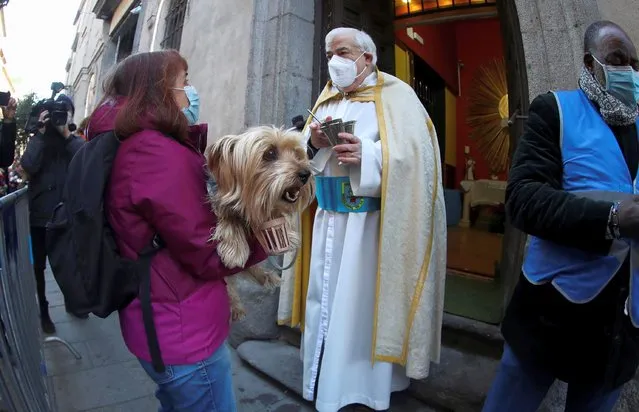
A woman holds her dog to be blessed outside St. Anton Church to mark St. Anton Day, Animal patron saint, in downtown Madrid, Spain, 17 January 2022. (Photo by David Fernandez/EPA/EFE)
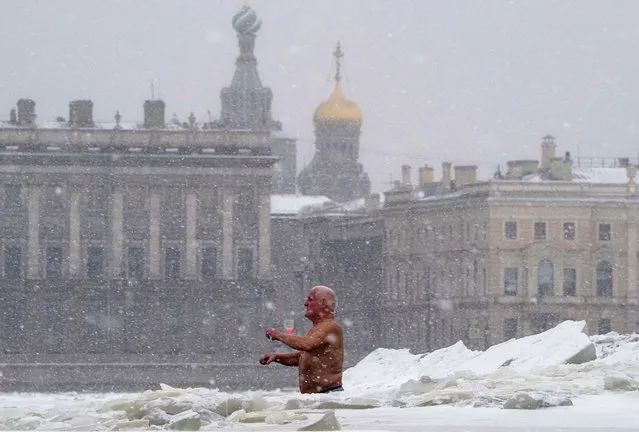
A man bathes in an ice hole in the Neva River in St. Petersburg, Russia, Wednesday, January 13, 2021. The temperature in St. Petersburg is –15C ( 5 °F). (Photo by Dmitri Lovetsky/AP Photo)
Fr. Denis Crosby blesses a live lamb during a Pattern Day mass to St. Brigid at the holy well of St. Brigid in Liscannor, Ireland February 1, 2017. (Photo by Clodagh Kilcoyne/Reuters)
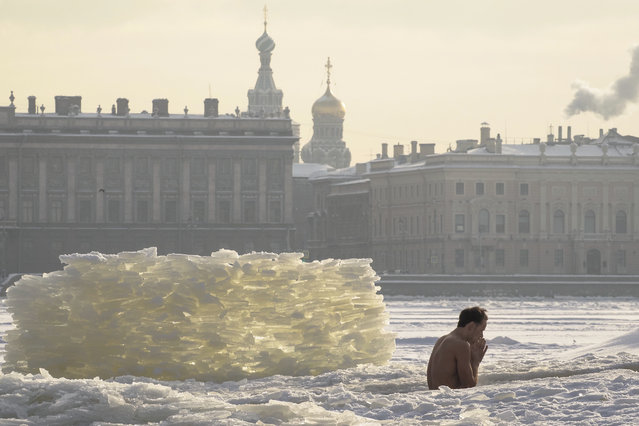
A man bathes in an ice hole in the Neva River St. Petersburg, Russia, Wednesday, February 10, 2021. The temperature in St. Petersburg is –15C ( 5 °F). (Photo by Dmitri Lovetsky/AP Photo)
A woman loses her hat as waves crash into the St. Joseph Lighthouses, Sunday, June 30, 2024, off Tiscornia Beach in St. Joseph, Mich. (Photo by Don Campbell/The Herald-Palladium via AP Photo)
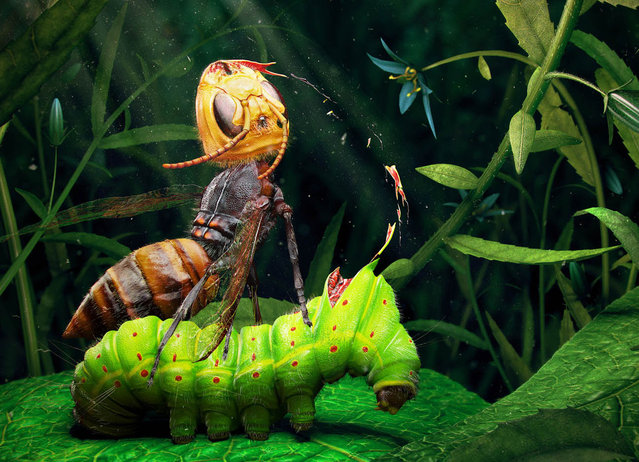
Hornets are insects that are the largest eusocial wasps. Some species can reach up to 5.5 cm (2.2 in) in length. The true hornets make up the genus Vespa and are distinguished from other vespines by the width of the vertex (part of the head behind the eyes), which is proportionally larger in Vespa and by the anteriorly rounded gasters (the section of the abdomen behind the wasp waist). The best known species is the European hornet (Vespa crabro), about 2–3.5 cm in length, widely distributed throughout Europe, Russia, North America and Northeast Asia.
Activists from climate action group Ocean Rebellion demonstrate in St Ives Harbour, ahead of the G7 summit, in St Ives, Cornwall, Britain, June 9, 2021. (Photo by Tom Nicholson/Reuters)
Students from St Andrews University indulge in a tradition of covering themselves with foam to honour the “academic family” on the lower college lawn on October 23, 2017, in St Andrews, Scotland. (Photo by Jeff J. Mitchell/Getty Images)