Loading...
Done


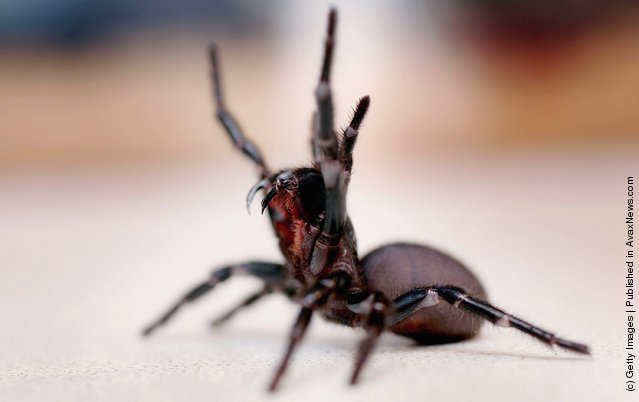
A Funnel Web spider is pictured at the Australian Reptile Park January 23, 2006 in Sydney, Australia. The Funnel Web is one of Australia's deadliest animals, with a venom that is packed with at least 40 different toxic proteins. A bite from a Funnel Web causes massive electrical over-load in the body's nervous system. Finally, fatalities occur from either heart attack or a pulmonary oedema, where the capillaries around the lungs begin to leak fluid and the patient effectively drowns. Death can come as quickly as two hours after a bite if no medical treatment is sought. Due to advances in anti-venom, there has been no death from a Funnel Web bite in Australia since 1980. Australia is home to some of the most deadly and poisonous animals on earth. (Photo by Ian Waldie/Getty Images)
Details
25 Apr 2011 07:49:00
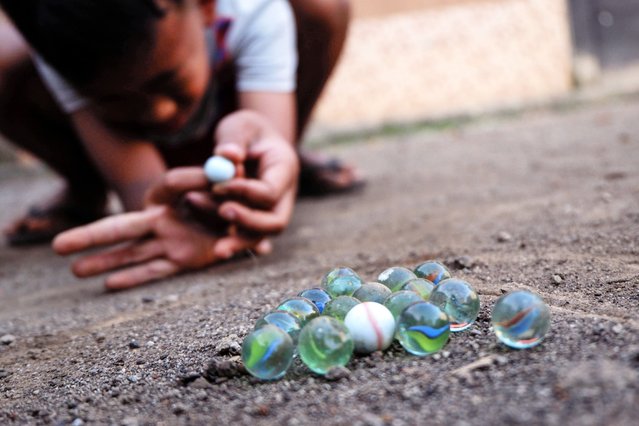
Children play marbles on the dirt in Garut, West Java, Indonesia on October 17, 2025. This traditional game, which was popular in the 1980s, is now rarely played by children due to the increasing popularity of modern games with advanced technology. According to a survey by the Indonesian Child Protection Commission (KPAI), more than 71.3% of school-age children own gadgets and play them for a considerable amount of time each day, and as many as 79% of child respondents are allowed to play gadgets for purposes other than learning. (Photo by Algi Febri Sugita/ZUMA Press Wire/Rex Features/Shutterstock)

Children play marbles on the dirt in Garut, West Java, Indonesia on October 17, 2025. This traditional game, which was popular in the 1980s, is now rarely played by children due to the increasing popularity of modern games with advanced technology. According to a survey by the Indonesian Child Protection Commission (KPAI), more than 71.3% of school-age children own gadgets and play them for a considerable amount of time each day, and as many as 79% of child respondents are allowed to play gadgets for purposes other than learning. (Photo by Algi Febri Sugita/ZUMA Press Wire/Rex Features/Shutterstock)
Details
26 Nov 2025 03:06:00
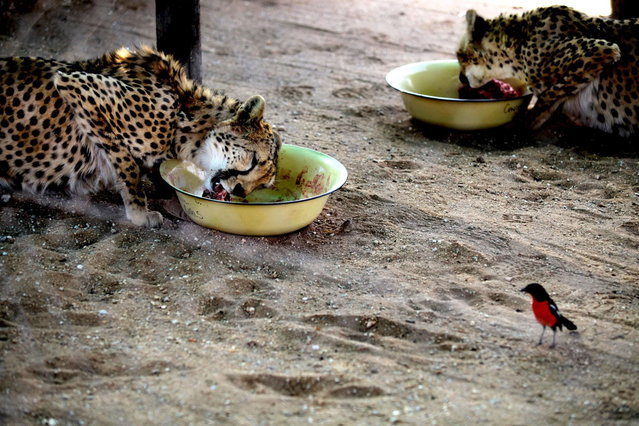
Young cheetahs eat meat at The Cheetah Conservation Fund (CCF) center in Otjiwarongo, Namibia, on August 13, 2013. The CCF started breeding Anatolian livestock dogs to promote cheetah-friendly farming after some 10,000 big cats – the current total worldwide population – were killed or moved off farms in the 1980s.  Up to 1,000 cheetahs were being killed a year, mostly by farmers who saw them as livestock killers. But the use of dogs has slashed losses for sheep and goat farmers and led to less retaliation against the vulnerable cheetah. (Photo by Jennifer Bruce/AFP Photo)

Young cheetahs eat meat at The Cheetah Conservation Fund (CCF) center in Otjiwarongo, Namibia, on August 13, 2013. The CCF started breeding Anatolian livestock dogs to promote cheetah-friendly farming after some 10,000 big cats – the current total worldwide population – were killed or moved off farms in the 1980s. Up to 1,000 cheetahs were being killed a year, mostly by farmers who saw them as livestock killers. But the use of dogs has slashed losses for sheep and goat farmers and led to less retaliation against the vulnerable cheetah. (Photo by Jennifer Bruce/AFP Photo)
Details
29 Aug 2013 10:56:00
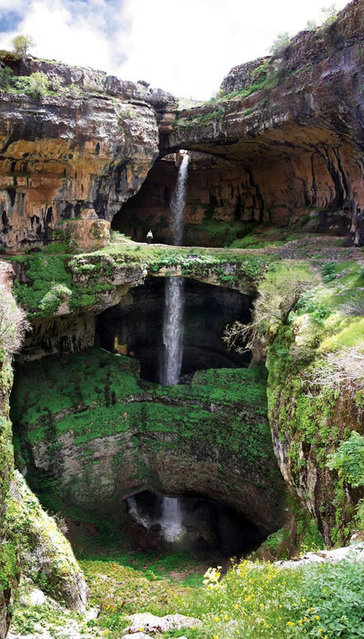
Baatara Gorge Waterfall

Discovered in 1952 by French bio-speleologist Henri Coiffait, the waterfall and accompanying sinkhole were fully mapped in the 1980s by the Spéléo club du Liban. The cave is also known as the "Cave of the Three Bridges." Traveling from Laklouk to Tannourine one passes the village of Balaa, and the "Three Bridges Chasm" (in French "Gouffre des Trois Ponts") is a five-minute journey into the valley below where one sees three natural bridges, rising one above the other and overhanging a chasm descending into Mount Lebanon. During the spring melt, a 90–100-metre (300–330 ft) cascade falls behind the three bridges and then down into the 250-metre (820 ft) chasm. A 1988 fluorescent dye test demonstrated that the water emerged at the spring of Dalleh in Mgharet al-Ghaouaghir.
Details
31 Aug 2013 11:27:00
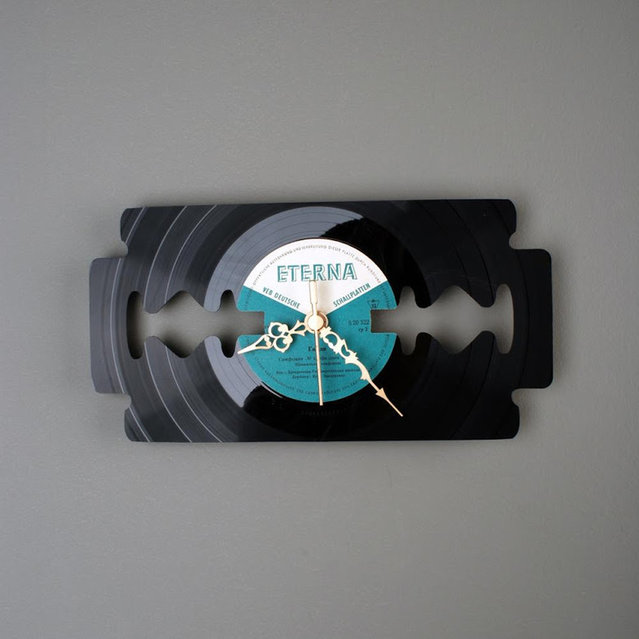
Vinyl Clock By Pavel Sidorenko Part 2

Pavel Sidorenko is an award winning Estonian designer who was born in 1980 in Tallinn and studied product design at Estonian Academy of Arts and Graduated in 2006. Not only does he incorporate pragmatic necessity, but also transmits an emotional qualities within the everyday environment. His fantastic collection of Re Vinyl designs are a result of upcycling a product fashioned from old vinyl records. Beautifully crafted and working with a range of themes from scenography to animal creatures, there is sure to be something for everyone with these stylish selection of recycled vinyl clocks!


See also: Part 1
Details
01 Mar 2014 11:09:00
Girls practice sit-ups during gymnastics lessons at the Shanghai Yangpu Youth Amateur Athletic School in Shanghai, China, on May 4, 2016. (Photo by Aly Song/Reuters)

Girls practice sit-ups during gymnastics lessons at the Shanghai Yangpu Youth Amateur Athletic School in Shanghai, China, on May 4, 2016. China's sports system has been enormously successful since the country returned to the Olympic fold in 1980, culminating with the host nation topping the medals' table at the 2008 Beijing Olympics. And yet, with the Rio de Janeiro Games less than three months away, the system is beginning to break down due to the shifting demographics of a more prosperous nation. (Photo by Aly Song/Reuters)
Details
02 Jun 2016 12:21:00
Children clean the interior of a granary in preparation for grain storage in Odek village, north of Uganda capital Kampala February 14, 2015. Odek is the birthplace of Joseph Kony, founder and leader of the rebel group Lord's Resistance Army. (Photo by James Akena/Reuters)

Children clean the interior of a granary in preparation for grain storage in Odek village, north of Uganda capital Kampala February 14, 2015. Odek is the birthplace of Joseph Kony, founder and leader of the rebel group Lord's Resistance Army. The LRA rose up against the government in northern Uganda under the leadership of Kony in the late 1980s and has been accused of abducting children to serve as fighters and s*x slaves. (Photo by James Akena/Reuters)
Details
24 Feb 2015 14:36:00
Vinyl Clock By Pavel Sidorenko Part 1

Pavel Sidorenko is an award winning Estonian designer who was born in 1980 in Tallinn and studied product design at Estonian Academy of Arts and Graduated in 2006. Not only does he incorporate pragmatic necessity, but also transmits an emotional qualities within the everyday environment. His fantastic collection of Re Vinyl designs are a result of upcycling a product fashioned from old vinyl records. Beautifully crafted and working with a range of themes from scenography to animal creatures, there is sure to be something for everyone with these stylish selection of recycled vinyl clocks!


See also:Part 2
Details
28 Feb 2014 08:55:00