Loading...
Done
Emily Ratajkowski and Vanessa Hudgens attend the 73rd Annual Tony Awards at Radio City Music Hall on June 09, 2019 in New York City. (Photo by Mike Coppola/Getty Images for Tony Awards Productions)

American model Emily Ratajkowski and Vanessa Hudgens attend the 73rd Annual Tony Awards at Radio City Music Hall on June 09, 2019 in New York City. (Photo by Mike Coppola/Getty Images for Tony Awards Productions)
Details
16 Jun 2019 00:01:00
Dancers rehearse for the Rockettes 2015 Radio City Christmas Spectacular in New York October 15, 2015. (Photo by Lucas Jackson/Reuters)

Dancers rehearse for the Rockettes 2015 Radio City Christmas Spectacular in New York October 15, 2015. (Photo by Lucas Jackson/Reuters)
Details
19 Oct 2015 08:04:00
The Radio City Rockettes perform during a rehearsal for their Christmas show in New York City, on October 13, 2021. The 2021 production will run from November 5, 2021, to January 2, 2022, at Radio City Music Hall. (Photo by Timothy A. Clary/AFP Photo)

The Radio City Rockettes perform during a rehearsal for their Christmas show in New York City, on October 13, 2021. The 2021 production will run from November 5, 2021, to January 2, 2022, at Radio City Music Hall. (Photo by Timothy A. Clary/AFP Photo)
Details
19 Oct 2021 08:00:00
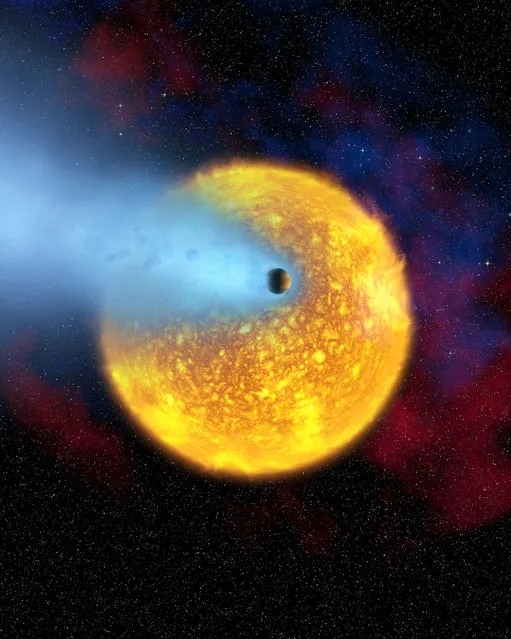
Dramatic changes spotted in HD 189733b exoplanet atmosphere

This artist's rendering illustrates the evaporation of HD 189733b's atmosphere in response to a powerful eruption from its host star. NASA's Hubble Space Telescope detected the escaping gases and NASA's Swift satellite caught the stellar flare. (Credit: NASA's Goddard Space Flight Center)
Details
29 Jun 2012 09:45:00
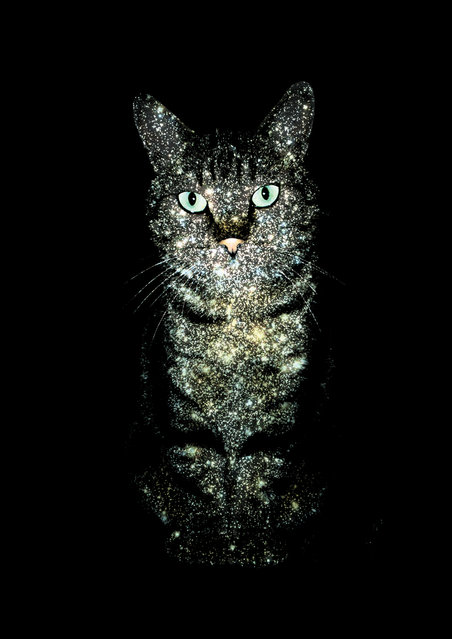
Space Cats By Zippora Lux

Boya Latumahina, alter ego, Zippora Lux is a Design student studying at Central St Martins in London. She has created these space age cats by combining two of her favourite things, cats and telescopic photographs.
Details
01 Dec 2013 10:34:00
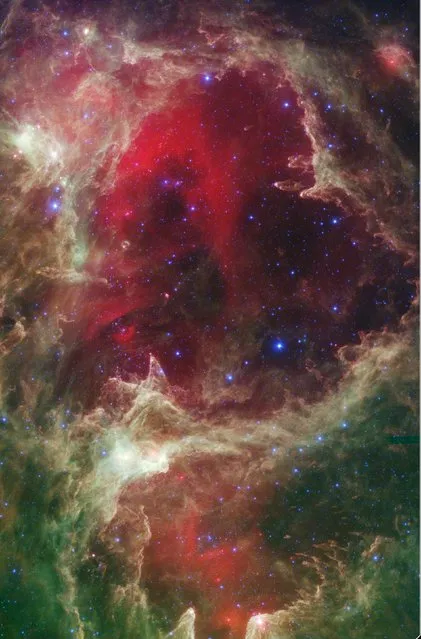
An infrared portrait from NASA's Spitzer Space Telescope which shows generations of stars is seen in this undated NASA handout image released February 14, 2013. In this wispy star-forming region, called W5, the oldest stars can be seen as blue dots in the centers of the two hollow cavities (other blue dots are background and foreground stars not associated with the region). Red shows heated dust that pervades the region's cavities, while green highlights dense clouds. (Photo by NASA/Reuters/JPL-Caltech/Harvard-Smithsonian/Handout)

An infrared portrait from NASA's Spitzer Space Telescope which shows generations of stars is seen in this undated NASA handout image released February 14, 2013. In this wispy star-forming region, called W5, the oldest stars can be seen as blue dots in the centers of the two hollow cavities (other blue dots are background and foreground stars not associated with the region). Red shows heated dust that pervades the region's cavities, while green highlights dense clouds. (Photo by NASA/Reuters/JPL-Caltech/Harvard-Smithsonian/Handout)
Details
03 Mar 2013 08:44:00
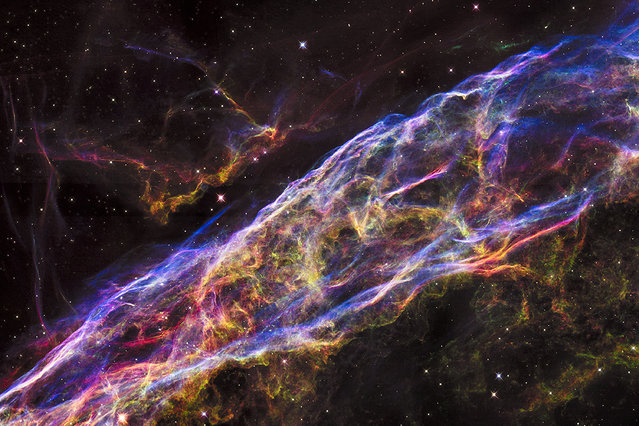
A small section of the expanding remains of the Veil Nebula, a massive star that exploded about 8,000 years ago. The entire nebula is 110 light-years across, covering six full moons on the sky as seen from Earth, and resides about 2,100 light-years away in the constellation Cygnus, the Swan. Image taken by NASA's Hubble Space Telescope. Released September 24, 2015. (Photo by Reuters/NASA/ESA/Hubble Heritage Team)

A small section of the expanding remains of the Veil Nebula, a massive star that exploded about 8,000 years ago. The entire nebula is 110 light-years across, covering six full moons on the sky as seen from Earth, and resides about 2,100 light-years away in the constellation Cygnus, the Swan. Image taken by NASA's Hubble Space Telescope. Released September 24, 2015. (Photo by Reuters/NASA/ESA/Hubble Heritage Team)
Details
10 Dec 2015 08:01:00
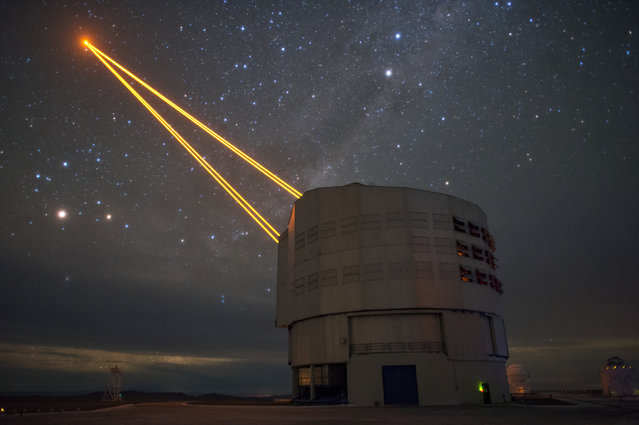
Four pillars of light from the 4 Laser Guide Star Facility on ESO's Very Large Telescope (VLT) are shown reaching into the Chilean night sky in this image from ESO Photo Ambassador Fred Kamphues, on September 2, 2016. The lasers are a key part of the adaptive optics system on the VLT. Adaptive optics allows astronomers to drastically reduce the atmospheric distortion present at even the best sites in the world for astronomy, including Paranal in Chile, the home of the VLT. (Photo by F. Kamphues/ESO)

Four pillars of light from the 4 Laser Guide Star Facility on ESO's Very Large Telescope (VLT) are shown reaching into the Chilean night sky in this image from ESO Photo Ambassador Fred Kamphues, on September 2, 2016. The lasers are a key part of the adaptive optics system on the VLT. Adaptive optics allows astronomers to drastically reduce the atmospheric distortion present at even the best sites in the world for astronomy, including Paranal in Chile, the home of the VLT. (Photo by F. Kamphues/ESO)
Details
23 Feb 2017 00:06:00