London photographer Tom Robinson got the idea for his Feet First series in 2005 while sitting on Brighton beach (England) with his new girlfriend Verity.
There's a wonderfully picturesque spot in Vöcklabruck, Austria where visitors are able to sit in the middle of a pond without getting wet. The scenic landscape includes a path leading down to a hollowed out circular area where people can take a seat and relax amongst nature. It's a surreal journey along the gradual ramp to the observational platform as the water level gains height either side. Once in the resting area, depending on perspective, visitors seem like they're wading in the lake without a drop of water on them.
Lake Louise, named Lake of the Little Fishes by the Stoney Natoka First Nations people, is a glacial lake within Banff National Park in Alberta, Canada. It is located 5 km (3.1 mi) west of the Hamlet of Lake Louise and the Trans-Canada Highway (Highway 1).
Originally known to the First Nations of the Okanagan Valley as Khiluk, which was- and remains today revered as a sacred site producing therapeutic waters. During World War I the minerals of Spotted Lake were used in manufacturing ammunition. Later the area came under the control of the Ernest Smith Family, for a term of about 40 years. In 1979 Smith attempted to create interest in a spa at the lake. The First Nations responded with an effort to buy the lake; in October 2001 they finally struck a deal. First Nations arranged the purchase of 22 hectares of land for a total of $720,000, and contributed about 20% of the cost. The Indian Affairs Department paid the remainder.
A woman rows her boat as she harvests tomatoes on Inle lake, in Myanmar's Shan State September 4, 2015. Inle is one of the country's most popular tourist sites. (Photo by Soe Zeya Tun/Reuters)
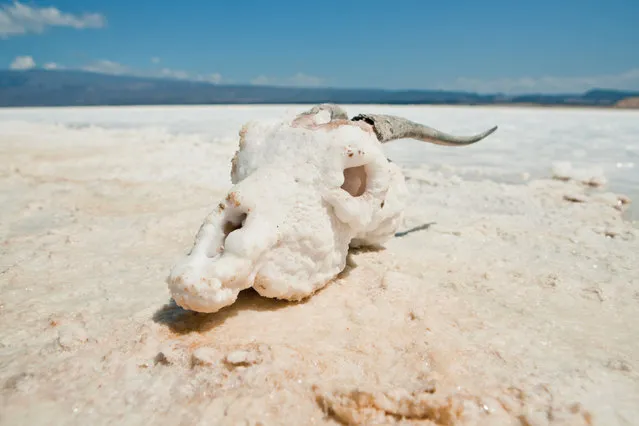
Lake Natron is a salt lake located in northern Tanzania, close to the Kenyan border, in the eastern branch of the East African Rift. The lake is fed by the Southern Ewaso Ng'iro River and also by mineral-rich hot springs. It is quite shallow, less than three meters (10 feet) deep, and varies in width depending on its water level, which changes due to high levels of evaporation, leaving concentrations of salt and other minerals, notably sodium carbonate (natron).
Yueyaquan is a crescent-shaped lake in an oasis, 6 km south of the city of Dunhuang in Gansu Province, China. It was named Yueyaquan in the Qing Dynasty. According to measurements made in 1960, the average depth of the lake was 4 to 5 meters, with a maximum depth of 7.5 metres In the following 40 years, the depth of the lake continually declined. In the early 1990s, its area had shrunk to only 5,500 m2 with an average depth of 0.9 meter (maximum 1.3 meter). In 2006, the local government with help of the central government started to fill the lake and restore its depth; its depth and size have been growing yearly since then. The lake and the surrounding deserts are very popular with tourists, who are offered camel and 4x4 rides.