Loading...
Done
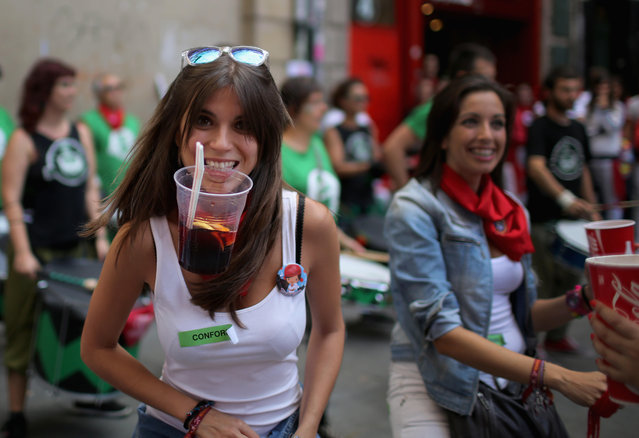
Revellers continue to party and dance through the night and day during the second day of the San Fermin Running Of The Bulls festival, on July 7, 2014 in Pamplona, Spain. The annual Fiesta de San Fermin, made famous by the 1926 novel of US writer Ernest Hemmingway “The Sun Also Rises”, involves the running of the bulls through the historic heart of Pamplona. (Photo by Christopher Furlong/Getty Images)

Revellers continue to party and dance through the night and day during the second day of the San Fermin Running Of The Bulls festival, on July 7, 2014 in Pamplona, Spain. The annual Fiesta de San Fermin, made famous by the 1926 novel of US writer Ernest Hemmingway “The Sun Also Rises”, involves the running of the bulls through the historic heart of Pamplona. (Photo by Christopher Furlong/Getty Images)
Details
08 Jul 2014 13:44:00
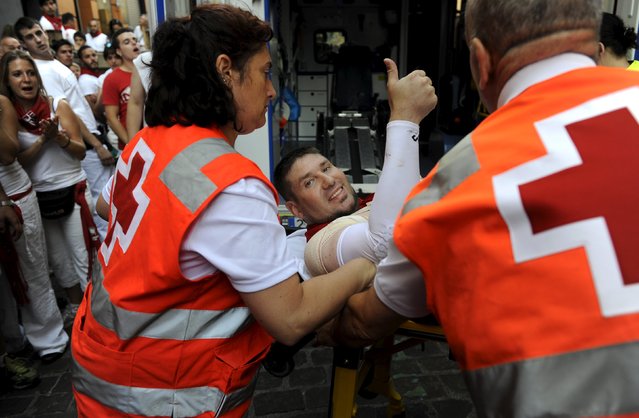
An unidentified runner gestures while being attended by medical services following the first running of the bulls of the San Fermin festival in Pamplona, northern Spain, July 7, 2015. (Photo by Eloy Alonso/Reuters)

An unidentified runner gestures while being attended by medical services following the first running of the bulls of the San Fermin festival in Pamplona, northern Spain, July 7, 2015. Two runners were gored in the run that lasted 2 minutes and 23 seconds, according to local media. (Photo by Eloy Alonso/Reuters)
Details
08 Jul 2015 11:41:00
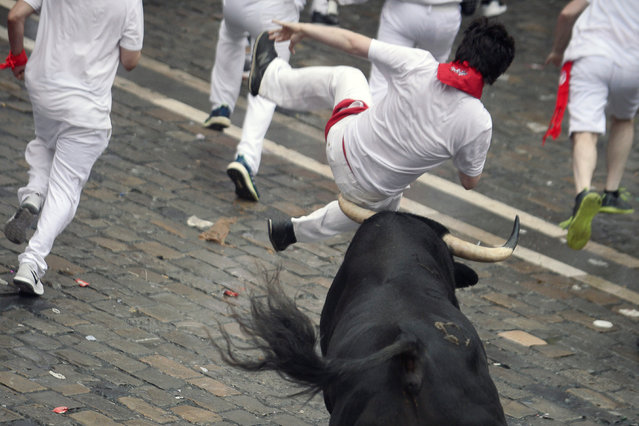
A bull hits a reveller during the first running of the bulls of the San Fermin festival in Pamplona, Spain, July 7, 2018. (Photo by Vincent West/Reuters)

A bull hits a reveller during the first running of the bulls of the San Fermin festival in Pamplona, Spain, July 7, 2018. Each day at 8am hundreds of people race with six bulls, charging along a winding, 848.6-metre (more than half a mile) course through narrow streets to the city's bull ring, where the animals are killed in a bullfight or corrida, during this festival dating back to medieval times and also featuring religious processions, folk dancing, concerts and round-the-clock drinking. (Photo by Vincent West/Reuters)
Details
11 Jul 2018 00:05:00
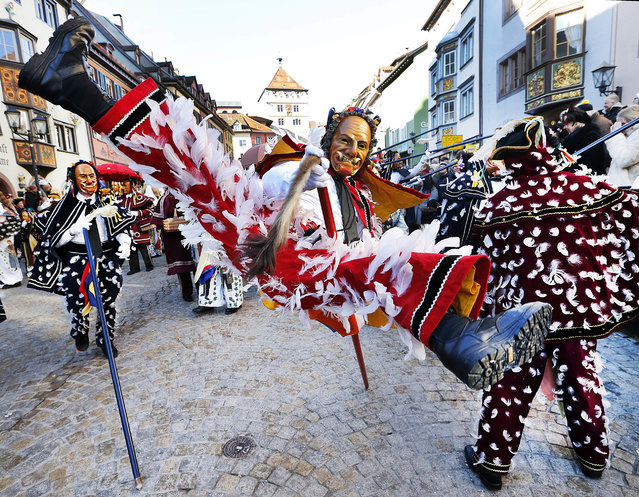
A “Federahannes”, a jester figure from Rottweil, participates in the “Narrensprung” (jester jump) parade in Rottweil, southern Germany, Monday, February 27, 2016. About 4000 jesters paraded through the city among thousands of spectators. The Rottweil Narrensprung is the highlight of the Swabian-Alemannic Fastnacht and one of the traditional pre-Lenten carnival parades in southwestern Germany. (Photo by Michael Probst/AP Photo)

A “Federahannes”, a jester figure from Rottweil, participates in the “Narrensprung” (jester jump) parade in Rottweil, southern Germany, Monday, February 27, 2016. About 4000 jesters paraded through the city among thousands of spectators. The Rottweil Narrensprung is the highlight of the Swabian-Alemannic Fastnacht and one of the traditional pre-Lenten carnival parades in southwestern Germany. (Photo by Michael Probst/AP Photo)
Details
04 Mar 2017 00:03:00
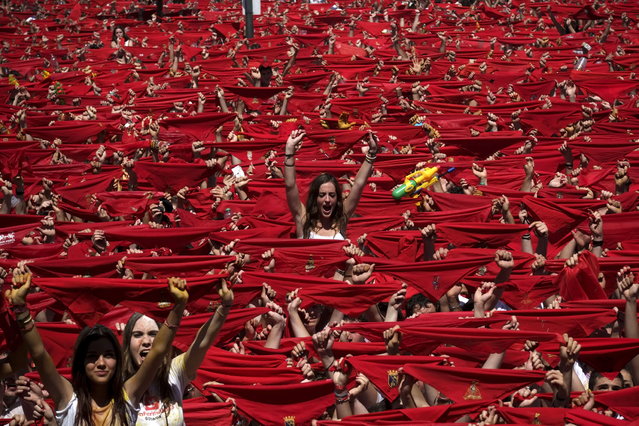
Participants hold red scarves as they celebrate the “Chupinazo” marking the start at noon sharp of the San Fermin Festival at Castle square in Pamplona, northern Spain on July 6, 2013. Ten of thousands of people packed Pamplona's streets for a drunken kick-off to Spain's best-known fiesta: the nine-day San Fermin bull-running festival. (Photo by Pedro Armestre/AFP Photo)

Participants hold red scarves as they celebrate the “Chupinazo” marking the start at noon sharp of the San Fermin Festival at Castle square in Pamplona, northern Spain on July 6, 2013. Ten of thousands of people packed Pamplona's streets for a drunken kick-off to Spain's best-known fiesta: the nine-day San Fermin bull-running festival. (Photo by Pedro Armestre/AFP Photo)
Details
11 Jul 2013 09:30:00
In this undated handout photo taken by mrwed54, a woman poses for a photo by a lake in the Siberian city of Novosibirsk, about 2,800 kilometers (1,750 miles) east of Moscow, Russia. Thousands of Novosibirsk residents, from scantily clad women to newlyweds have been instagramming selfies near the lake nicknamed the “Siberian Malvides” after the far-flung tropical islands in the Indian Ocean. This is in fact is a man-made dumb of coal from a nearby power station that provides for most of Novosibirsk’s energy needs. Environmentalists are warning people against coming into contact with the water. (Photo by mrwed54 via AP Photo)

In this undated handout photo taken by mrwed54, a woman poses for a photo by a lake in the Siberian city of Novosibirsk, about 2,800 kilometers (1,750 miles) east of Moscow, Russia. Thousands of Novosibirsk residents, from scantily clad women to newlyweds have been instagramming selfies near the lake nicknamed the “Siberian Malvides” after the far-flung tropical islands in the Indian Ocean. This is in fact is a man-made dumb of coal from a nearby power station that provides for most of Novosibirsk’s energy needs. Environmentalists are warning people against coming into contact with the water. (Photo by mrwed54 via AP Photo)
Details
15 Jul 2019 00:07:00
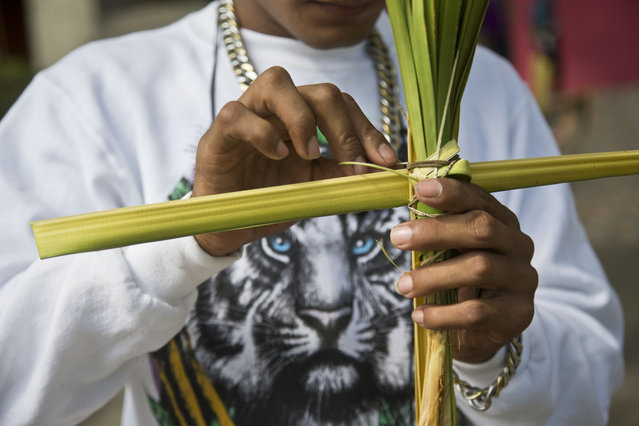
A young man weaves palm fronds into the shape of a cross before the start of a Mass to observe Palm Sunday, at the Metropolitan Cathedral, in Managua, Nicaragua, Sunday, March 29, 2015. For Christians, Palm Sunday marks the start of Holy Week ahead of Easter, commemorating Jesus Christ's entrance into Jerusalem, when his followers laid palm branches in his path. (Photo by Esteban Felix/AP Photo)

A young man weaves palm fronds into the shape of a cross before the start of a Mass to observe Palm Sunday, at the Metropolitan Cathedral, in Managua, Nicaragua, Sunday, March 29, 2015. For Christians, Palm Sunday marks the start of Holy Week ahead of Easter, commemorating Jesus Christ's entrance into Jerusalem, when his followers laid palm branches in his path. (Photo by Esteban Felix/AP Photo)
Details
30 Mar 2015 13:16:00
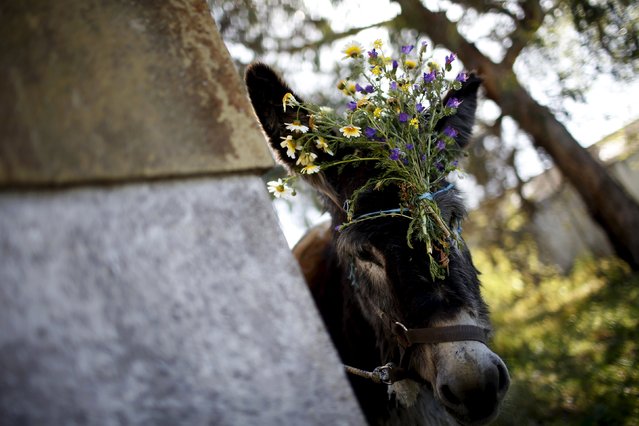
A donkey is seen before the start of the procession of the “Virgem da Atalaia” during Holy Week at Alcochete, near Lisbon April 5, 2015. (Photo by Rafael Marchante/Reuters)

A donkey is seen before the start of the procession of the “Virgem da Atalaia” during Holy Week at Alcochete, near Lisbon April 5, 2015. Women ride donkeys during the “Virgem da Atalaia” procession, that has been held annually for about 400 years. In the past, only single women rode the donkeys to ask for help from the Virgin to find a husband. (Photo by Rafael Marchante/Reuters)
Details
06 Apr 2015 09:43:00