Loading...
Done


A man cries in a graveyard during the funeral of Nasser Ali Afglio, a young Libyan rebel killed during battle with government troops loyal to Libyan ruler Moammar Gaddafi April 19, 2011 in Misrata, Libya. The graveyard where Nasser was buried has hundreds of simple concrete graves; many dozens are those that have been killed during the last two months of fighting in the besieged town. Thousands of civilians are trapped in Misrata as fighting continues between Libyan government forces that have surrounded the city and anti-government rebels there. (Photo by Chris Hondros/Getty Images)
Details
22 Apr 2011 08:22:00
An armed man herds his cattle close to the village of Nimini in northern South Sudan, February 8, 2017. (Photo by Siegfried Modola/Reuters)

An armed man herds his cattle close to the village of Nimini in northern South Sudan, February 8, 2017. In the chaos of South Sudan's civil war, it took three years for Nyagonga Machul to find her lost children. Machul had traveled from her village to the capital when President Salva Kiir, an ethnic Dinka, fired his deputy Riek Machar, a Nuer, in 2013. (Photo by Siegfried Modola/Reuters)
Details
19 Feb 2017 00:04:00


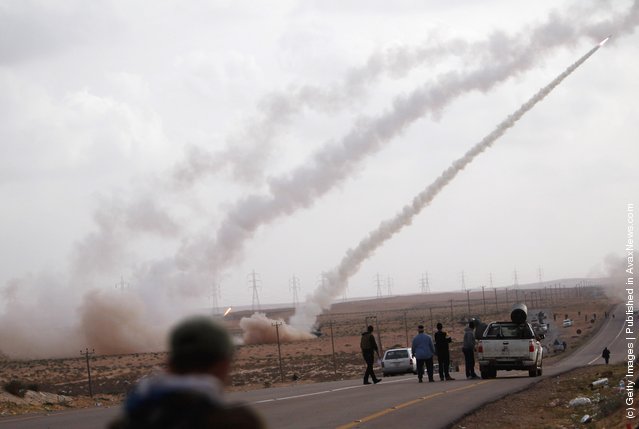
Libyan rebel soldiers watch as they fire rockets (background) toward Libyan government troops near front-line positions April 6, 2011 outside of Brega, Libya. Rebel militias fighting against Libyan government loyalist soldiers continued their stand-off in the eastern Libyan desert today, regaining ground toward a key oil port while awaiting further NATO airstrikes in their quest to unseat longtime Libyan ruler Muammar Gaddafi. (Photo by Chris Hondros/Getty Images)
Details
08 Apr 2011 10:27:00
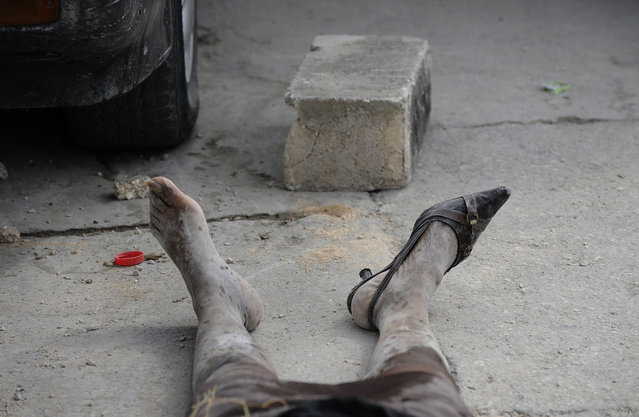
In this photo submitted by the Washington Post tilted “The Moment Time Stopped”, survivors piled bodies of the dead outside for weeks after earthquake on January 14, 2010 in Port-au-Prince, Haiti. The Washington Post has won a Pulitzer Prize for breaking news photography on Monday, April 18, 2011 for images taken in Haiti following the earthquake there.(Photo by Carol Guzy/AP Photo/The Washington Post)

In this photo submitted by the Washington Post tilted “The Moment Time Stopped”, survivors piled bodies of the dead outside for weeks after earthquake on January 14, 2010 in Port-au-Prince, Haiti. The 7.0 magnitude earthquake struck in 2010, and the Haitian government has said more than 300,000 people were killed. The exact toll is unknown because there was no systematic effort to count bodies among the chaos and destruction. (Photo by Carol Guzy/AP Photo/The Washington Post)
Details
13 Jan 2015 14:17:00
In this December 3, 2013 photo, an Aymara woman cops directs traffic on the streets of El Alto, Bolivia. The women wear the bright petticoats and shawls of indigenous women in the Andes, called cholitas in Bolivian slang, the main difference being that instead of bowler hats they wear khaki green police-style caps. Some don fluorescent traffic vests. (Photo by Juan Karita/AP Photo)

“This city in Bolivia's highlands has hired Aymara women dressed in traditional multilayered Andean skirts and brightly embroidered vests to work as traffic cops and bring order to its road chaos. About 20 of the “traffic cholitas” have been trained to direct cars and buses in El Alto, a teeming, impoverished sister city of La Paz in Bolivia's Andes mountains”. – El Alto via Associated Press. Photo: In this December 3, 2013 photo, an Aymara woman cops directs traffic on the streets of El Alto, Bolivia. The women wear the bright petticoats and shawls of indigenous women in the Andes, called cholitas in Bolivian slang, the main difference being that instead of bowler hats they wear khaki green police-style caps. Some don fluorescent traffic vests. (Photo by Juan Karita/AP Photo)
Details
25 Dec 2013 10:48:00
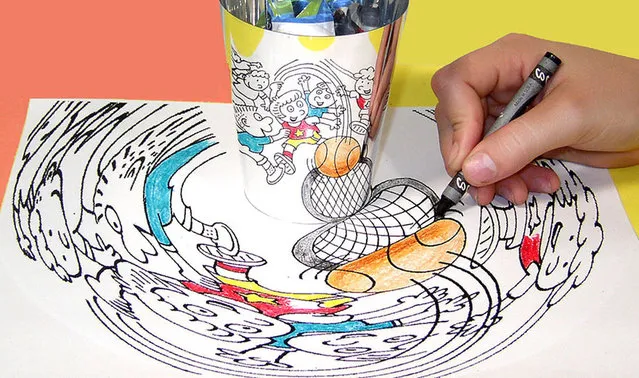
Anamorphic Art By Jonty Hurwitz

The truth can never be seen right away. Only by looking from a certain angle can we view the true nature of things. At other times, only with the help of some special object can we discern order in chaos. Anamorphosis is a form of art that allows us to see an object only by viewing it from a certain angle or by using cylindrical or conical mirror. Unsurprisingly, the first person in history to ever use this type of technique was the Leonardo Da Vinci. During late Renaissance period this technique was popularized as a children’s toy. Now, however, few people use this form of imagery due to its intricacy. Istvan Orosz, born in 1951, is one of the few people who specialize in anamorphosis. In our opinion, his most stunning piece of art is the one where a shipwreck scene turns into a portrait when viewed through a cylindrical mirror. (Photo by Jonty Hurwitz)
Details
05 Jan 2015 13:07:00
Men play cricket in Kabul, Afghanistan, 16 September 2021. A humanitarian crisis and alleged widespread human rights violations are among the top challenges Afghanistan faces a month after the Taliban's lightning-fast capture of Kabul. The economic crisis threatened to push 97 percent of the 40 million people into poverty by mid-2022, the United Nations has warned. (Photo by EPA/EFE/Stringer)

Men play cricket in Kabul, Afghanistan, 16 September 2021. A humanitarian crisis and alleged widespread human rights violations are among the top challenges Afghanistan faces a month after the Taliban's lightning-fast capture of Kabul. The economic crisis threatened to push 97 percent of the 40 million people into poverty by mid-2022, the United Nations has warned. (Photo by EPA/EFE/Stringer)
Details
22 Sep 2021 08:47:00
An elderly woman plays an accordion in Moscow, Russia on October 3, 2017. (Photo by Mladen Antonov/AFP Photo)

An elderly woman plays an accordion in Moscow, Russia on October 3, 2017. (Photo by Mladen Antonov/AFP Photo)
Details
07 Oct 2017 07:48:00