Loading...
Done
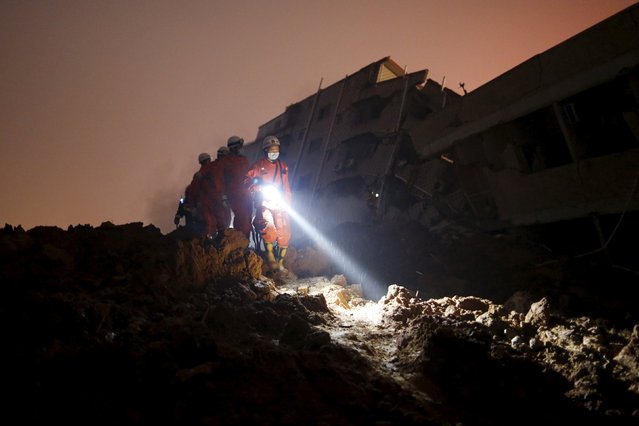
Firefighters use flashlights to search for survivors among the rubble of collapsed buildings after a landslide hit an industrial park in Shenzhen, Guangdong province, China December 20, 2015. (Photo by Tyrone Siu/Reuters)

Firefighters use flashlights to search for survivors among the rubble of collapsed buildings after a landslide hit an industrial park in Shenzhen, Guangdong province, China December 20, 2015. (Photo by Tyrone Siu/Reuters)
Details
22 Dec 2015 08:03:00
241543903 Heads In Freezer Part 1

241543903 (a.k.a “Heads in Freezers”) is a numerical keyword associated with a photo meme that involves people taking pictures with their heads in the freezer & sharing them online. By tagging a series of image files with a cryptic number, a high level of search engine optimization can be easily achieved. As a result, typing “241543903” into image search engines like Google Images successfully yields pages after pages of pictures showing people’s heads in freezers.
Details
07 Mar 2014 14:24:00
An Indian Runner duck searches for food on a snow-covered meadow in Aitrang, southern Germany, Wednesday. April 19, 2017. (Photo by Karl-Josef Hildenbrand/DPA via AP Photo)

An Indian Runner duck searches for food on a snow-covered meadow in Aitrang, southern Germany, Wednesday. April 19, 2017. (Photo by Karl-Josef Hildenbrand/DPA via AP Photo)
Details
23 Apr 2017 08:45:00
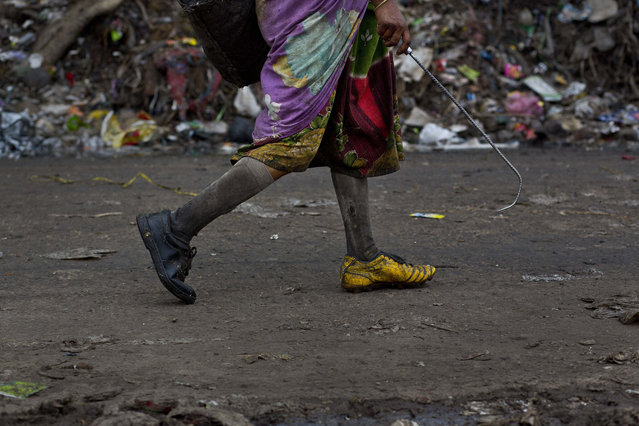
In this Monday, June 5, 2017, file photo, an Indian woman walks as se searches for recyclable materials at a garbage dumping site on the outskirts of Gauhati, Assam state, India. (Photo by Anupam Nath/AP Photo)

In this Monday, June 5, 2017, file photo, an Indian woman walks as se searches for recyclable materials at a garbage dumping site on the outskirts of Gauhati, Assam state, India. (Photo by Anupam Nath/AP Photo)
Details
12 Jun 2017 09:21:00
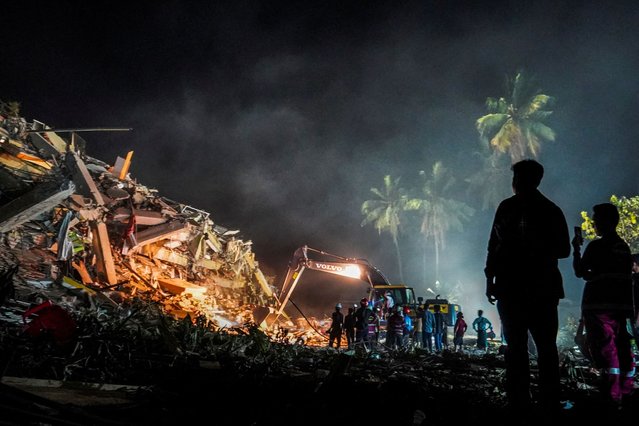
People look on as search and rescue operations continue in the aftermath of a strong earthquake, in Mandalay, Myanmar, on March 31, 2025. (Photo by Reuters/Stringer)

People look on as search and rescue operations continue in the aftermath of a strong earthquake, in Mandalay, Myanmar, on March 31, 2025. (Photo by Reuters/Stringer)
Details
19 Apr 2025 00:12:00
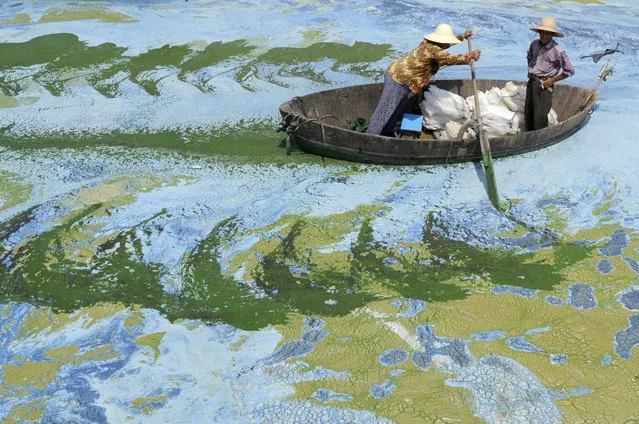
Fishermen row a boat in the algae-filled Chaohu Lake in Hefei, Anhui province, June 19, 2009. The country has invested 51 billion yuan ($7.4 billion) towards the construction of 2,712 projects for the treatment of eight rivers and lakes including Huaihe River, Haihe River, Liaohe River, Chaohu Lake, Dianchi Lake, Songhua River, the Three Gorges region of the Yangtze River and its upstream area, Xinhua News Agency reported. (Photo by Jianan Yu/Reuters)

Growing cities, overuse of fertilizers and factory wastewater have degraded China's water supplies to the extent that half the nation's rivers and lakes are severely polluted. China aims to spend $850 billion to improve filthy water supplies over the next decade, but even such huge outlays may do little to reverse damage caused by decades of pollution and overuse in Beijing's push for rapid economic growth. Photo: Fishermen row a boat in the algae-filled Chaohu Lake in Hefei, Anhui province, June 19, 2009. (Photo by Jianan Yu/Reuters)
Details
03 Aug 2014 08:01:00
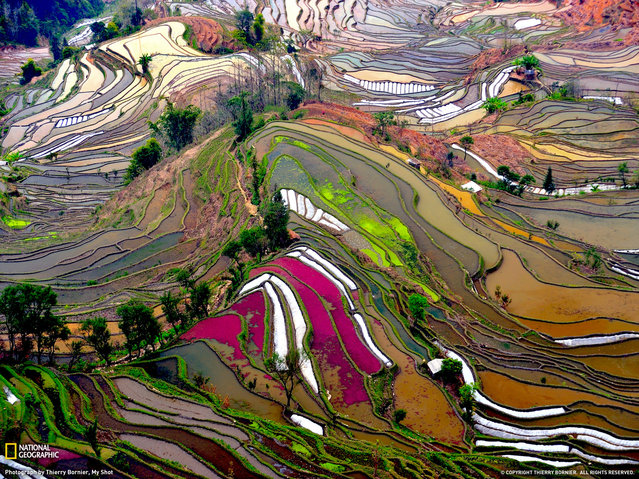
Longsheng Rice Terraces

The Longsheng Rice Terraces are located in Longsheng County, about 100 km (2 hours drive) from Guilin, Guangxi, China. The most popular are Ping An Rice Terrace and Jinkeng Rice Terrace. The terraced fields are built along the slope winding from the riverside up to the mountain top, the highest part being 880 m in elevation while the lowest part is 380 m[citation needed]. The coiling line that starts from the mountain foot up to the mountain top divides the mountain into layers of water glittering in the sun in spring, layers of green rice shoots in summer, layers of golden rice in fall, and layers of silvery frost in winter. The terraced fields were mostly built during the Ming Dynasty, about 500 years ago.

Details
18 Oct 2013 12:45:00
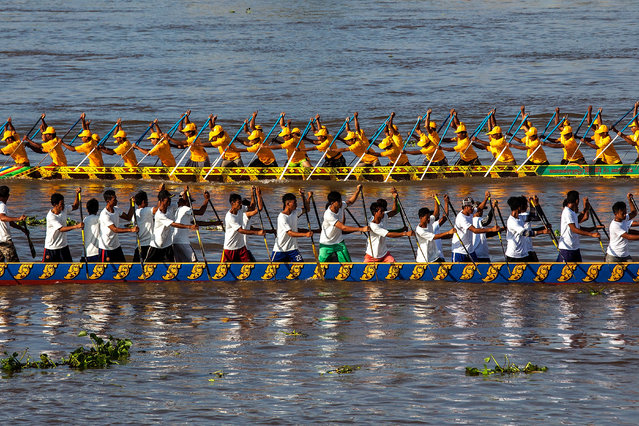
Boat crew members train on the waters of the Tonle Sap River on the morning of the first day of the Water Festival on November 13, 2016 in Phnom Penh, Cambodia. The yearly three-day Water Festival is one of the most important holidays in Cambodia and celebrates the end of the rainy season and the start of the rice harvesting. The Festival also coincides with the Tonle Sap river reversing course, which it does twice a year. Approximately 2 million people are expected to attend this year's festival, during which 259 boats and nearly 20,000 oarsmen will participate in the races. After a fatal stampede resulting in the death of some 353 people during the Water Festival in 2010, it has been cancelled four times over the past five years, with weather used as an official excuse. (Photo by Omar Havana/Getty Images)

Boat crew members train on the waters of the Tonle Sap River on the morning of the first day of the Water Festival on November 13, 2016 in Phnom Penh, Cambodia. The yearly three-day Water Festival is one of the most important holidays in Cambodia and celebrates the end of the rainy season and the start of the rice harvesting. The Festival also coincides with the Tonle Sap river reversing course, which it does twice a year. Approximately 2 million people are expected to attend this year's festival, during which 259 boats and nearly 20,000 oarsmen will participate in the races. After a fatal stampede resulting in the death of some 353 people during the Water Festival in 2010, it has been cancelled four times over the past five years, with weather used as an official excuse. (Photo by Omar Havana/Getty Images)
Details
15 Nov 2016 11:26:00