Loading...
Done
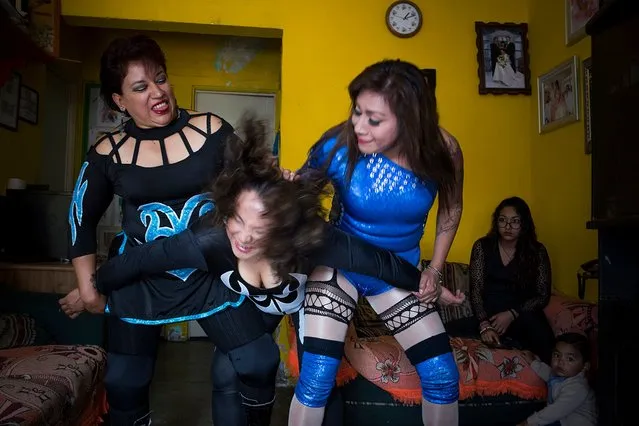
Juliza meets with colleagues at her home. (Photo by Diana Bagnoli/The Washington Post)

Lucha libre is Mexico’s version of what in the United States refer to as pro wrestling. Its dates to 1863, when a Mexican wrestler named Enrique Ugartechea developed a form of “freestyle” wrestling that was based on Greco-Roman wrestling. Lucha libre began to soar in popularity in Mexico after two Italian businessmen started promoting fights in the early 1900s. It has since become popular around the globe. Here: Juliza meets with colleagues at her home. (Photo by Diana Bagnoli/The Washington Post)
Details
15 Jun 2018 00:05:00
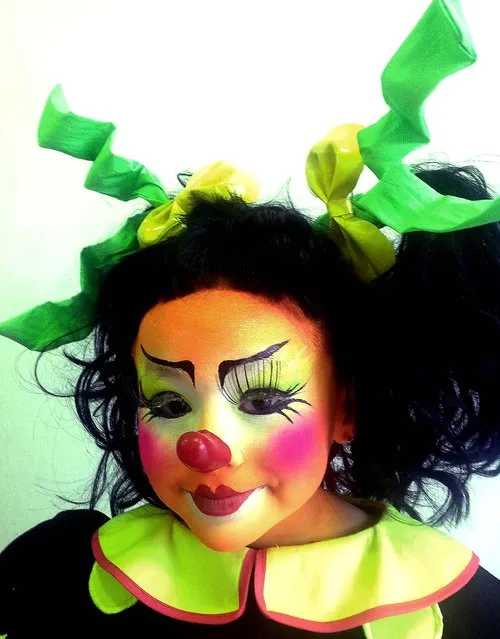
Kika-evolution, 5, an Auguste clown, poses for a photo during Mexico’s 17th annual clown convention, La Feria de la Risa, in Mexico City, October 23, 2012. Approximately 500 clowns gathered at two local theaters in the capital city to exchange ideas, compete for laughs and show off their comedy performances. (Photo by Anita BacaAP Photo)

Kika-evolution, 5, an Auguste clown, poses for a photo during Mexico’s 17th annual clown convention, La Feria de la Risa, in Mexico City, October 23, 2012. Approximately 500 clowns gathered at two local theaters in the capital city to exchange ideas, compete for laughs and show off their comedy performances. (Photo by Anita Baca/AP Photo)
Details
27 Oct 2012 07:51:00
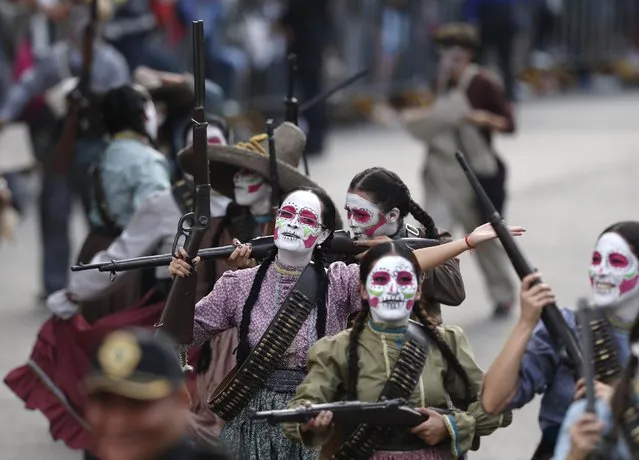
Performers participate in the Day of the Dead parade on Mexico City's main Reforma Avenue, Saturday, October 28, 2017. (Photo by Eduardo Verdugo/AP Photo)

Performers participate in the Day of the Dead parade on Mexico City's main Reforma Avenue, Saturday, October 28, 2017. Mexico's capital is holding its Day of the Dead parade, an idea actually born out of the imagination of a scriptwriter for the James Bond movie “Spectre”. (Photo by Eduardo Verdugo/AP Photo)
Details
29 Oct 2017 08:24:00
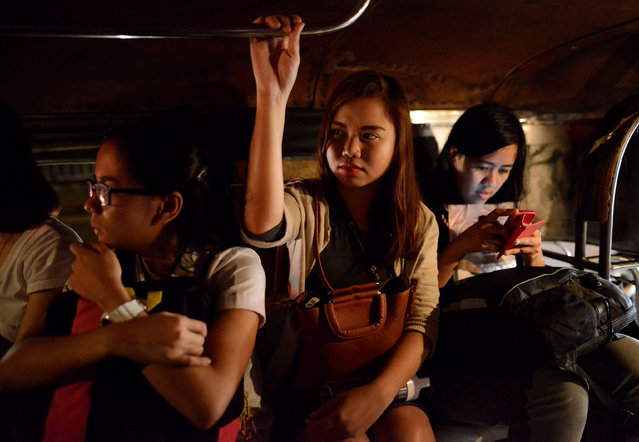
Cristine Angelie Garcia (C), 24, rides a jeepney on her way to work at a call centre for the midnight shift in Taguig city, Metro Manila, Philippines October 3, 2016. “Maybe there is another way where people do not need to die”, she said, adding she felt safer walking the streets at night. “I'm on Duterte's side. Maybe he's just misunderstood because he grew up on the streets”. (Photo by Ezra Acayan/Reuters)

Cristine Angelie Garcia (C), 24, rides a jeepney on her way to work at a call centre for the midnight shift in Taguig city, Metro Manila, Philippines October 3, 2016. “Maybe there is another way where people do not need to die”, she said, adding she felt safer walking the streets at night. “I'm on Duterte's side. Maybe he's just misunderstood because he grew up on the streets”. (Photo by Ezra Acayan/Reuters)
Details
29 Dec 2016 07:48:00
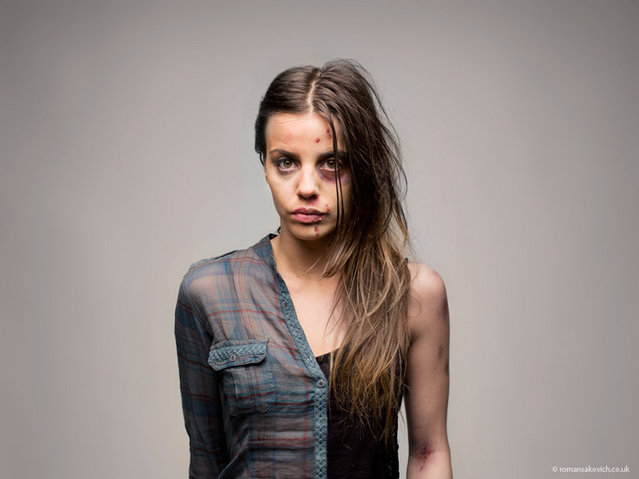
Roman Sakovich's By Portraits Before And After Drug Abuse

The above portrait is part of London-based photographer Roman Sakovich's project, “Half”, which highlights the drastic physical effects of substance abuse. Sakovich has created split images that simultaneously portray an individual prior to and post addiction, leaving the viewer with a stark visualization of the damaging effects of drug use on our bodies.
Details
10 Mar 2013 11:19:00
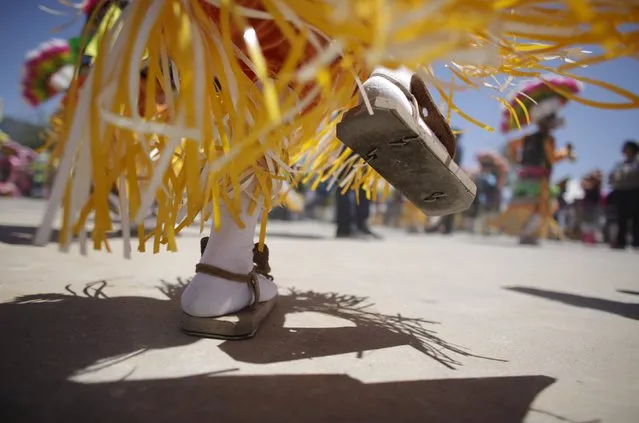
Matachines dancers participate in a religious festival in Saltillo, Mexico, April 17, 2016. Matachines dancing is a masked dance introduced by Spanish missionaries, and has been adopted by cultures from Peru to northern Mexico. It is performed to show respect to Mother Mary or the Guadalupe Virgin, a saint, or to simply worship God. (Photo by Daniel Becerril/Reuters)

Matachines dancers participate in a religious festival in Saltillo, Mexico, April 17, 2016. Matachines dancing is a masked dance introduced by Spanish missionaries, and has been adopted by cultures from Peru to northern Mexico. It is performed to show respect to Mother Mary or the Guadalupe Virgin, a saint, or to simply worship God. (Photo by Daniel Becerril/Reuters)
Details
19 Apr 2016 13:27:00
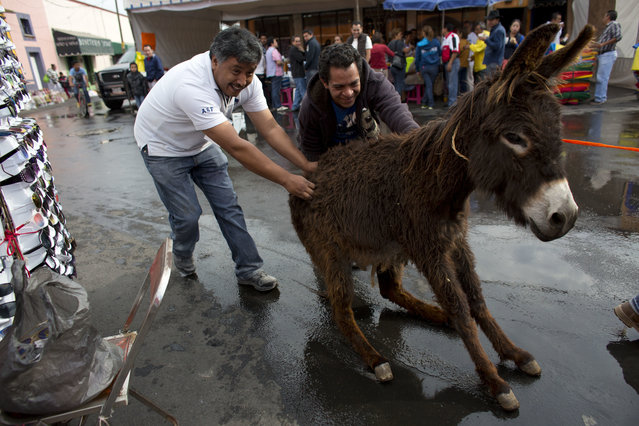
In this May 1, 2016 photo, a reluctant donkey is alternately pushed and pulled and enticed with carrots toward town hall in order to be dressed for the costume competition at the annual donkey festival in Otumba, Mexico state, Mexico. Otumba was an important donkey market during Spanish colonial times, standing at the crossroads of major roads leading to Mexico City, where the beasts pulled heavy loads and carried travelers. Today, however, farmers use tractors and pickup trucks, and the donkey population is in decline. (Photo by Rebecca Blackwell/AP Photo)

In this May 1, 2016 photo, a reluctant donkey is alternately pushed and pulled and enticed with carrots toward town hall in order to be dressed for the costume competition at the annual donkey festival in Otumba, Mexico state, Mexico. Otumba was an important donkey market during Spanish colonial times, standing at the crossroads of major roads leading to Mexico City, where the beasts pulled heavy loads and carried travelers. Today, however, farmers use tractors and pickup trucks, and the donkey population is in decline. (Photo by Rebecca Blackwell/AP Photo)
Details
04 May 2016 11:55:00
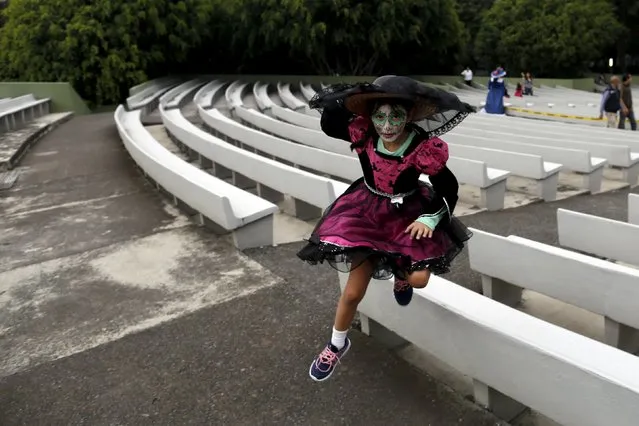
A girl with her face painted to look like the popular Mexican figure called "Catrina",  jumps as she takes part in the annual Catrina Fest in Mexico City November 1, 2015. (Photo by Carlos Jasso/Reuters)

A girl with her face painted to look like the popular Mexican figure called "Catrina", jumps as she takes part in the annual Catrina Fest in Mexico City November 1, 2015. (Photo by Carlos Jasso/Reuters)
Details
05 Nov 2015 08:03:00