Loading...
Done
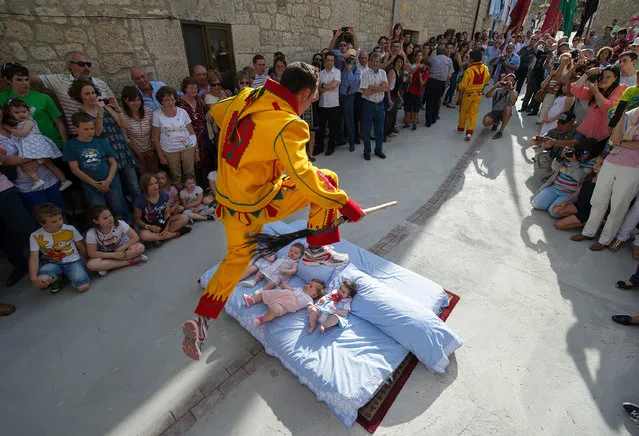
A man representing the devil leaps over babies during the festival of El Salto del Colacho (the devil's jump) on June 22, 2014 in Castrillo de Murcia, Spain. The festival, held on the first Sunday after Corpus Cristi, is a catholic rite of the devil cleansing babies of original sin. (Photo by Denis Doyle/Getty Images)

A man representing the devil leaps over babies during the festival of El Salto del Colacho (the devil's jump) on June 22, 2014 in Castrillo de Murcia, Spain. The festival, held on the first Sunday after Corpus Cristi, is a catholic rite of the devil cleansing babies of original sin. (Photo by Denis Doyle/Getty Images)
Details
29 Jun 2014 09:07:00
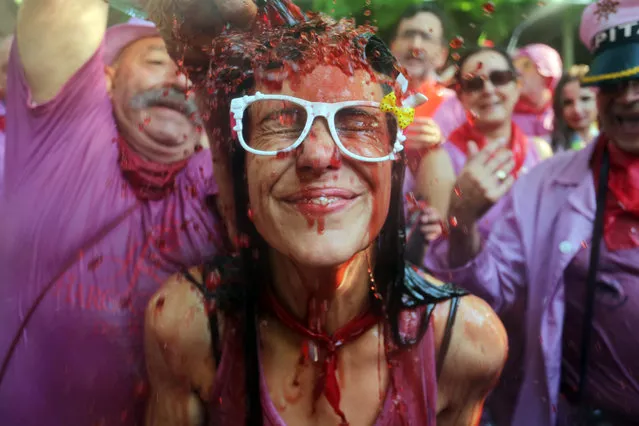
A man pours red wine on a girl's head during the Batalla del Vino (Battle of Wine) in Haro, on June 29, 2015. Every year thousands of locals and tourists climb a mountain in the northern Spanish province of La Rioja to celebrate St. Peter's day covering each other in red wine while tanker trucks filled with wine distribute the alcoholic beverage to water pistols, back mounted spraying devices, buckets which are randomly poured on heads and into any other available container. (Photo by Cesar Manso/AFP Photo)

A man pours red wine on a girl's head during the Batalla del Vino (Battle of Wine) in Haro, on June 29, 2015. Every year thousands of locals and tourists climb a mountain in the northern Spanish province of La Rioja to celebrate St. Peter's day covering each other in red wine while tanker trucks filled with wine distribute the alcoholic beverage to water pistols, back mounted spraying devices, buckets which are randomly poured on heads and into any other available container. More than nine thousand people threw around 130,000 litres of wine during this year's Haro Wine Festival, according to local media. (Photo by Cesar Manso/AFP Photo)
Details
30 Jun 2015 11:56:00
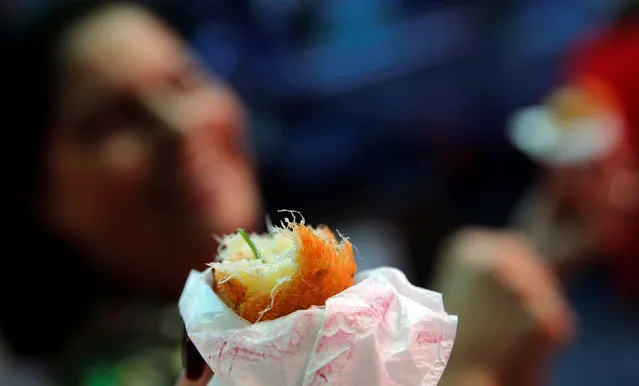
A view of traditional bolinhos de bacalhau (fried codfish balls) in Rio de Janeiro, Brazil, May 7, 2016. (Photo by Sergio Moraes/Reuters)

If the most popular foods of Rio de Janeiro have one thing in common, it is their informality. You can find fine restaurants in the city, but they do not set Rio apart from other places. What does set it apart, and what invariably brings its residents, known as "Cariocas," together is the unpretentious food they eat in bright, loud, crowded bars and restaurants, on busy street corners, or after a day at the beach. Here: A view of traditional bolinhos de bacalhau (fried codfish balls) in Rio de Janeiro, Brazil, May 7, 2016. (Photo by Sergio Moraes/Reuters)
Details
05 Aug 2016 13:20:00
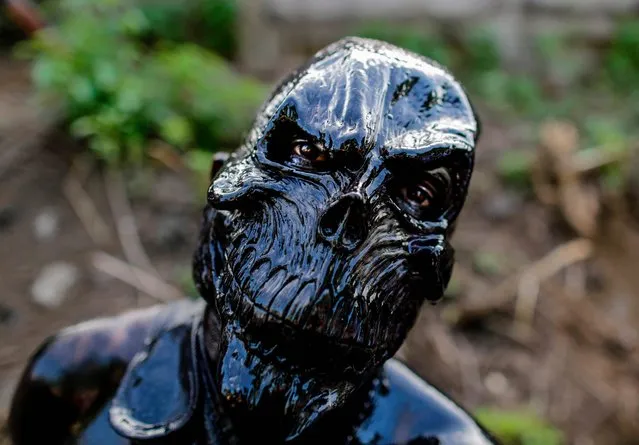
A catholic faithful smeared in burnt oil, takes part in the opening of the ten-day celebration of the Santo Domingo de Guzman festival in Managua, on August 1, 2019. (Photo by Inti Ocon/AFP Photo)

A catholic faithful smeared in burnt oil, takes part in the opening of the ten-day celebration of the Santo Domingo de Guzman festival in Managua, on August 1, 2019. In Central America the black devil, or El Cadejo, is an evil dog-like spirit with glowing red eyes that locals believe eats new born puppies. (Photo by Inti Ocon/AFP Photo)
Details
06 Aug 2019 00:01:00
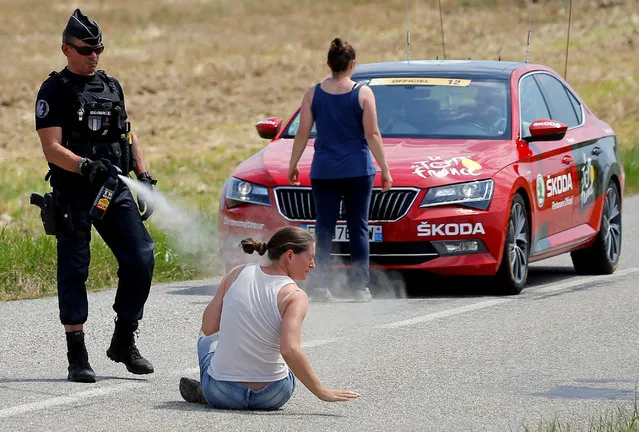
A police officer pepper sprays a protester as another protester stands in front of the race director's car during a farmers' protest who attempted to block the stage' s route, during the 16 th stage of the 105 th edition of the Tour de France cycling race, between Carcassonne and Bagneres- de- Luchon, southwestern France, on July 24, 2018. The race was halted for several minutes on July 24 after tear gas was used as protesting farmers attempted to block the route. (Photo by Stephane Mahe/Reuters)

A police officer pepper sprays a protester as another protester stands in front of the race director's car during a farmers' protest who attempted to block the stage' s route, during the 16 th stage of the 105 th edition of the Tour de France cycling race, between Carcassonne and Bagneres- de- Luchon, southwestern France, on July 24, 2018. The race was halted for several minutes on July 24 after tear gas was used as protesting farmers attempted to block the route. (Photo by Stephane Mahe/Reuters)
Details
26 Jul 2018 00:01:00
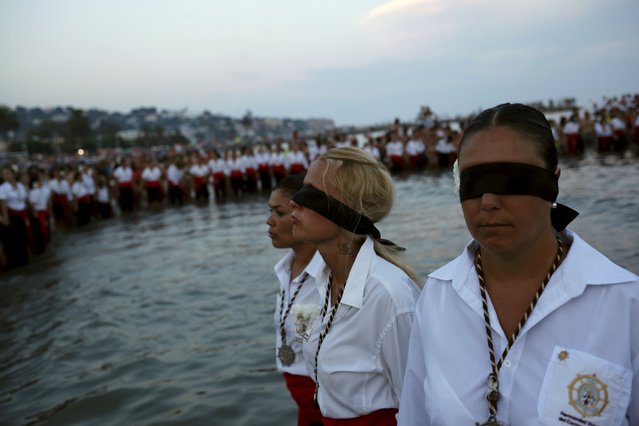
Women in traditional costumes wait for a statue of the El Carmen Virgin to be carried into the sea during a procession in Malaga July 16, 2015. (Photo by Jon Nazca/Reuters)

Women in traditional costumes wait for a statue of the El Carmen Virgin to be carried into the sea during a procession in Malaga July 16, 2015. Many seaside towns celebrate the annual feast of the El Carmen Virgin, who is worshipped as the patron saint of sailors. (Photo by Jon Nazca/Reuters)
Details
17 Jul 2015 13:31:00
Indigenous dancers participate in a traditional healing ceremony for the mother earth at El Salvador del Mundo Square in San Salvador, December 10, 2014. Salvadorean indigenous organizations participated in a ceremony to ask for solutions to stop climate change and respect planet earth as the U.N. Climate Change Conference COP 20 is bring held in Peru. (Photo by Jose Cabezas/Reuters)

Indigenous dancers participate in a traditional healing ceremony for the mother earth at El Salvador del Mundo Square in San Salvador, December 10, 2014. Salvadorean indigenous organizations participated in a ceremony to ask for solutions to stop climate change and respect planet earth as the U.N. Climate Change Conference COP 20 is bring held in Peru. The two-week long United Nations climate summit opened on December 1 in Lima, with experts and analysts from around the world gathering to discuss melting glaciers and extreme weather patterns. (Photo by Jose Cabezas/Reuters)
Details
12 Dec 2014 12:51:00
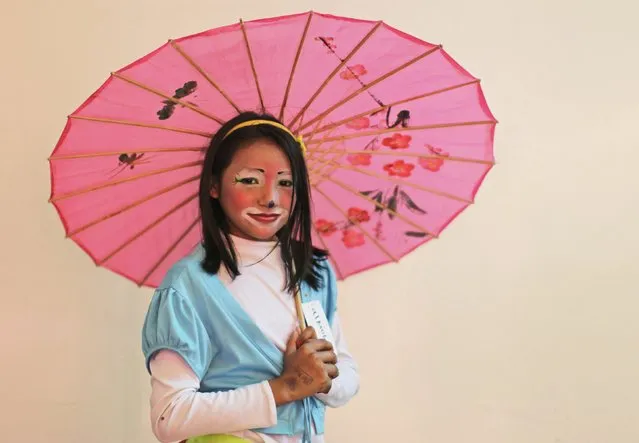
A Salvadorean clown going by the name of “Almohadita” poses during National Clown Day celebrations at Beethoven Square in San Salvador December 3, 2014. The Salvadorean congress declared the second Wednesday of December as National Clown Day to honour all Salvadorean clowns in their efforts to bring fun to the country, reported local media. (Photo by Jose Cabezas/Reuters)

A Salvadorean clown going by the name of “Almohadita” poses during National Clown Day celebrations at Beethoven Square in San Salvador December 3, 2014. The Salvadorean congress declared the second Wednesday of December as National Clown Day to honour all Salvadorean clowns in their efforts to bring fun to the country, reported local media. (Photo by Jose Cabezas/Reuters)
Details
05 Dec 2014 13:26:00