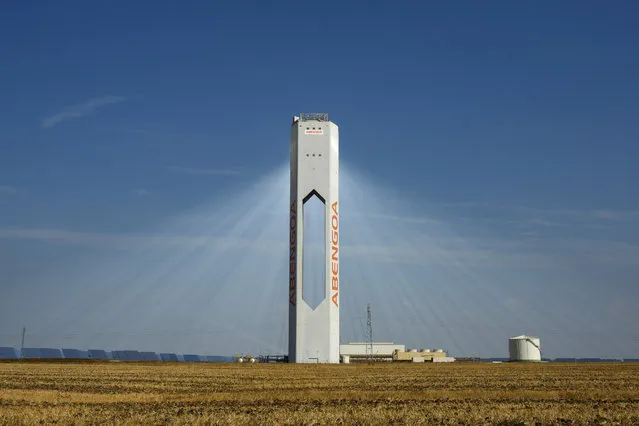
A tower belonging to the Abengoa solar plant at the Solucar solar park is seen in Sanlucar la Mayor, Spain on October 1, 2018. (Photo by Marcelo del Pozo/Reuters)
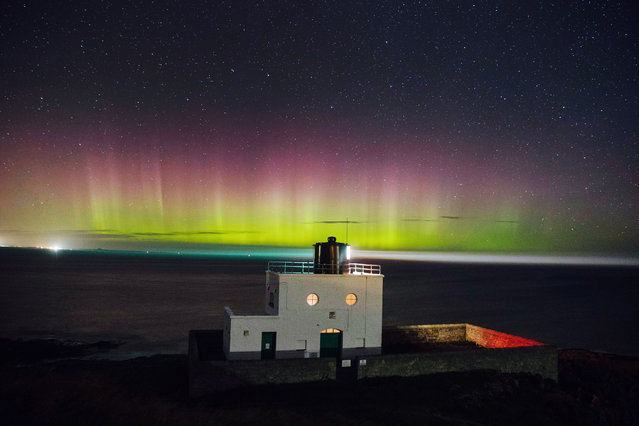
The northern lights, or aurora borealis, appear in the sky over the Bamburgh lighthouse at Stag Rock in Northumberland, England on September 28, 2016. (Photo by Owen Humphreys/PA Wire via ZUMA Press)
New exhibition of sustainable fashion explores the role of tartan in Scottish traditional dance, opening on April 23, 2024 as part of the Pomegranates festival in Edinburgh, Scotland. Vengefully Changed Allegiance is asolo exhibition by fashion designer Alison Harm, founder of Edinburgh Psychomoda clothing brand, who uses industry scraps, vintage clot and broken jewellery. (Photo by Sally Anderson/Alamy Live News)
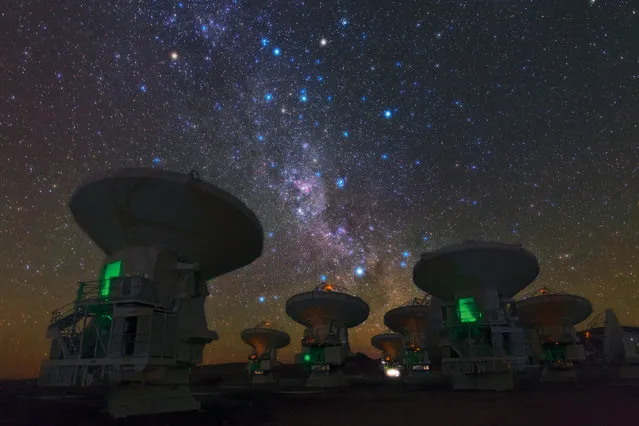
The antennas of the European Southern Observatory's Atacama Large Millimeter/Submillimeter Array, also known as ALMA, are set against the splendor of the Milky Way in this picture by Babak Tafreshi. Construction of the full ALMA array is due to be completed in Chile's Atacama Desert in 2013, but the facility is already making scientific observations with a partial array of antennas. (Photo by ESO/B. Tafreshi/TWAN)
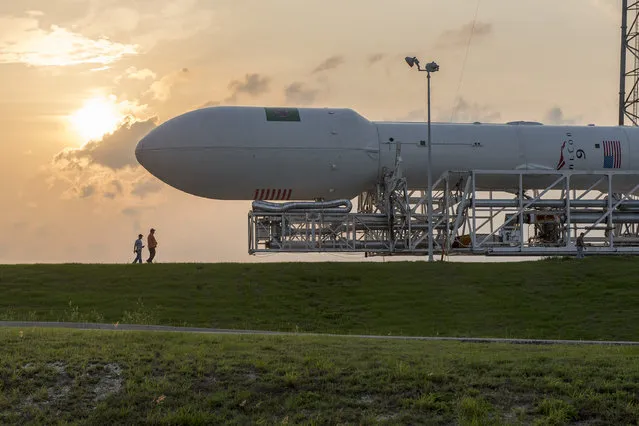
In this handout provided by the National Aeronautics and Space Administration (NASA), SpaceX's Falcon 9 is moved to the launch pad prior to the rocket's Thales Alenia Space launch attempt on April 26, 2015 in Cape Canaveral, Florida. (Photo by NASA via Getty Images)
Keeper Silvia Salvatierra, 59, is kissed by a chimp named “Jony”, 54, who was rescued from a circus, at the Lujan Zoo from where felines, including tigers and lions, will be transferred to a wildlife sanctuary in India, in Lujan, on the outskirts of Buenos Aires, Argentina on April 8, 2024. (Photo by Agustin Marcarian/Reuters)
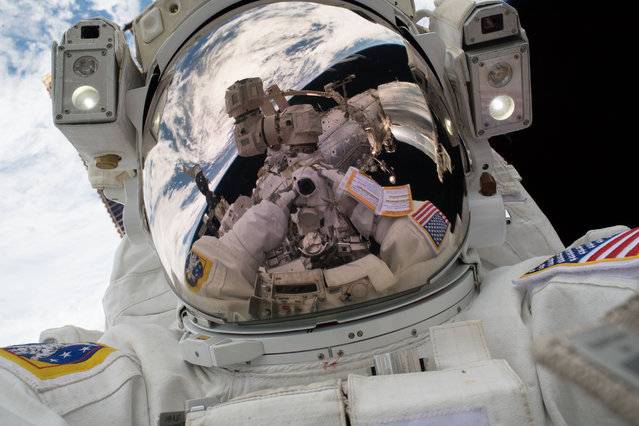
Spacewalker Mark Vande Hei took his own photograph during the first spacewalk of 2018, on January 23, 2018. These sky-high pictures are better known as “space-selfies”. (Photo by Mark Vande Hei/NASA)
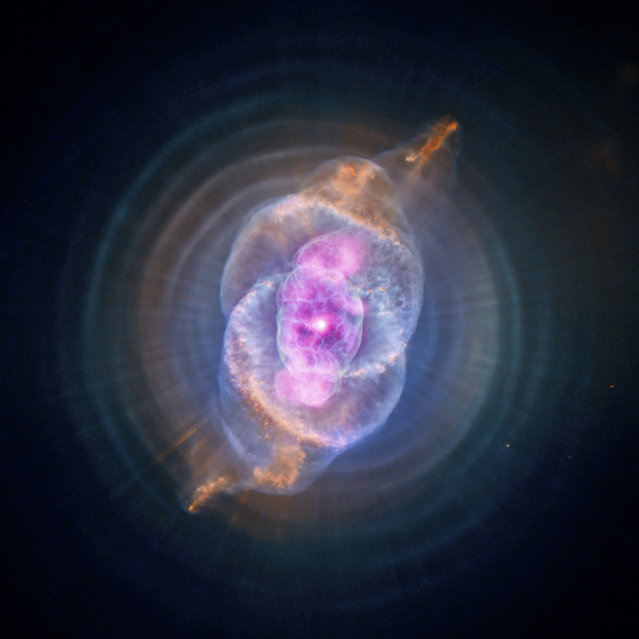
This image is NGC 6543 known as the Cat's Eye Nebula as it appears to the Chandra X-Ray Observatory and Hubble Telescope. A planetary nebula is a phase of stellar evolution that the sun should experience several billion years from now, when it expands to become a red giant and then sheds most of its outer layers, leaving behind a hot core that contracts to form a dense white dwarf star. This image was released October 10, 2012. (Photo by J. Kastner/NASA/CXC/RIT)