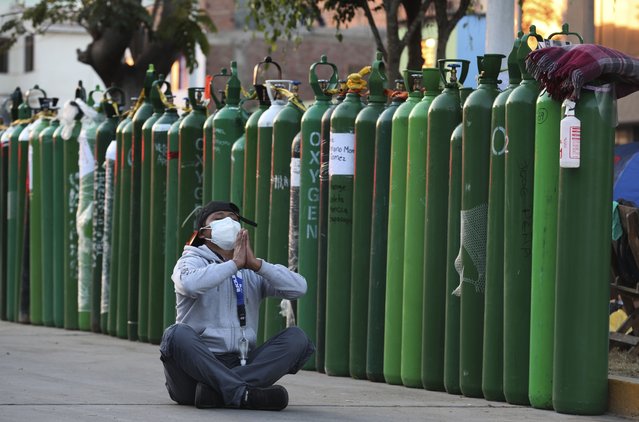
Alejandro Ccasa prays after waiting three days next to an empty oxygen tank for his uncle who has COVID-19 outside a refill shop where he is the first in line before it opens in Callao, Peru, early Tuesday, February 2, 2021. Ccasa said his family has one large tank and it gives about four hours of oxygen therapy. (Photo by Martin Mejia/AP Photo)
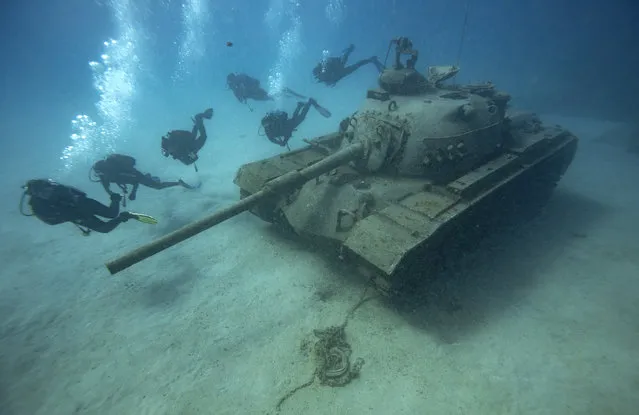
A view of sunken tank which promotes scuba diving tourism with its location at an artificial reef of Guvercin Island region of Kas district of Antalya, Turkiye on December 04, 2022. The sunken tank, situated at a depth of around 15 meters, is visible to both seasoned divers and those undergoing basic diving training. (Photo by Mahmut Serdar Alakus/Anadolu Agency via Getty Images)
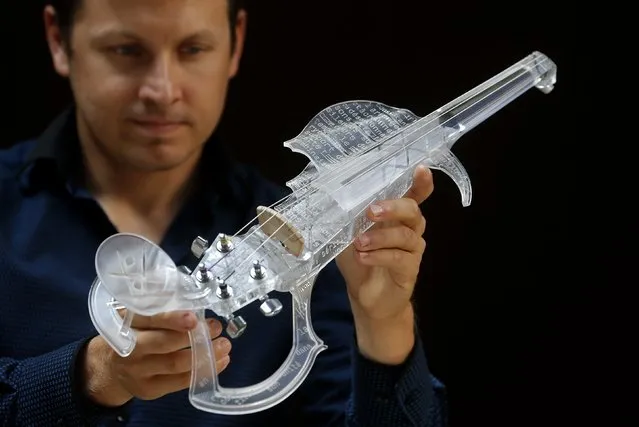
French engineer and professional violinist Laurent Bernadac poses with the “3Dvarius”, a 3D printed violin made of transparent resin, during an interview with Reuters in Paris, France, September 11, 2015. (Photo by Christian Hartmann/Reuters)
A frog sits on a leaf and instead of seeing a reflection of itself in the water below, it sees a snail, attached to the bottom of the leaf, in a fish tank in Vietnam. (Photo by Duong Quoc Dinh/Solent Ne/SIPA Press)
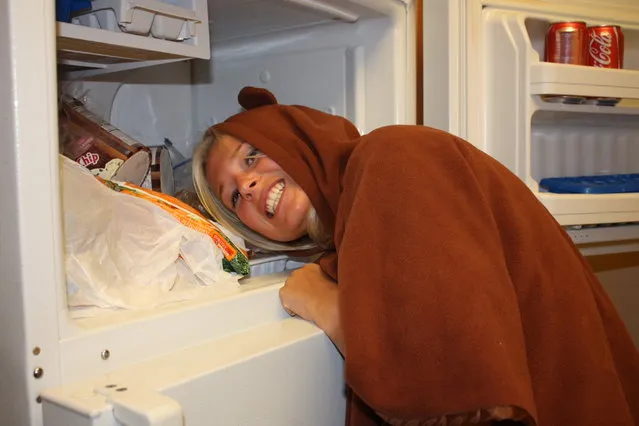
241543903 (a.k.a “Heads in Freezers”) is a numerical keyword associated with a photo meme that involves people taking pictures with their heads in the freezer & sharing them online. By tagging a series of image files with a cryptic number, a high level of search engine optimization can be easily achieved. As a result, typing “241543903” into image search engines like Google Images successfully yields pages after pages of pictures showing people’s heads in freezers.
A wide-angle view shows the ascent of the shuttle Challenger on January 28, 1986. In the seconds after ignition, the rocket engines' hot blast began the process of destruction. (Photo by NASA)