Loading...
Done
Women wearing traditional hats, known as a non la, sell fruits in Hoi An, Vietnam April 4, 2016. (Photo by Jorge Silva/Reuters)

Women wearing traditional hats, known as a non la, sell fruits in Hoi An, Vietnam April 4, 2016. The non la hats are made of readily available materials such as palm leaves, tree bark and bamboo and are visible everywhere in the city, a UNESCO World Heritage site. Hoi An's history as a busy trading port is evident throughout its architecture, a mix of eras and styles, with traditional wooden Vietnamese houses, Chinese temples and French colonial buildings. (Photo by Jorge Silva/Reuters)
Details
11 May 2016 11:32:00
Lost City Shicheng found Underwater in China

Qiandao Lake (Chinese: 千島湖, lit. Thousand Island Lake), a man-made lake located in Chun'an County, Zhejiang, China, formed after the completion of the Xin'an River hydroelectric station in 1959. 1,078 large islands dot the lake and a few thousand smaller ones are scattered across it. The lake covers an area of 573 km² and has a storage capacity of 17.8 km³. The islands in the lake cover about 86 km²
Details
07 Feb 2014 13:25:00
These images, scanned from old glass negatives which had surfaced in northern France, were believed to have been taken by a local amateur photographer in 1916. They showed British and a few Australian soldiers, in formal or informal poses, during or just before the most murderous battle in the history of the British Empire – Battle of the Somme. Who are these British and British Empire soldiers? The identity of the soldiers is, and may always remain, a mystery. (Property of Bernard Gardin/Dominique Zanardi/Joel Scribe/The Independent Magazine)

These images, scanned from old glass negatives which had surfaced in northern France, were believed to have been taken by a local amateur photographer in 1916. They showed British and a few Australian soldiers, in formal or informal poses, during or just before the most murderous battle in the history of the British Empire – Battle of the Somme. Who are these British and British Empire soldiers? The identity of the soldiers is, and may always remain, a mystery... (Property of Bernard Gardin/Dominique Zanardi/Joel Scribe/The Independent Magazine)
Details
04 Aug 2014 14:06:00
Tsetse, six-year-old daughter of Dukha herder Erdenebat Chuluu, sits among her family's reindeer in a forest near the village of Tsagaannuur, Khovsgol aimag, Mongolia, April 21, 2018. (Photo by Thomas Peter/Reuters)

Tsetse, six-year-old daughter of Dukha herder Erdenebat Chuluu, sits among her family's reindeer in a forest near the village of Tsagaannuur, Khovsgol aimag, Mongolia, April 21, 2018. Nyamaa is an ethnic Darkhad, herders of northern Mongolia who have historically inhabited the steppe that borders the Taiga forests. (Photo by Thomas Peter/Reuters)
Details
26 May 2018 00:03:00
A participant poses backstage before a drag queen competition during carnival festivities in Las Palmas on the Spanish Canary Island of Gran Canaria February 20, 2015. (Photo by Borja Suarez/Reuters)

A participant poses backstage before a drag queen competition during carnival festivities in Las Palmas on the Spanish Canary Island of Gran Canaria February 20, 2015. (Photo by Borja Suarez/Reuters)
Details
22 Feb 2015 10:39:00
People prepare for the burning of the 'Ninot' caricatures during the last day of the 'Fallas' festival on March 19, 2012 in Valencia, Spain

“The Falles is a traditional celebration held in commemoration of Saint Joseph in Valencia, Spain. The term Falles refers to both the celebration and the monuments created during the celebration. A number of towns in the Valencian Community have similar celebrations inspired by the original in Valencia”. – Wikipedia

Photo: A person prepares for the burning of the “Ninot” caricatures during the last day of the “Fallas” festival on March 19, 2012 in Valencia, Spain. The festival, which runs March 15 – 19, celebrates the arrival of spring with fireworks, fiestas and bonfires. (Photo by Xaume Olleros/Getty Images)
Details
20 Mar 2012 11:36:00
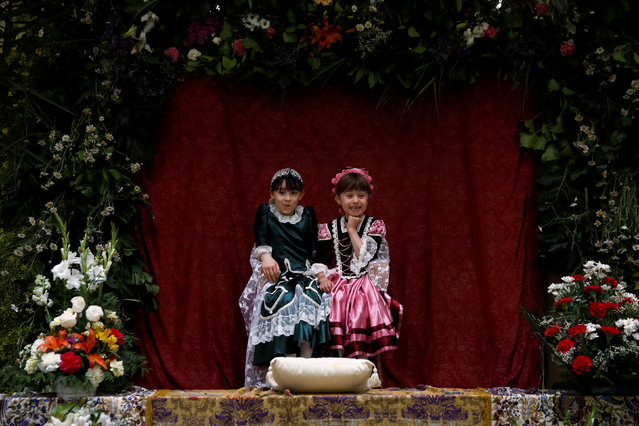
A “Maya” girl sits in an altar during the traditional celebration of “Las Mayas” on the streets in Colmenar Viejo, near Madrid, Spain, Friday, May 2, 2014. (Photo by Daniel Ochoa de Olza/AP Photo)

A “Maya” girl sits in an altar during the traditional celebration of “Las Mayas” on the streets in Colmenar Viejo, near Madrid, Spain, Friday, May 2, 2014. The festivity of the Maya comes from pagan rites and dates from the medieval age, appearing in ancient documents, it takes place every year in the beginning of May and celebrates the beginning off the spring. A girl between 7 and 11years is chosen as “Maya” and should sit still, serious, and quiet for a couple of hours in an altar on the street decorated with flowers and plants, afterwards they walk to the church with their family where they attend a ceremony. (Photo by Daniel Ochoa de Olza/AP Photo)
Details
13 May 2014 10:17:00
A man gestures towards a bull during a traditional bullfighting festival called “Toros a la tica” in San Jose, Costa Rica January 6, 2017. (Photo by Juan Carlos Ulate/Reuters)

A man gestures towards a bull during a traditional bullfighting festival called “Toros a la tica” in San Jose, Costa Rica January 6, 2017. (Photo by Juan Carlos Ulate/Reuters)
Details
08 Jan 2017 14:14:00