Loading...
Done


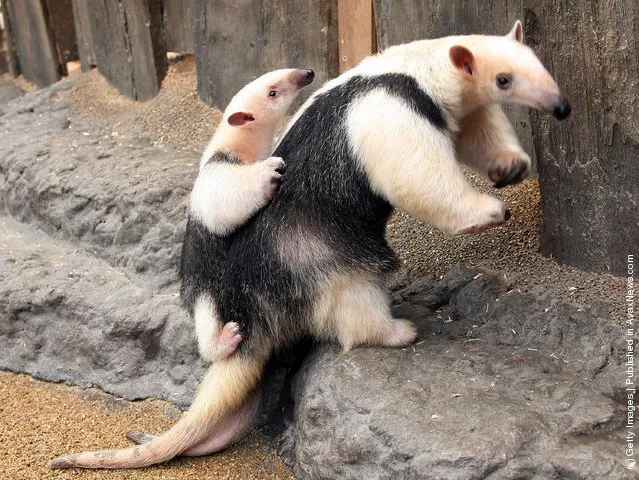
“The Southern Tamandua, Collared Anteater or Lesser Anteater (Tamandua tetradactyla) is a species of anteater from South America. It is a solitary animal, found in many habitats from mature to highly disturbed secondary forests and arid savannas. It feeds on ants, termites and bees. It has very strong foreclaws that can be used to break insect nests or to defend itself”. – Wikipedia

Photo: A three-month-old baby Southern Tamandua “Konbu” lies on its mother Tae's back at Sunshine International Aquarium on July 7, 2009 in Tokyo, Japan. Baby Southern Tamandua feels safe and comfortable holding onto something and normally stays on the mother's back until around 3 months old. (Photo by Junko Kimura/Getty Images)
Details
19 May 2011 10:31:00
A journalist (R) is attacked by residents who are trying to prevent migrants from disembarking on the Greek island of Lesbos, on March 1, 2020. The United Nation called on March 1 for calm and urged states to refrain from “excessive” force, as thousands of migrants have flooded to Turkey's border with Greece in a bid to enter the EU. A massive influx of migrants swelled along the border over the weekend after Turkey's President Recep Tayyip Erdogan threatened to open its frontier to Europe as tensions mount over its deepening conflict in Syria. (Photo by AFP Photo/Stringer)

A journalist (R) is attacked by residents who are trying to prevent migrants from disembarking on the Greek island of Lesbos, on March 1, 2020. The United Nation called on March 1 for calm and urged states to refrain from “excessive” force, as thousands of migrants have flooded to Turkey's border with Greece in a bid to enter the EU. A massive influx of migrants swelled along the border over the weekend after Turkey's President Recep Tayyip Erdogan threatened to open its frontier to Europe as tensions mount over its deepening conflict in Syria. (Photo by AFP Photo/Stringer)
Details
03 Mar 2020 00:07:00
A protester peeks out from behind of a banner as supporters of anti-immigrant activists and nationalists march to protest against the Polish governments decision to accept migrants from Syria and North Africa, in Warsaw, Poland, September12, 2015. (Photo by Jacek Turczyk/EPA)

A protester peeks out from behind of a banner as supporters of anti-immigrant activists and nationalists march to protest against the Polish governments decision to accept migrants from Syria and North Africa, in Warsaw, Poland, September12, 2015. EU President Donald Tusk said he would call a special summit on the migration crisis if the bloc's interior ministers do not display “solidarity and unity” at emergency talks on 14 September about the thousands of migrants streaming into Europe. (Photo by Jacek Turczyk/EPA)
Details
14 Sep 2015 13:26:00
Activists and supporters of Ukrainian nationalist groups light flares during a rally to mark the third anniversary of the Euromaidan Revolution in downtown Kiev, Ukraine, 21 November 2016. (Photo by Roman Pilipey/EPA)

Activists and supporters of Ukrainian nationalist groups light flares during a rally to mark the third anniversary of the Euromaidan Revolution in downtown Kiev, Ukraine, 21 November 2016. About one thousand activists took park in the rally during which they burned tires on the Independence Square, destroyed the Russian bank Sberbank and broke windows in the office of a Ukrainian politician Viktor Medvedchuk, according to Ukrainian media. (Photo by Roman Pilipey/EPA)
Details
22 Nov 2016 10:23:00
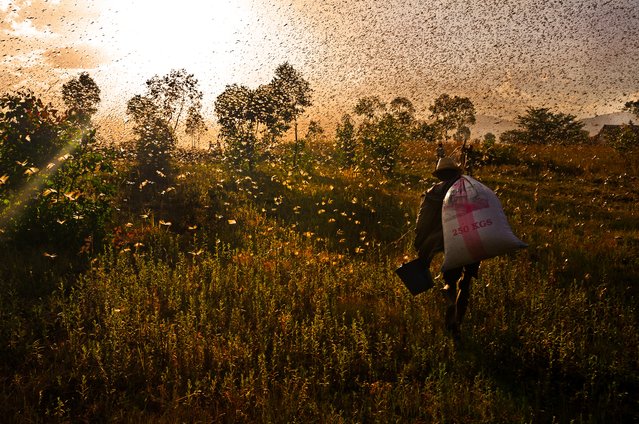
“Locusts & Men”. Oppression, interaction, collaboration. In the life cycle of nature nothing is lost, but the coexistence of different species is sometimes difficult. In Madagascar periodically returns the archaic antagonism between man and the migratory locust, in a circle of life where the two species are looking for space and food for their survival. Photo location: Madagascar, 2013. (Photo and caption by Michele Martinelli/National Geographic Photo Contest)

“Locusts & Men”. Oppression, interaction, collaboration. In the life cycle of nature nothing is lost, but the coexistence of different species is sometimes difficult. In Madagascar periodically returns the archaic antagonism between man and the migratory locust, in a circle of life where the two species are looking for space and food for their survival. At the end of the day a man walks home carrying on his shoulders the heavy bag which contains the locusts captured during the day. The insects provide nutritious meals for the man and his family. Photo location: Madagascar, 2013. (Photo and caption by Michele Martinelli/National Geographic Photo Contest)

ATTENTION! All pictures are presented in high resolution. To see Hi-Res images – just TWICE click on any picture. In other words, click small picture – opens the BIG picture. Click BIG picture – opens VERY BIG picture.
Details
03 Dec 2013 10:59:00
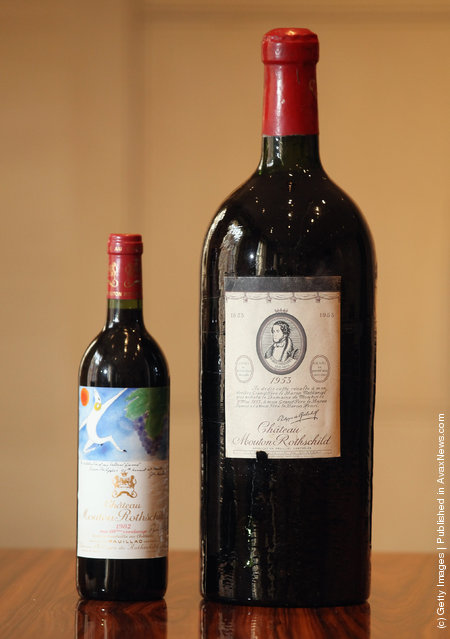
A rare Jeroboam of Chateau Mouton Rothschild from 1953 and a bottle of Chateau Mouton Rothschild from 1982

A rare Jeroboam of Chateau Mouton Rothschild from 1953 (R) and a bottle of Chateau Mouton Rothschild from 1982 on January 17, 2012 in London, England. (Photo by Oli Scarff/Getty Images)
Details
19 Jan 2012 09:08:00
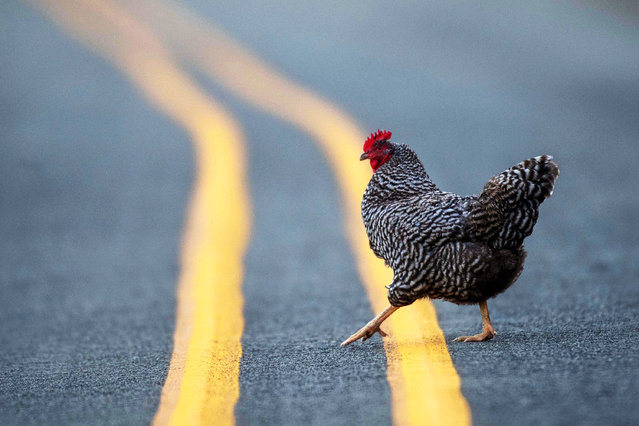
A chicken gingerly crosses the double yellow line of a country road near Roseburg in western Oregon, USA on July 16, 2018. (Photo by Robin Loznak/ZUMA Wire/Alamy Live News)

A chicken gingerly crosses the double yellow line of a country road near Roseburg in western Oregon, USA on July 16, 2018. (Photo by Robin Loznak/ZUMA Wire/Alamy Live News)
Details
22 Jul 2018 00:03:00


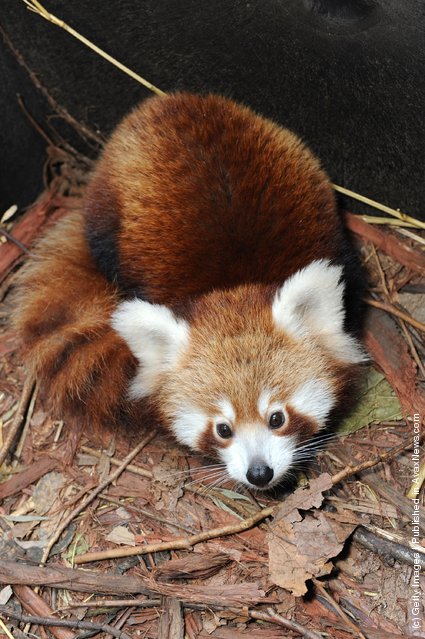
“The red panda (Ailurus fulgens, or shining-cat), is a small arboreal mammal native to the eastern Himalayas and southwestern China. It is the only species of the genus Ailurus. Slightly larger than a domestic cat, it has reddish-brown fur, a long, shaggy tail, and a waddling gait due to its shorter front legs. It feeds mainly on bamboo, but is omnivorous and may also eat eggs, birds, insects, and small mammals. It is a solitary animal, mainly active from dusk to dawn, and is largely sedentary during the day”. – Wikipedia

Photo: In this handout image provided by Taronga Zoo, Seba, a baby Red Panda, explores his new home at Taronga Zoo on April 7, 2011 in Sydney, Australia. The Red Panda cub was born at Christmas and is the 45th to be born at the zoo since 1977. (Photo by Peter Hardin/Taronga Zoo via Getty Images)
Details
07 Apr 2011 08:51:00