Loading...
Done
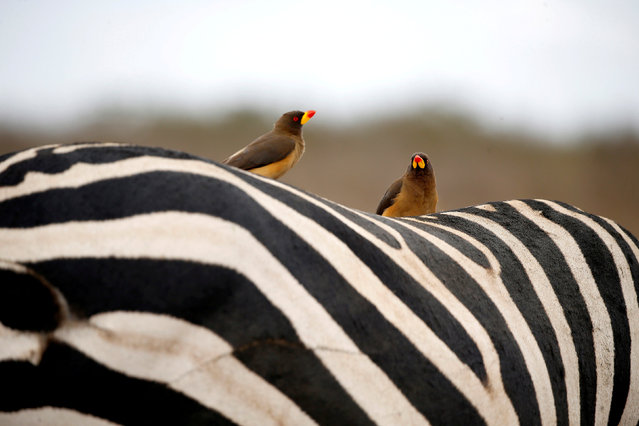
Birds sit on the back of a zebra in the Nairobi National Park, near Nairobi, Kenya, November 21, 2018. (Photo by Baz Ratner/Reuters)

Birds sit on the back of a zebra in the Nairobi National Park, near Nairobi, Kenya, November 21, 2018. (Photo by Baz Ratner/Reuters)
Details
25 Nov 2018 00:03:00
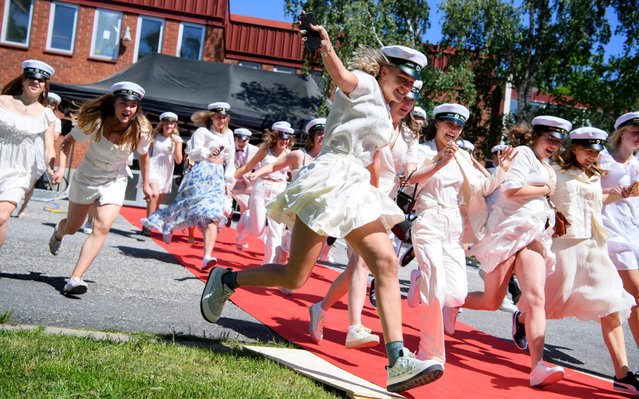
Students run out of their school celebrating their high school graduation at Nacka Gymnasium following the spread of the corona virus disease (COVID-19) in Stockholm, Sweden, June 3, 2020. (Photo by Jessica Gow/TT News Agency via Reuters)

Students run out of their school celebrating their high school graduation at Nacka Gymnasium following the spread of the corona virus disease (COVID-19) in Stockholm, Sweden, June 3, 2020. (Photo by Jessica Gow/TT News Agency via Reuters)
Details
05 Jun 2020 00:07:00
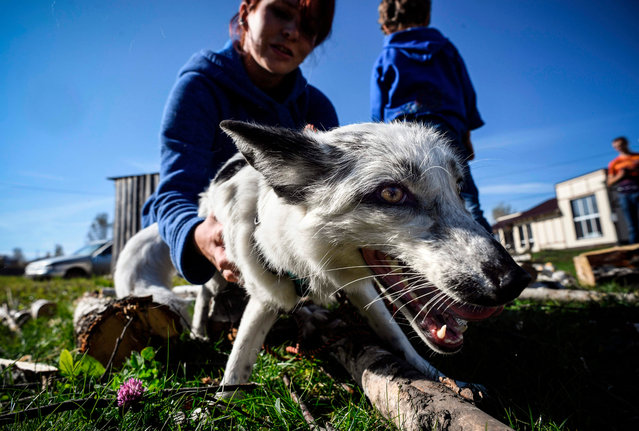
Tatyana Abramova, 33, plays with her home fox Plombir at her countryside house outside Siberian city of Novosibirsk on September 12, 2020. The official start of the Soviet experiment to better understand the domestication of animals by humans began in 1959, and was initiated by geneticists Dmitri Beliaiev and Lioudmila Trout on a farm in Akademgorodok, the scientific center of excellence in Siberia. Their primary objective was to domesticate foxes, to understand how the ancestor of wolves, another canine, evolved into a loyal and loving dog. And understand what this domestication tells us about the genetic evolution of species. (Photo by Alexander Nemenov/AFP Photo)

Tatyana Abramova, 33, plays with her home fox Plombir at her countryside house outside Siberian city of Novosibirsk on September 12, 2020. The official start of the Soviet experiment to better understand the domestication of animals by humans began in 1959, and was initiated by geneticists Dmitri Beliaiev and Lioudmila Trout on a farm in Akademgorodok, the scientific center of excellence in Siberia. Their primary objective was to domesticate foxes, to understand how the ancestor of wolves, another canine, evolved into a loyal and loving dog. And understand what this domestication tells us about the genetic evolution of species. (Photo by Alexander Nemenov/AFP Photo)
Details
25 Oct 2020 00:05:00
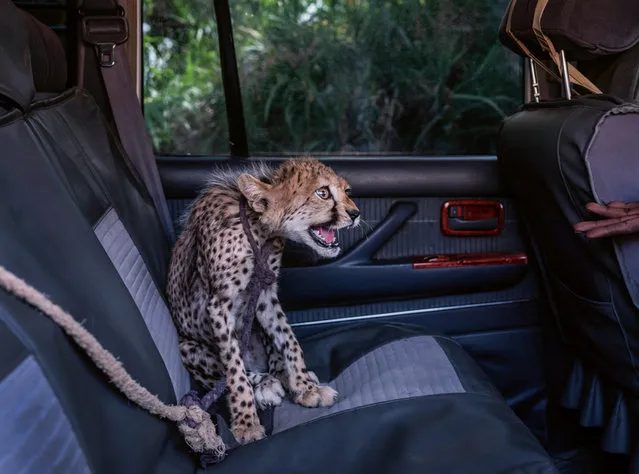
A five-month-old cheetah seated in the back of a Land Cruiser growls at an outstretched hand after being taken from traffickers in Ethiopia and driven to Harirad, Somaliland, in 2020. This photo is part of the work of more than 100 artists in Why We Photograph Animals, a new collection of wildlife photography that aims to help understand why people have photographed animals at different points in history and what it means in the present. (Photo by Nichole Sobecki/Thames & Hudson)

A five-month-old cheetah seated in the back of a Land Cruiser growls at an outstretched hand after being taken from traffickers in Ethiopia and driven to Harirad, Somaliland, in 2020. This photo is part of the work of more than 100 artists in Why We Photograph Animals, a new collection of wildlife photography that aims to help understand why people have photographed animals at different points in history and what it means in the present. (Photo by Nichole Sobecki/Thames & Hudson)
Details
28 Apr 2024 03:15:00
Person viewing the Northern lights over the lava landscape, Reykjanes Peninsula, Iceland. (Photo by Arctic-Images/Getty Images)

A person viewing the Northern lights over the lava landscape, Reykjanes Peninsula, Iceland. (Photo by Arctic-Images/Getty Images)
Details
19 Nov 2016 11:30:00
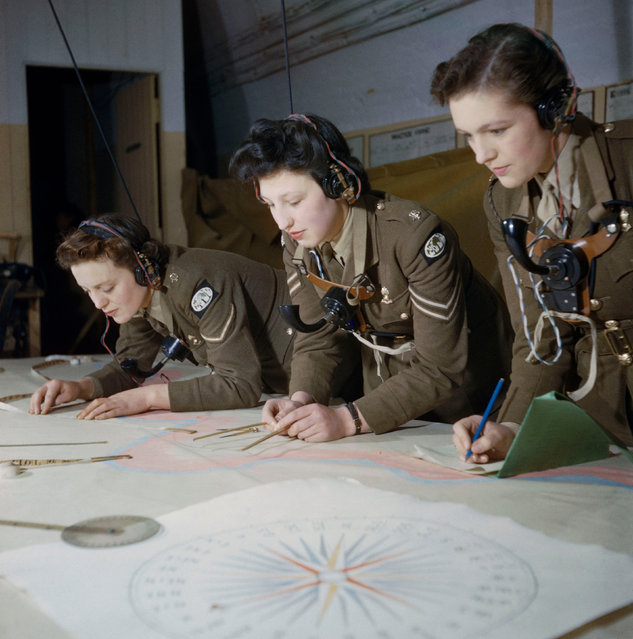
Auxiliary Territorial Service (ATS) plotters at work at Coastal Artillery Headquarters in Dover, December 1942. (Photo by Ted Dearberg/IWM/PA Wire)

Auxiliary Territorial Service (ATS) plotters at work at Coastal Artillery Headquarters in Dover, December 1942. The Auxiliary Territorial Service was the women's branch of the British Army during the Second World War. It was formed on 9 September 1938, initially as a women's voluntary service, and existed until 1 February 1949, when it was merged into the Women's Royal Army Corps. The ATS had its roots in the Women's Auxiliary Army Corps (WAAC), which was formed in 1917 as a voluntary service. During the First World War its members served in a number of jobs including clerks, cooks, telephonists and waitresses. The WAAC was disbanded after four years in 1921. (Photo by Ted Dearberg/IWM/PA Wire)
Details
13 Jul 2017 07:52:00
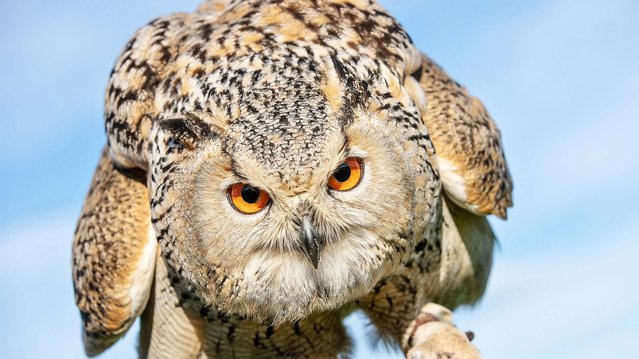
A Siberian eagle owl, which can grow up to 71cm tall, is among a collection of 60 birds of prey at SMJ Falconry near Oxenhope, West Yorkshire, England. (Photo by Charlotte Graham)

A Siberian eagle owl, which can grow up to 71cm tall, is among a collection of 60 birds of prey at SMJ Falconry near Oxenhope, West Yorkshire, England. (Photo by Charlotte Graham)
Details
03 Mar 2019 00:03:00
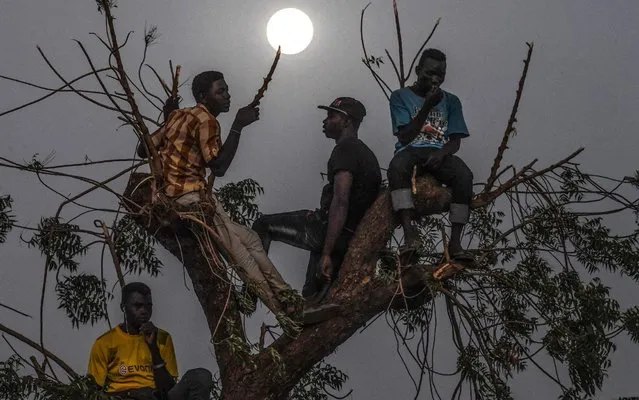
Sudanese protesters rally outside the army complex in Sudan's capital Khartoum on April 18, 2019. Huge crowds of protesters thronged the Sudanese capital Khartoum today, a week after the army's ouster of president Omar al-Bashir, determined to complete their revolution seeking civilian rule. (Photo by Ozan Kose/AFP Photo)

Sudanese protesters rally outside the army complex in Sudan's capital Khartoum on April 18, 2019. Huge crowds of protesters thronged the Sudanese capital Khartoum today, a week after the army's ouster of president Omar al-Bashir, determined to complete their revolution seeking civilian rule. (Photo by Ozan Kose/AFP Photo)
Details
21 Apr 2019 00:07:00