Loading...
Done


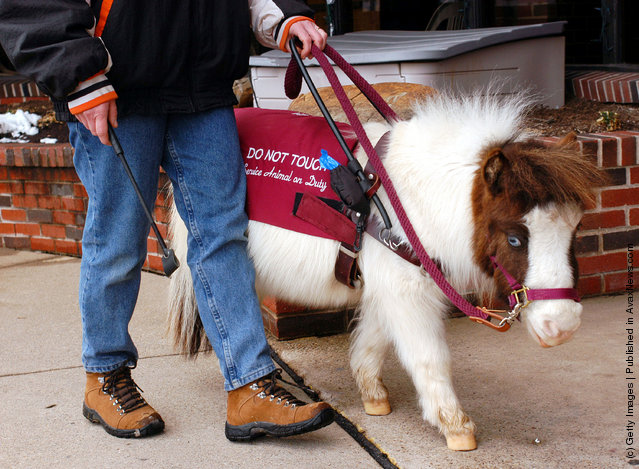
“A guide horse is an experimental mobility option for blind people who do not wish to or cannot use a guide dog. They are provided by The Guide Horse Foundation, founded in 1999 to provide miniature horses as assistance animals to blind users living in rural environments”. – Wikipedia

Photo: Shari Bernstiel, of Lansdale, Pennsylvania is helped along the sidewalk by Tonto, her guide horse March 19, 2004 in Lansdale, Pennsylvania. Tonto, a minature horse who went through one year of training, acts as Sheri's seeing eye dog and is one of three working guide horses in the United States. (Photo by William Thomas Cain/Getty Images)
Details
20 Jun 2011 14:05:00
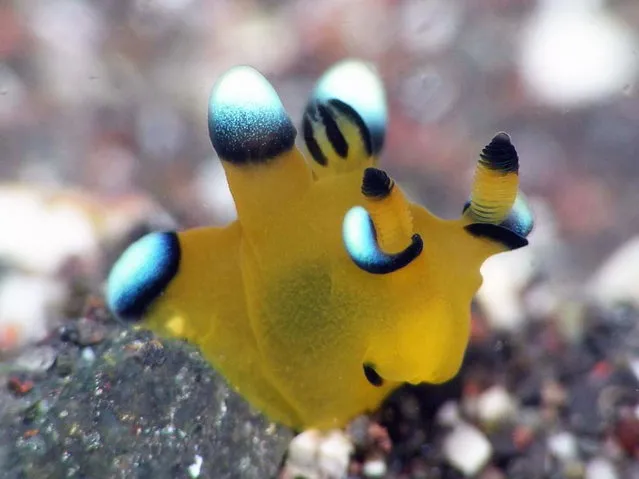
Thecacera Pacifica AKA Pikachu

If you ever wanted to meet a live Pikachu, you might have a hard time finding one. However, there is a creature on this Earth that kind of looks like one. That creature’s name is Thecacera pacifica and it is a species of a sea slug. These little critters can be found in the Indian Ocean from African coast to Indonesia and Vanuatu. Their vibrant orange and blue colors look gorgeous, making it look like some sort of anemone. Also, as you might have guessed from the striking colors of the sea slug, just like most of anemones, this creature is very toxic. Thus, keeping it as a pet isn’t an option.

Details
19 Dec 2014 12:51:00
Aegean airlines air hostesses take selfies after a news conference in Athens, Wednesday, March 28, 2018. (Photo by Petros Giannakouris/AP Photo)

Aegean airlines air hostesses take selfies after a news conference in Athens, Wednesday, March 28, 2018. In a deal worth up to $5 billion, Greek airline Aegean says it will buy 30 new Airbus aircraft, with the option of an additional 12, to upgrade its fleet as the country expects to break tourism records. The signing of the final purchase agreement is expected in June. (Photo by Petros Giannakouris/AP Photo)
Details
30 Mar 2018 06:39:00
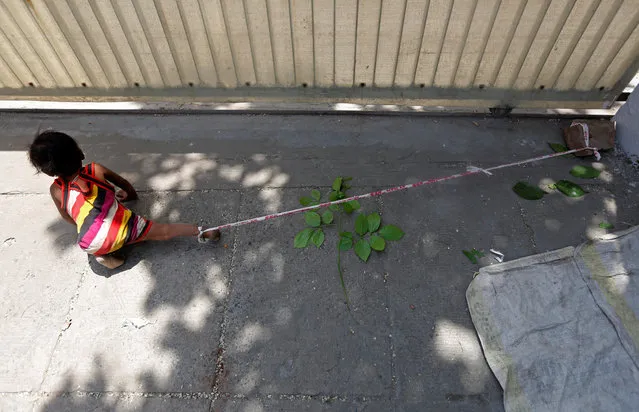
Barrier tape is tied around 15-month-old Shivani's ankle to prevent her from running away, while her mother Sarta Kalara works at a construction site nearby, in Ahmedabad, India, April 19, 2016. Kalara says she has no option but to tether her daughter Shivani to a stone despite her crying, while she and her husband work for 250 rupees ($3.8) each a shift digging holes for electricity cables in the city of Ahmedabad. There are about 40 million construction workers in India, at least one in five of them women, and the majority poor migrants who shift from site to site, building infrastructure for India's booming cities. Across the country it is not uncommon to see young children rolling in the sand and mud as their parents carry bricks or dig for new roads or luxury houses. (Photo by Amit Dave/Reuters)

Barrier tape is tied around 15-month-old Shivani's ankle to prevent her from running away, while her mother Sarta Kalara works at a construction site nearby, in Ahmedabad, India, April 19, 2016. Kalara says she has no option but to tether her daughter Shivani to a stone despite her crying, while she and her husband work for 250 rupees ($3.8) each a shift digging holes for electricity cables in the city of Ahmedabad. There are about 40 million construction workers in India, at least one in five of them women, and the majority poor migrants who shift from site to site, building infrastructure for India's booming cities. Across the country it is not uncommon to see young children rolling in the sand and mud as their parents carry bricks or dig for new roads or luxury houses. (Photo by Amit Dave/Reuters)
Details
14 Dec 2016 07:39:00
Sculputure by Anish Kapoor

“Anish Kapoor CBE RA (born 12 March 1954) is a British sculptor of Indian birth. Born in Mumbai (Bombay), Kapoor has lived and worked in London since the early 1970s when he moved to study art, first at the Hornsey College of Art and later at the Chelsea School of Art and Design”. – Wikipedia

Photo: Workmen install a large-scale sculputure by Anish Kapoor at the Lisson Gallery on October 10, 2006 in London, England. (Photo by Gareth Cattermole/Getty Images)
Details
07 Aug 2011 11:15:00
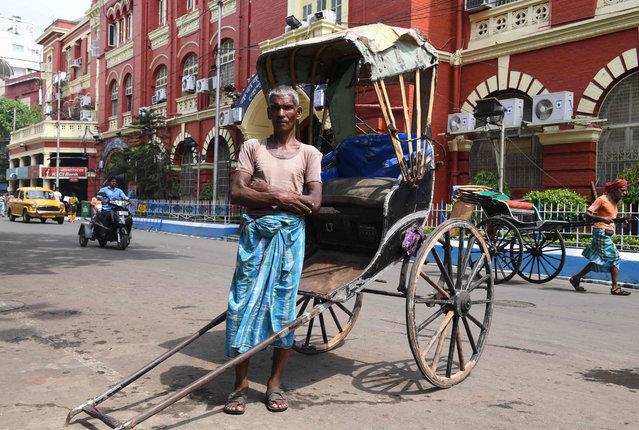
Mohammad Ashgar, 65, an Indian rickshaw puller, poses for a photograph next to his rickshaw in Kolkata on April 21, 2018. A mainstay of 19 th century transportation options, the hand- pulled rickshaw survives in India only in Kolkata after being outlawed elsewhere. The local puller's union puts the number of pullers in the city at 3,000. The union has resisted all previous attempts to ban their livelihood, previously organising mass protests of their members against moves to stamp out the practice. (Photo by Dibyangshu Sarkar/AFP Photo)

Ahead of May Day, AFP' s video and photo teams spoke to men and women around the globe whose jobs are becoming increasingly rare, particularly as technology transforms societies. Here: Mohammad Ashgar, 65, an Indian rickshaw puller, poses for a photograph next to his rickshaw in Kolkata on April 21, 2018. (Photo by Dibyangshu Sarkar/AFP Photo)
Details
02 May 2018 00:01:00


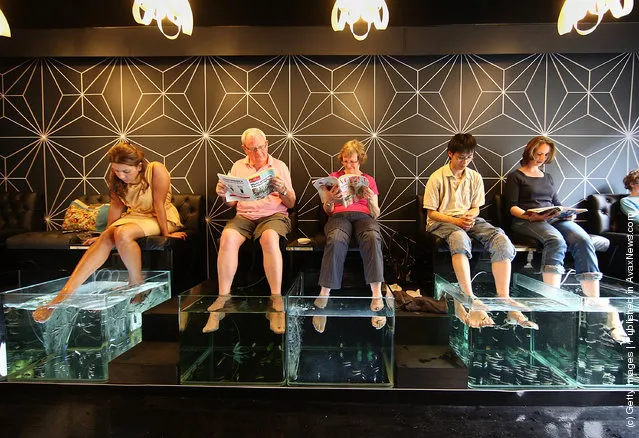
“Doctor fish is the name given to two species of fish: Garra rufa and Cyprinion macrostomus. Other nicknames include nibble fish, kangal fish, physio fish and doctorfishen; in non-medical contexts, Garra rufa is called the reddish log sucker. They live and breed in the outdoor pools of some Turkish spas, where they feed on the skin of patients with psoriasis. The fish are like combfishes in that they only consume the affected and dead areas of the skin, leaving the healthy skin to grow, with the outdoor location of the treatment bringing beneficial effects. The spas are not meant as a curative treatment option, only as a temporary alleviation of symptoms, and patients usually revisit the spas every few months”. – Wikipedia

Photo: Visitors to the Aqua Sheko fish therapy spa have their feet exfoliated on June 24, 2010 in London, England. Customers sit with their feet in a tank filled with 100-150 Garra Rufa fish which remove any dead skin by nibbling and sucking. A half hour session is then followed by a foot massage. (Photo by Peter Macdiarmid/Getty Images)
Details
22 Jun 2011 10:44:00
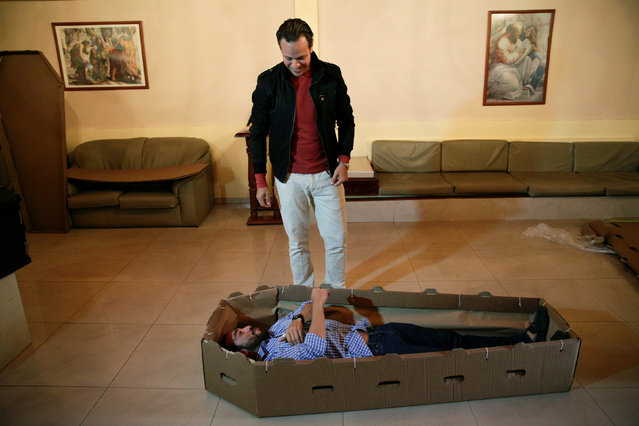
Elio Angulo (bottom C) lies inside a cardboard coffin next to Alejandro Blanchard as they introduce their product to potential customers at a mortuary in Valencia, in the state of Carabobo, Venezuela August 25, 2016. (Photo by Marco Bello/Reuters)

Elio Angulo (bottom C) lies inside a cardboard coffin next to Alejandro Blanchard as they introduce their product to potential customers at a mortuary in Valencia, in the state of Carabobo, Venezuela August 25, 2016. When Venezuelan entrepreneurs Alejandro Blanchard and Elio Angulo decided to create cardboard coffins, they were looking for an ecological selling point to compete against classic wood and brass caskets. Three years on, with the oil-rich country mired in deep economic crisis, their “bio-coffins” are becoming a viable option because of high prices for wooden coffins and shortages of brass ones. (Photo by Marco Bello/Reuters)
Details
27 Aug 2016 11:18:00