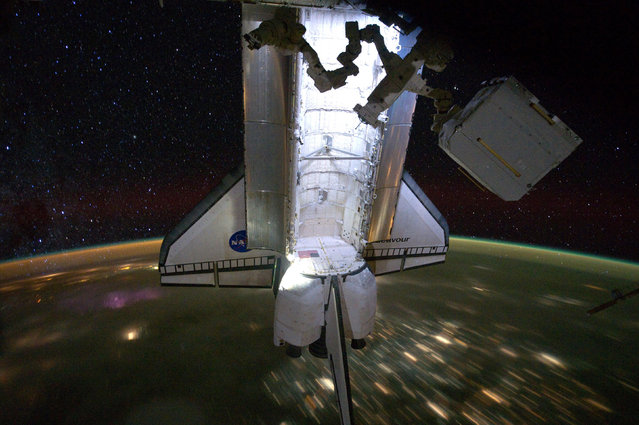
Backdropped by a night time view of the Earth and the starry sky, the Space Shuttle Endeavour is seen docked to the International Space Station on May 28, 2011. (Photo by Reuters/NASA)
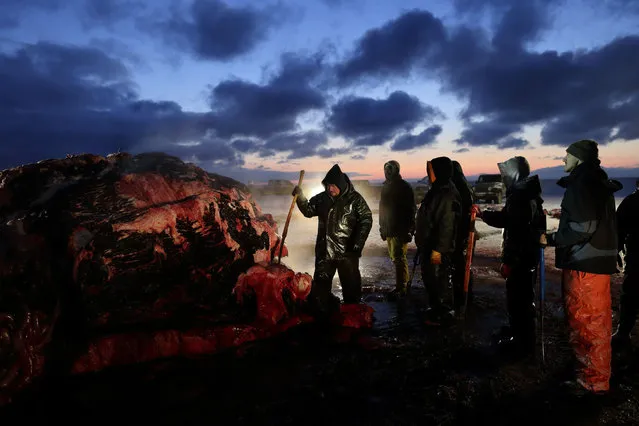
In this October 7, 2014, photo, Fredrick Brower, center, helps cut up a bowhead whale caught by Inupiat subsistence hunters on a field near Barrow, Alaska. Drawing on tradition, and keeping within the closely monitored Aboriginal subsistence whaling guidelines, a bowhead whale is carved and divided by a crew armed with knives and hooks, and then shared according to custom. (Photo by Gregory Bull/AP Photo)
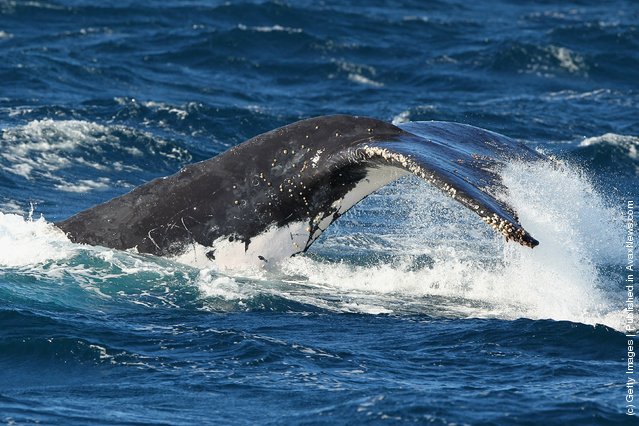
A humpback whale is seen at the beginning of whale watching season during a Manly Whale Watching tour on June 8, 2011 in Sydney, Australia. The first day of winter in New South Wales, June 1st, marks the start of the Humback and southern right whales migration from southern regions to the north to warmer waters. Whale watchers should expect tohave plenty to see with the whale population increasing each year. The migration north continues through July and with the whales returning between September and November. (Photo by Cameron Spencer/Getty Images)
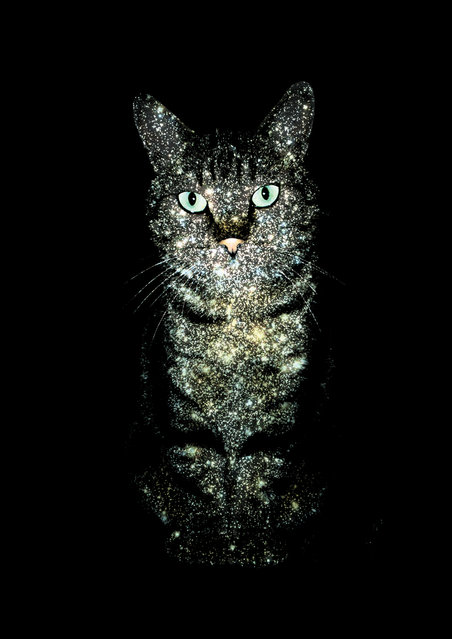
Boya Latumahina, alter ego, Zippora Lux is a Design student studying at Central St Martins in London. She has created these space age cats by combining two of her favourite things, cats and telescopic photographs.
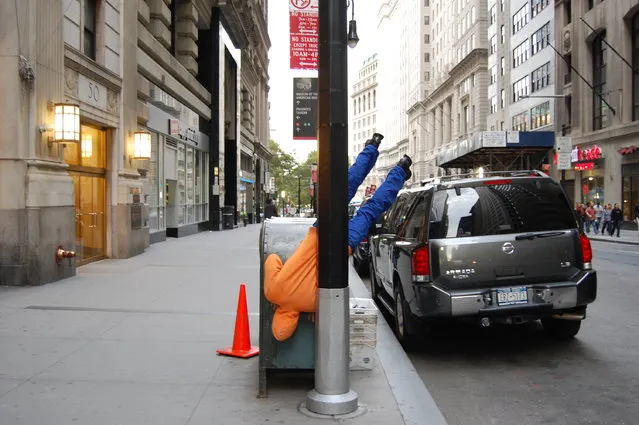
“Bodies in urban spaces” is a temporarily intervention in diversified urban architectonical environment. The intention of “bodies in urban spaces” is to point out the urban functional structure and to uncover the restricted movement possibilities and behavior as well as rules and limitations. Photo: “Bodies in Urban Spaces”, September 26, 2010. (Photos by Andrew Russeth)
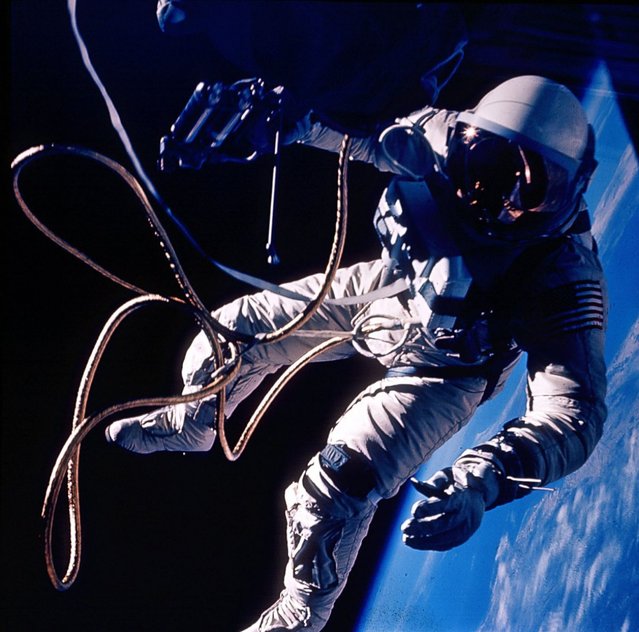
The First U.S. Spacewalk – Gemini 4 Ed White made the United States' first spacewalk on June 3, 1965 during the Gemini 4 mission. The extra-vehicular activity (EVA) started at 19:45 UT (3:45 p.m. EDT) on the third orbit when White opened his hatch and used the hand-held manuevering oxygen-jet gun to push himself out of the capsule. (Photo by NASA)
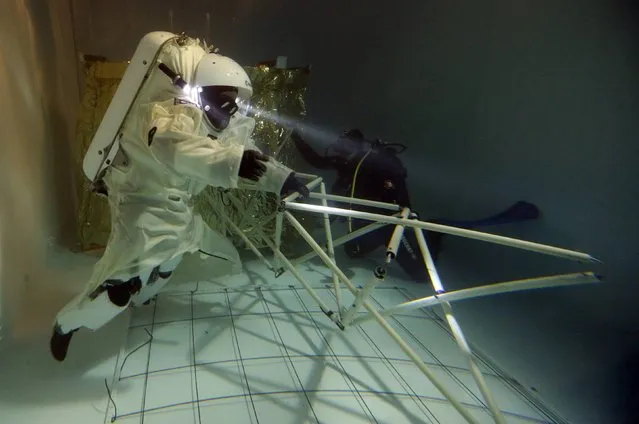
National Diving School director Jerome Vincent, wearing a Gandolfi space suit, executes training procedures in a swimming pool in Marseille October 22, 2014. The underwater test session develops European expertise in spacewalk simulations under partial gravity for exploring the Moon, asteroids and Mars.The training is organised by Comex, a French company specializing in engineering and deep sea diving operations, in collaboration with the European Space Agency (ESA) and with Apollo XI “Under the sea”. (Photo by Jean-Paul Pelissier/Reuters)
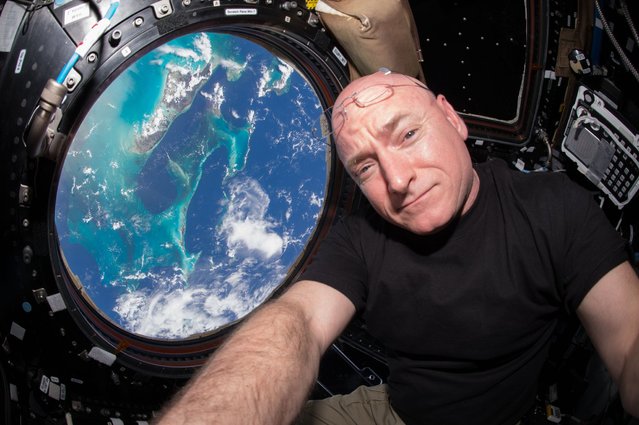
Expedition 44 flight engineer and NASA astronaut Scott Kelly seen inside the Cupola, a special module which provides a 360-degree viewing of the Earth and the International Space Station. Kelly is one of two crew members spending an entire year in space. (Photo by Scott Kelly/NASA)