Loading...
Done
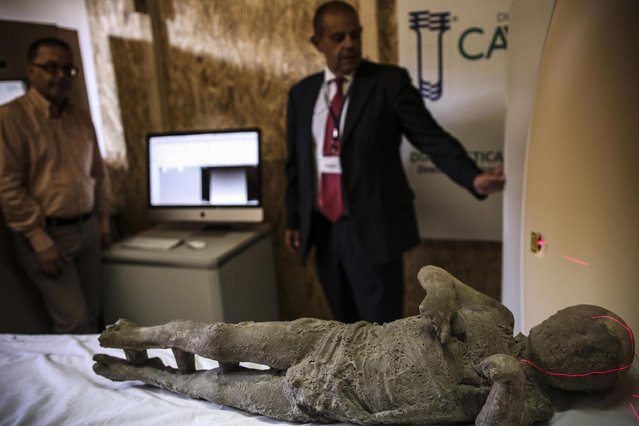
A working team appointed by the Archaeological Superintendence of Pompeii performs a Cat scan (Computerized axial tomography) one out of thirty casts of victims of the eruption of Vesuvius in 79 AD in Pompeii, in Napoli, Italy, 29 September 2015. (Photo by Cesare Abbate/EPA)

A working team appointed by the Archaeological Superintendence of Pompeii performs a Cat scan (Computerized axial tomography) one out of thirty casts of victims of the eruption of Vesuvius in 79 AD in Pompeii, in Napoli, Italy, 29 September 2015. The project which aims to trace the habits of life, employment and social class of the victims, involves a working team of archeologists, anthropologists, radiologists, dentists and engineers to obtain results from the scan. (Photo by Cesare Abbate/EPA)
Details
02 Oct 2015 08:04:00
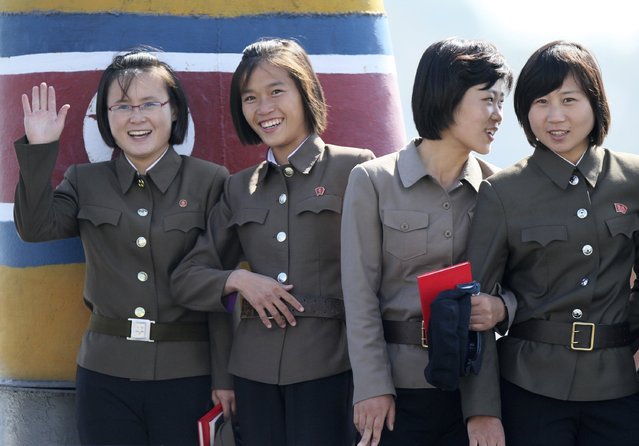
North Korean soldiers wave along the Yalu River, near the North Korean town of Sinuiju, opposite to the Chinese border city of Dandong October 7, 2014. (Photo by Jacky Chen/Reuters)

North Korean soldiers wave along the Yalu River, near the North Korean town of Sinuiju, opposite to the Chinese border city of Dandong October 7, 2014. (Photo by Jacky Chen/Reuters)
Details
10 Oct 2014 12:34:00
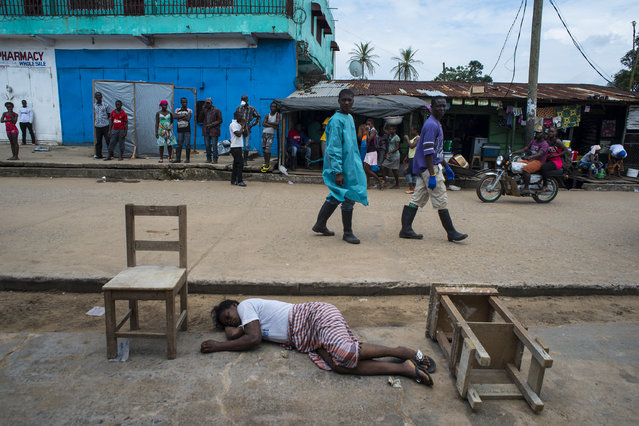
A woman lays dead outside the Redemption Hospital on Saturday September 20, 2014 in Monrovia, Liberia. Ebola patients come to the hospital, which has become a transfer and holding center to intake Ebola patients, but there is no space and some die while waiting outside. Redemption is located in one of the poorest neighborhoods of Monrovia that locals call "New Kru Town”. (Photo by Michel du Cille/The Washington Post)

A woman lays dead outside the Redemption Hospital on Saturday September 20, 2014 in Monrovia, Liberia. Ebola patients come to the hospital, which has become a transfer and holding center to intake Ebola patients, but there is no space and some die while waiting outside. Redemption is located in one of the poorest neighborhoods of Monrovia that locals call "New Kru Town”. Health workers are overwhelmed with a constant stream of new patients since the Ebola outbreak. (Photo by Michel du Cille/The Washington Post)
Details
16 Oct 2014 12:59:00
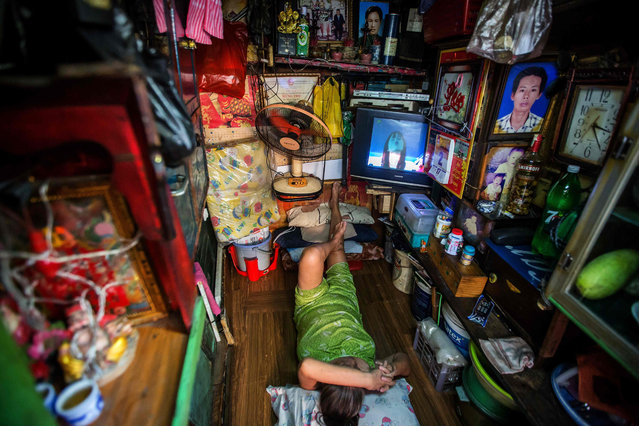
Kha Tu Ngoc rests in her two- square- meter house in Ho Chi Minh City on May 2, 2018. (Photo by Thanh Nguyen/AFP Photo)

Kha Tu Ngoc rests in her two- square- meter house in Ho Chi Minh City on May 2, 2018. The “micro- house” dwellings are dotted throughout Vietnam' s bustling southern hub, occupied by families clinging to postage stamp- sized plots a city developing at breakneck pace. Tucked away in winding alleys, nestled under new condo developments or sandwiched between street food stalls and shops, the tiny houses are easily missed by the unattentive passerby. (Photo by Thanh Nguyen/AFP Photo)
Details
04 Jun 2018 00:01:00
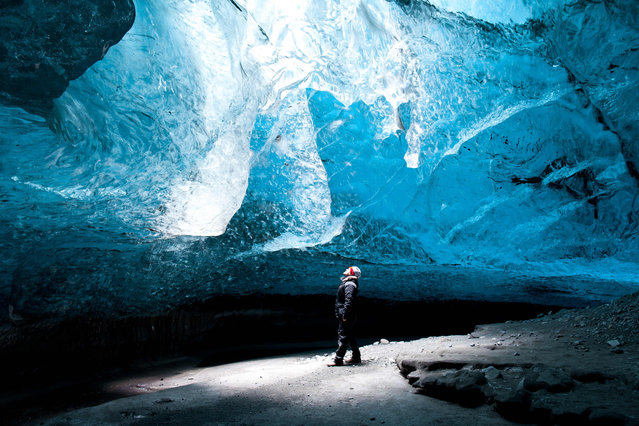
A wide view of Rob Lott  in the crystal ice cave in the Vatnajokull Glacier, Iceland. (Photo by Rob Lott/Barcroft Media)

Shimmering clearest blue and stretching as far as the eye can see, this is one of Iceland's famed crystal ice caves. The giant solid waves look frozen in time but they are slowly moving along as part of the Vatnajokull Glacier – which stretches across eight per cent of the island. The images were captured in February 2014 by British photographer Rob Lott, 49. Photo: A wide view of Rob Lott in the crystal ice cave in the Vatnajokull Glacier, Iceland. (Photo by Rob Lott/Barcroft Media)
Details
17 Mar 2014 08:26:00
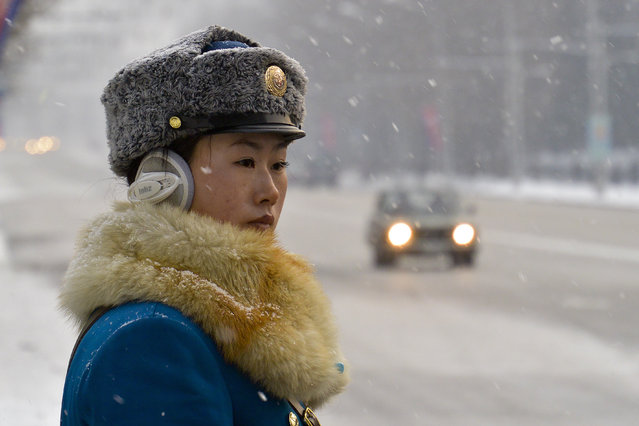
A female traffic police officer in the snow in February 2013, in Pyongyang, North Korea. (Photo by Andrew Macleod/Barcroft Media)

North Korea has closed its borders in fear of the spread of the Ebola virus. But at a time when the secretive state was still welcoming tourists, former aid worker Andrew Macleod made the journey to the repressive nation. Andrew's holiday snaps and camera footage provide a unique insight into the reclusive country, where he came across deserted motorways, metro stations plastered with propaganda and attractive border guards. Here: a female traffic police officer in the snow in February 2013, in Pyongyang, North Korea. (Photo by Andrew Macleod/Barcroft Media)
Details
06 Nov 2014 09:11:00
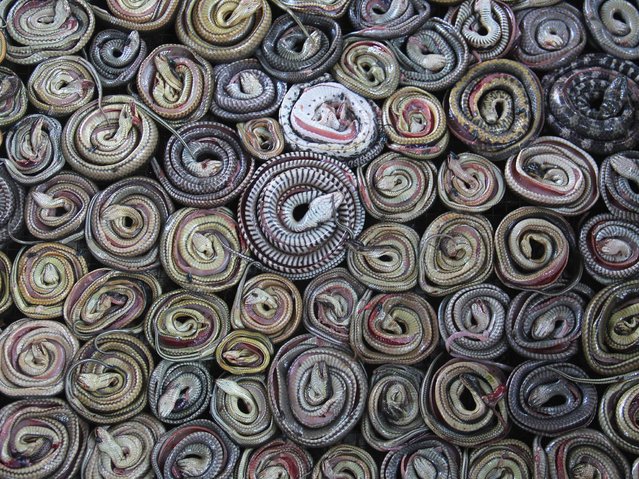
Snakes are collected and rolled before putting into the oven on March 2, 2014 in the village of Kertasura, Cirebon, Indonesia. (Photo by Nurcholis Anhari Lubis/Getty Images)

Snakes are collected and rolled before putting into the oven on March 2, 2014 in the village of Kertasura, Cirebon, Indonesia. At slaughter house snake skins measuring in the hundreds of metres, are sold to bag factories in the West and Central Java provinces on a monthly basis. From snake skin was manufactured into bags, shoes, wallets and belts. The price of a bag made from snake skin costs between 150,000 rupiah ($15 USD) and 300,000 rupiah ($30 USD), depending on its size. When snake skins reach Western fashion houses their price can increase dramatically and sell for up to $4,000 USD. (Photo by Nurcholis Anhari Lubis/Getty Images)
Details
05 Mar 2014 07:31:00
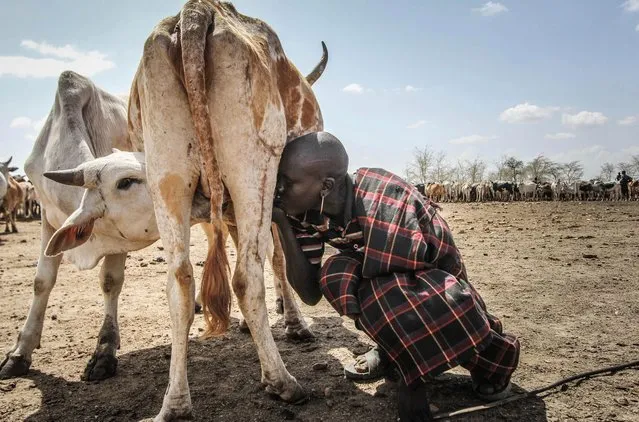
Cattle are the most important way of livelihood for the Karamojong: they provide milk, meat, blood and money when sold, Karamoja, Uganda, February 2017. (Photo by Sumy Sadurni/Barcroft Images)

Cattle are the most important way of livelihood for the Karamojong: they provide milk, meat, blood and money when sold, Karamoja, Uganda, February 2017. (Photo by Sumy Sadurni/Barcroft Images)
Details
17 Feb 2017 00:02:00